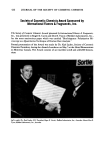
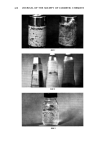
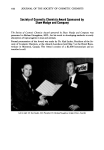
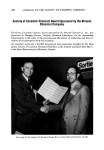
440 JOURNAL OF THE SOCIETY OF COSMETIC CHEMISTS Society of Cosmetic Chemists Award Sponsored by Shaw Mudge and Company The Society of Cosmetic Chemists Award sponsored by Shaw Mudge and Company was presented to Richard Stoughton, M.D., for his work in developing methods to study absorption of topical agents in man and animals. Formal presentation of the Award was made by Dr. Karl Laden, President of the So- ciety of Cosmetic Chemists, at the Awards Luncheon held May 5 at the Hotel Bona- venture in Montreal, Canada. The Award consists of a $2,000 honorarium and an inscribed scroll. Left to right: Dr. Karl Laden, SCC President Dr. Richard Stoughton, Scripps Clinic, Awardee

J. Soc. Cosmet. Chem., 28, 441-446 (August 1977) Antiperspirant efficacy E. S. BRETSCHNEIDER, A.M. RUBINO, and J. J. MARGILES Reheis Chemical Company, Division of Armour Pharmaceutical Company, Berkeley Heights, NJ 07922 Received September 1 O, 1976. Presented Ninth IFSCC Congress, June 1976, Boston, MA. Synopsis ANTIPERSPIRANT EFFICACY of ALUMINUM CHLOROHYDRATE "TYPE" INGREDIENTS is dis- cussed. The optimal efficacy for aluminum chlorohydrate and aluminum bromohydrate in aqueous solution occurs at concentrations of 15 per cent (3.75 per cent A1) and 24 per cent (5.0 per cent A1), respectively. No difference in efficacy between aluminum chlorohydrate-A1Cla combinations and aluminum chl- orohydrate alone, is found. Efficacy differences are observed as a function of vehicle. For example, aqueous formulations appear to be more efficacious than anhydrous formulations. Efficacy of aluminum-zirconium compounds is discussed in terms of variation of Al:Zr ratio. No differences are found. INTRODUCTION Antiperspirants as topical drugs have come under the scrutiny of FDA-OTC panels. Because of this interest and since the definition of antiperspirants is based on their efficacy, a study of the effectiveness of commonly used active ingredients would be useful. Unfortunately, there is a paucity of published information in this area. Recent papers have dealt with experimental designs and statistical interpretation of data (1,2, 3), mostly on formulated products. Since efficacy can be influenced by adjuvants in formulations, we believed an investigation of active ingredients in simple aqueous and nonaqueous vehicles worthwhile. In recognition of this information gap, we have studied the relationship between active ingredient efficacy with both concentration and solvent variations. We hope that this data will enlarge the cosmetic chemist's horizons, in developing new and improved vehicles for the application of a chosen anti- perspirant. To render this study both feasible and meaningful, we limited our investigational ef- forts to aluminum chlorohydrate "types" as well as aluminum-zirconium complexes. Aluminum chlorhydrate, a 5/6 basic aluminum "salt," AI2(OH)sC1, has been used as an antiperspirant for over 30 years (4). Other aluminum salts, such as aluminum chloride, were available as antiperspirants in the early part of the twentieth century, primarily for use by actors and models. The drawback of this product is its high acidity resulting in fabric damage and skin irritation. To circumvent this problem, buffers such as urea were used. Then in the early 1940s an internally buffered product, aluminum chlorohydrate, became available. In recent years, however, aluminum chloride has regained popularity, primarily when used in conjunction with basic aluminum "salts." In a twist of fate, aluminum chlorohydrate, which originally replaced buffered alu- minum chloride systems, is now being used to buffer aluminum chloride, the dif- 441
Purchased for the exclusive use of nofirst nolast (unknown)
From: SCC Media Library & Resource Center (library.scconline.org)