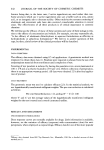
442 JOURNAL OF THE SOCIETY OF COSMETIC CHEMISTS ference being that, in the latter case, 2 active ingredients are used rather than one. Some products which use 2 active ingredients also use a buffer such as urea, amino acid, or an inorganic salt to decrease acidity. Other multi-active systems consisting of aluminum and zirconium salts have also received considerable attention in recent years. The effectiveness of all these products is of critical importance to cosmetic chemists. We will discuss the efficacy of many of these systems and some of their isologs in rela- tion to the effects of concentration and vehicle. For example, one may reasonably ask, "Is the efficacy of aluminum chlorohydrate in aqueous formulations as effective as hydroalcoholic or anhydrous formulations?" We will try to answer questions of this type, but first, a brief review of the clinical procedure will be described. EXPERIMENTAL DATA COLLECTION* The efficacy data were obtained using 0.5 ml applications. A gravimetric method was employed to obtain these data (1). Panelists were required to abstain from the use of all antiperspirant materials from enrollment until completion of test. Sweating of test panelists is induced by having the panelists sit in a room maintained at 100 +_ 2øF and at a relative humidity of 35 per cent. Before collection of perspiration, there is an appropriate warmup period. All data were obtained 22 h after final applica- tion of product. DATA TREATMENT The geometric mean was used to calculate efficacy (2,3). In the statistical analysis, we use logarithmically transformed milligram weights. The per cent reduction is calculated as follows: Per cent Sweat Reduction = [1-antilog (T' - C')]x 100 where T' and C' are the average values of the logarithmically transformed milligram weights for the test (treated) and control (untreated) axillae. RESULTS AND DISCUSSIONS ONE-INGREDIENT FORMULATIONS Dose response curves are normally available for drugs. Little information is available, however, on the variation of efficacy (response) with concentration (dose) for anti- perspirants, when employed as topical drugs. Efficacy data for one of the more popular *Efficacy data obtained from Hill Top Research, Inc., Miamiville, OH. For a detailed account of their method, see (1).

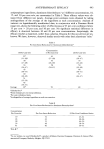
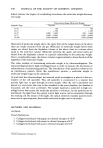
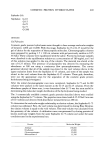
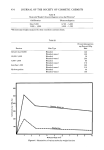
ANTIPERSPIRANT EFFICACY 443 antiperspirant ingredients, aluminum chlorohydrate,* at 3 different concentrations, ! 0, 15, and 20 per cent w/w, are summarized in Table I. These efficacy values were ob- tained from different test panels. Average point estimates were obtained by taking antilogarithms of the average of the logarithms at each concentration. Analysis of variance on logarithmically transformed data, in conjunction with a Neuman-Keuls range test, shows the following order of effectiveness at 95 per cent confidence limits: 15 per cent 20 per cent, and 10 per cent. No significant statistical difference in efficacy is observed between 10 and 20 per cent concentrations. Surprisingly, the efficacy reaches a maximum, rather than a plateau. Reasons for this occurrence are un- known. We have, however, observed similar trends with other basic aluminum "salts." Table I Per Cent Sweat Reduction for Aluminum Chlorohydrate a Concentration 10 Per Cent w/w 15 Per Cent w/w 20 Per Cent w/w Average 25 b 63 38 (11-38) ½ (57-68) (30-47) 38 56 35 (27-48) (43-69) (23-46) 36 58 50 (26-47) (50-67) (39-60) 43 44 (30-55) (38-51) 40 37 (30-49) (26-47) 51 (35-56) 46 (39-53) 39 • 59 40 aChlorhydrol. © bPoint estimate per cent sweat inhibition. ½Per cent confidence limits. •Antilogarithm of average logarithms at each concentration. Table II Per Cent Sweat Reduction for Aluminum Bromohydrate • Concentration Per Cent w/w Per Cent Sweat Reduction 95 Per Cent Confidence Limits 10 52 24 63 28 51 36 46 43 46 43-61 6O-66 46-56 38-54 39-53 aB.A.B.© *In our studies, we used Chlorhydrol ©, a product of Reheis Chemical Company, Division of Armour Phar- maceutical Company, Berkeley Heights, NJ 07922.
Purchased for the exclusive use of nofirst nolast (unknown)
From: SCC Media Library & Resource Center (library.scconline.org)