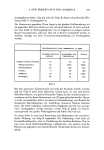
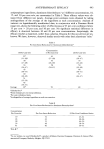
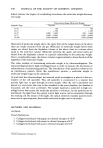
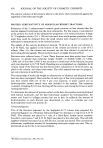
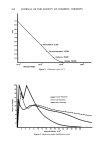
450 JOURNAL OF THE SOCIETY OF COSMETIC CHEMISTS The elution volumes of the proteins shown in the above chart were plotted against the logarithm of the molecular weight. PROTEIN SUBSTANTIViTY OF MOLECULAR WEIGHT FRACTIONS Evaluation of the 3 unfractionated cosmetic grade proteins on hair showed that the enzyme digested hydrolysate was the most substantive. For this reason, it was selected as the protein for study of the substantivity properties of its various fractions. A large G-75 Sephadex column (5.0 x 100 cm) was used, since much greater quantities of ma- terial than could be obtained from the small column were required to conduct the substantivity measurements on the various fractions. The sample of the enzyme hydrolyzed material, 50 ml of an 18 per cent solution in 0.25 M NaCI, was applied to the bottom of the column and eluted at a rate of 0.5 ml/min. After 4 h, the column was inverted and the flow allowed to proceed as a descending chromatograph. This procedure insures a straight horizontal front. Fractions were collected every 15 min. These fractions were then pooled into 4 main fractions: (1) greater than molecular weight 30,000 (2) 30,000-5,000 (3) 5,000- 1,000 and (4) less than 1,000. It was necessary to desalt each of the fractions, because each was dissolved in 0.25 M NaCI. Desairing was accomplished on a Sephadex G-10 column. Each of the fractions was first freeze-dried, redissolved in 10 ml of water, ap- plied to the column, and eluted with water. The solid material was used to prepare 5 per cent solutions of each fraction. The relationship of molecular weight to substantivity to bleached and bleached-waved hair was then investigated. Hair swatches of each type of hair were prepared and each was then treated with one of the 5 per cent solutions. A water control and an hydroxyproline treated swatch were also included in the analysis. The treatment consisted of soaking for 10 min, blotting off the excess, and rinsing for 30 sec in warm running tap water. To determine the amount of protein sorbed on the hair, the swatches were hydrolyzed with barium hydroxide, and the hair hydrolysate analyzed for hydroxyproline, the amino acid found in collagen protein but not in hair. In addition, the amount of hydroxyproline in each fraction was determined in order to correlate per cent hydroxyproline to per cent protein (6). Ultracentrif ugation Two of the fractions separated by the Sephadex G-75 column were prepared for ultracentrifugation on a Beckman Ultracentrifuge* by diluting to 2 mg/ml in 0.25 M NaC1. This solution was placed in 1 side of a filled-Epon double sector synthetic boundary center piece,* and 0.25 M NaCI was placed in the other side. The cell with sapphire windows was placed in an AN-D rotor, and the run started. The conventional sedimentary equilibrium method of determining molecular weight was used. The ex- perimental set-up for the 2 runs was as follows. *Beckman Instruments Inc., Palo Alto, CA.

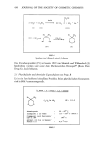
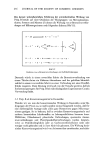
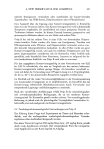
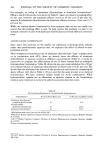
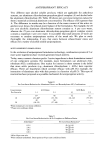
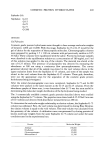
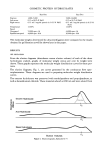
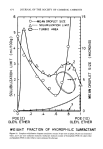
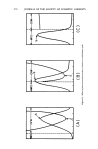
COSMETIC PROTEIN HYDROLYSATES 451 Run One Run Two Fraction Left sector Right sector 1,000-5,000 0.15 ml 0.25 M NaC1 0.15 ml 2 mg/ml protein in 0.25 M NaC1 Temperature 13.00øC Speed Overspeed 52,000 rpm-4 h 44,000 rpm-3 h Equilibrium speed 44,000 rpm-18 h 30,000 rpm- 18 h 5,000-30,000 0.15 ml 0.25 M NaC1 0.12 ml 2 mg/ml protein in 0.25 M NaC1 13.00øC The molecular weights determined by ultracentrifugation were compared to the results obtained by gel filtration as will be shown later in this paper. RESULTS GEL FILTRATION From the elution diagrams (absorbance versus elution volume) of each of the three hydrolysates studied, graphs of molecular weight versus per cent by weight were drawn. These graphs represent the molecular weight distribution curves for these pro- teins. The elution diagrams, Fig. 1, are curves generated by the continuous flow spec- trophotometer. These diagrams are used in preparing molecular weight distribution curves. The enzyme hydrolysate was preserved with methylparabens and propylparabens, as well as benzalkonium chloride. These materials absorb at 280 nm and were eluted from e Enzyme Hydrolysate //•I!• ,,' .,,,\ '• 0 VT 0½13 Acid Hydrolysate ! v T Steam Hydrolysate • I Elution Volumes Figure 1. Elution diagrams, Sephadex G-75 V T
Purchased for the exclusive use of nofirst nolast (unknown)
From: SCC Media Library & Resource Center (library.scconline.org)