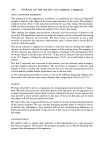
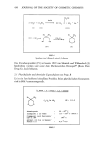
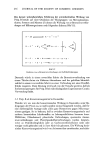
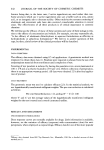
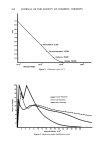
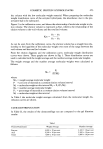
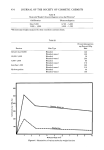
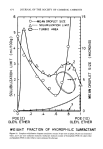
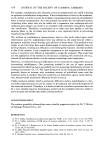
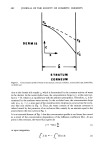
482 JOURNAL OF THE SOCIETY OF COSMETIC CHEMISTS DERMIS X STRATUM CORNEUM Figure 1. Concentration profile of water in the stratum corneum: solid line, nonoccluded case dashed line, occluded case tion at the dermis side equals c 0, which is determined by the constant activity of water in the dermis. In the nonoccluded case, the concentration drops to c'• at the outer sur- face (x = 8), which is at equilibrium with the ambient atmosphere. Therefore, c'• is de- termined by the ambient water activity. In the occluded case, the concentration drops only to c• (c• c• ), since part of the overall activity drop has to occur across the occlu- sive film (not shown in Fig. 1). Thus, the water content of the stratum corneum is indeed raised by the presence of an occlusive film, namely by an amount equal to the area between the two curves in Fig. 1. It is an essential feature of Fig. 1 that the concentration profile is not linear, but curved as a result of the concentration dependence of the diffusion coefficient D(c). At any point in the corneum, the water flux is given by or upon integration, dc j = -D(c) •xx (1) fo J dx =- D(c) dc c o (2)

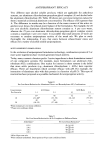
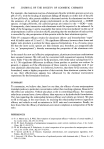
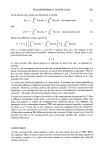
TRANSEPIDERMAL WATER LOSS 483 In the steady state, J does not depend on x, so that Jb = - D(c)dc = D(c)dc and (occluded case) (3) fCo c'b fc,8:0 J'b = - D(c)dc = D(c)dc (nonoccluded case) (4) Hence, the difference in flux is given by = i D(c)dc - D(c)dc 1 J'-J • =• D(c)dc (5) Since ca is always greater than c'a, and D(c) is greater than zero, the integral on the right-hand side will always be positive, whatever the form of D(c), which leads to the general conclusion that j, 3 j (6) i.e., the occlusive film always results in a decrease in water loss rate, as expected in- tuitively. As in (1), the assumption was made that the corneum thickness, 8, does not change as a result of increased hydration however, we know that swelling does take place. This ef- fect can only further increase the difference between J' and J. It should be noted also that the use of activities instead of concentrations in the above analysis in no way modifies the result. It is clear now where the analysis in (1) went astray. It assumes, and quite rightfully so (2), that the diffusion coefficient increases with increasing concentration of water in the corneum. However, in their analysis, the authors consider "D to be constant for each membrane, even though this may not be the case for nonuniformly hydrated stratum corneum." This basic internal inconsistency gives rise to the paradox. It is not our intention to dispute the validity of the experimental data quoted in (1). But a different mechanism would have to be found to explain such findings. Other data exist that appear to violate the straightforward diffusion theory. For example, the maximum in the relationship between TWL and ambient relative humidity, as reported by Grice et al. (3) for the in vivo situation, cannot be explained this way. However, other in vivo (4), as well as in vitro (5,6), data do show the expected continuous increase of flux with increasing RH difference across the corneum. In this connection, it may be pointed out that in vivo measurements are notoriously variable and sensitive to ex- traneous influences. CONCLUSION A truly occlusive film, when applied to skin, can only reduce the rate of TWL. When the opposite effect is found in practice, the conclusion must be that the agent applied is not simply occlusive (i.e., inert) but must interact in a more complex way with the stratum corneum.
Purchased for the exclusive use of nofirst nolast (unknown)
From: SCC Media Library & Resource Center (library.scconline.org)