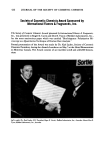
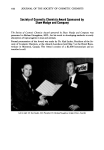
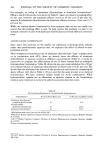
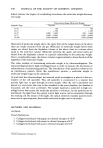
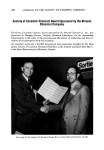
480 JOURNAL OF THE SOCIETY OF COSMETIC CHEMISTS Society of Cosmetic Chemists Award Sponsored by the Miranol Chemical Company The Society of Cosmetic Chemists Award sponsored by the Mirand Chemical Co., Inc., was presented to Douglas Howes, Unilever Research Laboratory, for his outstanding achievements in the study of the precutaneous absorption of surfactants and the cor- relation of this absorption with skin irritation. An inscribed scroll and a $2,000 honorarium were presented formally by Dr. Karl Laden, Society of Cosmetic Chemists President, at the Awards Luncheon held May 5, at the Hotel Bonaventure in Montreal, Canada. , rtie Left to right: Dr. Karl Laden, SCC President Douglas Howes, Unilever Research Laboratory, Awardee

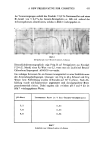
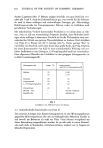
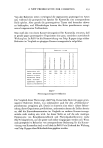
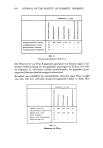
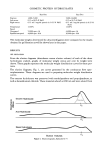
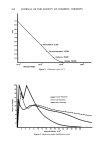
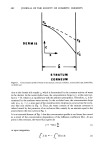
J. Soc. Cosmetic Chem., 28, 481-484 (August 1977) Diffusion theory analysis of transepidermal water loss through occlusive films IRA WEIL and HENRICUS M. PRINCEN Lever Brothers Company, Research Center, Edgewater, NJ 07020. Re•edJanua• 25,1977. Synopsis It is shown that simple DIFFUSION THEORY dictates that the application of an OCCLUSIVE FILM on SKIN always results in a decrease in TRANSEPIDERMAL WATER LOSS (TWL), as expected intuitively. The basic inconsistency in a previous analysis, which seemed to predict the possibility of the opposite effect, is pointed out. INTRODUCTION In a recent paper in this Journal (1), a theoretical argument was advanced to demonstrate that an occlusive film, when applied to skin, may lead not only to increased hydradon of the stratum corneum but, contrary to expectation, to a concur- rent increase in the transepidermal water loss (TWL). The authors used their argument to explain some experimental data that seemed to indicate such an increased flux, and to caution against rejecting potential occlusive agents that exhibit this effect, since they may, nevertheless, be excellent in their ability to effect increased skin hydradon. The authors went so far as to state that "this increase in TWL is evidence of increased skin hydradon in the stratum corneum." Although the analysis seemed sound at first sight, we had the distinct impression that the conclusion had to be in violation of some basic principles in transport phenomena. If not, some curious paradoxes could be envisaged (for example, insulating one's house could conceivably lead to a greater heat loss in wintertime). The question to be asked is whether introduction of an extra resistance in a transport process can cause a change in the original resistance that will not only nullify, but overcompensate for, the intrinsic effect of the added resistance. We believe that such an effect is, in general, impossible, although we shall prove it only, in a very simple way, for the system of an occlusive film on skin. THEORETICAL Let us consider the concentration (or activity) profile of water in the stratum corneum in the absence and presence of an occlusive film (Fig. 1). In both cases, the concentra- 481
Purchased for the exclusive use of nofirst nolast (unknown)
From: SCC Media Library & Resource Center (library.scconline.org)