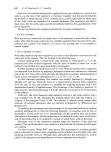
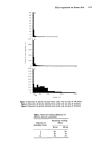
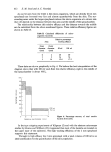
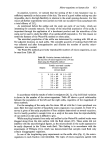
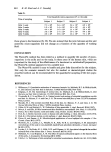
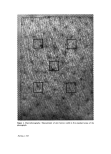
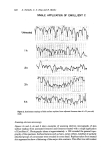
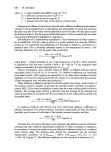
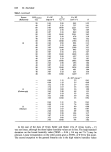
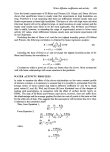
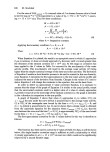
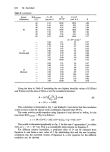
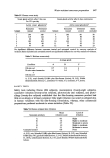
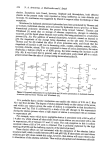
Emollients and the stratum corneum 621 Skin surface replicas Figure 2 shows a group of representative surfometer tracings from the replicas of a control area and areas treated with Emollient C. These tracings provide information about skin surface topography. We have attempted to quantitate the results by measuring the area (planimetrically) within the major contours in a known length of trace and determining the total length of contour by curvimetry. Tables V- VII summarise our findings. Table V. Effect of Bath Oil A. Area under surfometer tracing in 10 cm length of trace from replicas Post immersion time (min) Mean area (cm 2 _+ SD) Oil leg Water leg Controls 14'3 + 3.7 15'4 + 5.7 5 10'9 + 2.9 12'4 + 2.9 60 8'4 + 1.9' 9-3 + 2'2'1- 240 8.9 + 1.6' 10-1 + 2.0 * Significant difference from control P 0'01 t Significant difference from control P 0'05 Table ¾I. Effect of Emollient B. Area under surfometer tracing in 10 cm of trace from replicas Post application time (min) Normal skin Dry skin Controls 9'2 + 3.2 10.5 + 2.0 0 7.9 + 2.6 10'1 + 3.7 30 7.8 + 2.8 9.1 + 2.4 60 7'4 + 1-1 8.8 + 3-2 120 6.7 + 1.7 8.0 + 2'4 240 6-9 + 3.1 9.0 + 1.8 Table VII. Effect of Emollient C. Length of contour of surfometer tracings from replicas Post application time (min) Length of contour (cm + SD) in 8.5 cm of tracing Controls 38.0 + 6.3 60 34'4 + 6.1 120 30.6 + 7.09* 180 32.7 + 6.4 300 33.3 + 4.3 * Significant difference from controls (P 0.01) It can be seen from Tables V and VI that a decrease in replica area was apparent sub- sequent to treatment and that total contour length (Table VII) also appears to decrease after application of Emollient C.

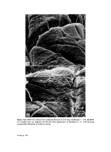
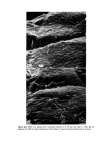
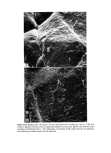
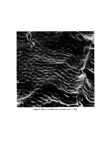
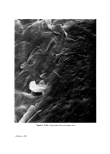
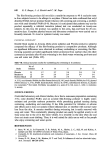
622 S. Nicholls, C. S. King and R. Marks SINGLE APPLICATION OF EMOLLIENT C Untreated Ih 2h 3h •'L '•.L 6 l.:/, -'./?•x• ..'!_ _• I. • •_, .:...,, • 1-1.. • •!, 5h ' . L ._ '•' '• • • •• i• • • ..: '• I •-- ' • '•• l•••••J•l_._J i..I i , • •,• .... L.• •, l Fig•e 2. Surfomctcr tracings of skin surface replicas from adjacent forearm sites of a 23 year old male. Scanning electron microscopy Figures 3a and b, 4a and b show examples of scanning electron micrographs of skin surface replicas from untreated forearms and forearms treated with a single application of Emollient C. Photographs taken at approximately x 200 revealed the general topo- graphy of the specimen. Surface features such as hairs, sweat orifices, lamellae of partially attached groups of corneocytes were revealed in some detail. Replicas taken from treated skin appeared to show a flattening of the major skin contours. This effect was still evident
Purchased for the exclusive use of nofirst nolast (unknown)
From: SCC Media Library & Resource Center (library.scconline.org)