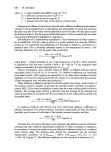
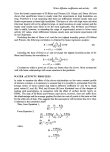
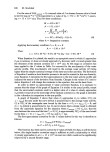
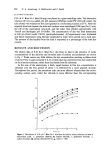
Water chJfusion coefficients and activity 635 this effect could reverse the relative values of CB and C•,, which would result in an increased TEWL. It is possible to use Equation 13 to calculate Ca for an observed value of J - Ju- This should enable the calculation of an apparent diffusion coefficient for water through the barrier layer (Du), providing the barrier layer thickness is known. From Ficks' law: O(C0 - Ca) t D}3( C• - C•) where t• = barrier layer thickness (cm). Where CE = 0, this gives From Equation 6 Thus D B • OtB(Co-C•) t% D Ir0'175Cø -t-0'46) o = C = 0.7C0+0.3 C• / 0.58C0 -t-0.54) D = DOkc--•-•_C• l'04taDoCo 0-46 Dotu D• = (14) t C s t Equations 13 and 14 enable the calculation of an apparent D• from measured values of J, Js and rs. DISCUSSION In view of the variety of sources of information used in obtaining the correlation between water activity and relative diffusion coefficient (Equation 6), the degree of correlation obtainable is surprisingly good. This suggests that, although the value of the gradient and intercept may vary according to source of stratum corneum and experimental conditions, the general nature of the correlation, i.e. D is proportional to Col(Co - C) must be basically correct. (The confidence limit is greater than 99'9•o.) This relationship is one in which the diffusion coefficient approaches infinity as the water activity approaches its maximum. This is reasonable when viewed in the light of known facts about the stratum corneum. As the humidity to which it is exposed ap- proaches 100•o, the stratum corneum increases its water content several fold. It has been shown that water is present in at least two states (16-19) and the relative proportion of unbound water will increase with the total water content (high humidity). It is reason- able to expect that when the water content of the stratum corneum increases consider- ably, the diffusion coefficient for water will tend to approach that for diffusion in pure water. The latter is several orders of magnitude greater than that for the stratum corneum at moderate hydration levels (7) and can be regarded as close to infinity in this context. Thus theory would predict a relationship similar to that of Equation 6. The water activity profiles derived from Equation 6 (e.g. Equations 7 and 8 and Fig. 2) represent useful models, which can be used in conjunction with known water

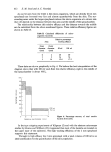
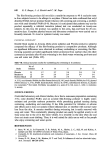
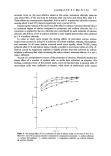
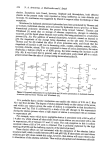
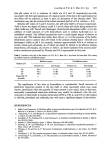
636 M. Stockdale activity/physical property relationships for stratum corneum (2-4, 20, 21), to extend our understanding of observed in vivo stratum corneum properties and appearances. In order to relate them to water content rather than water activity, it is necessary to combine them with sorption isotherms of water on stratum corneum (1, 2, 21, 22). These show a non-linear curve with rapid increases in water content at high humidities. Figure 3 shows the results of combining the model activity profile of Equation 7 with the sorption isotherm of Wildnauer, Miller and Humphries (2). The 100•o relative humidity point is taken to be the water content of the viable epidermis (7). In general, however, the curves of Fig. 2 will be more useful, since the physical parameters, e.g. Young's modulus (20) are generally correlated with water activity, or ambient relative humidity, rather than actual water content. 9C 8O 7O 6O • 5o ,• 40 2o IO / / / edge of .__•/ stratum corneum i i i i I i I 1 4 8 12 16 X x IO 4 (cm) Figure 3. Water content profile for normal skin. Derived from Equation 7 and the water sorption isotherm for stratum corneum of Wildnauer et al. (2). R.H.external = 0Yo. In theory, it is possible to extend the treatment on water activity profiles derived from Equation 6, by considering models for abnormal stratum corneum conditions caused by either abnormal epidermal metabolism, e.g. psoriasis, or external conditions, e.g. regular exposure to detergents, etc. A simple model for the regular detergent ex- posure would be to assume increasing damage for the older, outer stratum corneum cells, due to longer total exposure. Mathematically this may be represented by a factor (F•) applied to the diffusion constant, Di, dependent on distance from the edge of the stratum corneum: Fi = Kos- where K is a constant and skin thickness is assumed to be 15 x 10 -4 cm. For a threefold increase in TEWL, which is observable under these conditions (15), the constant K has a value of 1.24. dx RiFiD o -- dCi Jr Jn = TEWL of damaged skin.
Purchased for the exclusive use of nofirst nolast (unknown)
From: SCC Media Library & Resource Center (library.scconline.org)