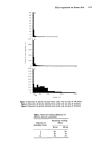
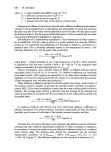
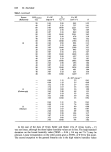
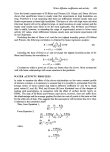
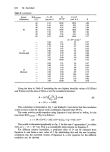
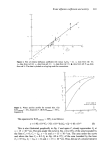
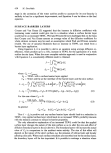
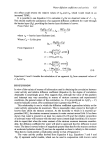
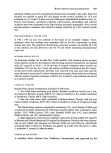
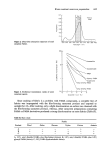
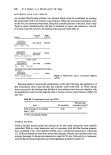
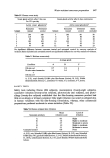
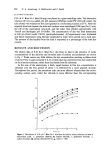
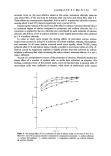
Water diffusion coefficients and activity 629 from the kinetic experiments of E1-Shimi and Princen (13). Rieger and Deem (4) have shown that equilibrium times in steady state flux experiments at high humidities are long. Therefore it is not surprising that there are differences between steady state and kinetic experiments at these high humidities. The layers of skin with high water activities (the inner layers) will not be subject to large, or rapid variations in water content and the steady state results seem likely to be the most applicable. The E1-Shimi and Princen data is useful, however, in extending the range of experimental points to lower water activity (C) values, where differences between steady state and kinetic experiments will be less important. Excluding the data of Grice et al. and the two highest humidity points of E1-Shimi and Princen, the following correlation is obtained by linear regression analysis: R = 0.29(C%)+0.50 (2) n = 61 r = 0.894. Including the data of Grice et al. and all except the highest humidity points of E1- Shimi and Princen, the correlation is R = 0.29( Cø ) Co- C +0.51 (3) n = 67 r = 0.885. Correlations within a given set of data are better than the above. Most correspond well with linear relationships with some variation in the gradients. WATER ACTIVITY PROFILES In order to examine the effect of the above relationships on the water content profile of stratum corneum, it is necessary to assume that it is possible to extrapolate from the average values of water content and relative diffusion coefficient (C and R) to single point values (Ci and Ri). Well and Princen (6) have illustrated one of the dangers of making such assumptions, in connection with the effect of surface barrier layers on TEWL. The data of E1-Shimi and Princen used above, however, does not suffer from this disadvantage and the average gradient for their two sets of points is the same as that for the other sets of data. This suggests that the assumption will introduce less error than is inherent in the correlation itself. Thus, from Equation 1, dx Di RiD o -- -- dCi J J From Equation 2, where dx 0.2_9Do( Co '• 0.50Do •-•i -• J \Co- Ci] -[ • dx M d Ci Co -- Ci + N 0'29DOC0 M= J 0'50D o J

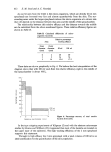
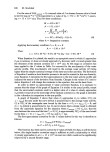
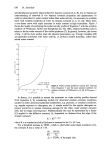
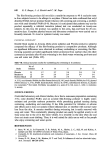
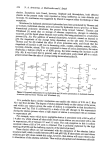
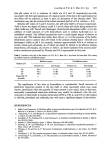
630 M. Stockdale For the case of R.H.exter•a• = 0, a normal value of J on human forearm skin is found to be 0.22 mg cm -a h -x (15) (equivalent to a value olD0 = 7.52 x 10 -a cm •' h -x, assum- ing t = 15 x 10 -4 cm). Thus for these conditions: M = 4.35 x 10 -4 N= 1-71x10 -a x =f(C%•+N) dC' x -- NCi- M ln(Co- Ci)+ A (4) where A = integration constant. Applying the boundary condition Ci = 0 x = 0 A=-1.36 x 10 -a Thus: x = 1.71 x 10-aC•-4.35 x 10 -4 In (Co-C0-1'36x 10 -a (5) When Equation 5 is plotted, the result is an asymptotic curve in which G approaches Co as x increases. Ci does not closely approach Co, however, until x is much greater than the thickness of the stratum corneum (15 x 10 -4 cm). At this stage no correction has been applied to the C values in Table I to account for the non-linearity of the water activity profile. This non-linearity will result in the average water activity (C) being higher than the simple numerical average of the inner and outer activities. The derivation of Equation 5 enables a short iterative process to be used to correct for this non-linearity, since Equation 5 represents the first approximation to the true water activity profile and indicates the nature of the deviation •rom linearity. Changes in the values of C used to derive Equation 5 will change the constants in the equation, but not the basic form. In order to derive an approximate C value correction function, it is necessary to assume that the shape of the graph of Equation 5 is similar to the actual profile, except that the uncorrected constants result in a higher value of x when Ci closely approaches Co (which it must do at the inner edge of the stratum corneum) i.e. the graph is stretched in the x direction in comparison to the true profile. A graph of Equation 5 shows that when Ci approaches Co to within 2'5•o (at x = x97.5), the area under the curve (which is proportional to the average water activity, C) is 70•o of the rectangular area bound by the lines x = 0 x = x•?.5 Ci = 0 and Ci = Co (which is proportional to Co). It can be shown that a similar result is obtained from the equivalent equation for the situation where Cextmm = 0'5 Co (i.e. that the area between the curve and the line Ci -- 0.5 Co is approximately 70•o of the area bound by the lines x -- 0 x = x97.5 Ci = 0.5 Co and Ci: Co). The first approximate correction for the C values derived in this way is therefore as follows' C = C, xt•m•iq-0'70 (C o- Ccxternal ) i.e. C = 0.7 Co + 0.3 Cext•a• This function has been used to correct the Cvalues of Table I. In fact, as will be shown below, this single iterative correction stage is sufficient to yield a relationship in which Ci closely approaches Co at x -- 15 x 10 -4 cm and one which would not be significantly improved by a second iterative stage.
Purchased for the exclusive use of nofirst nolast (unknown)
From: SCC Media Library & Resource Center (library.scconline.org)