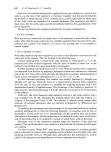
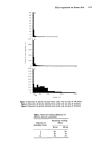
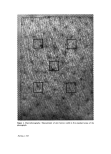
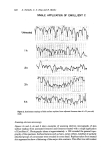
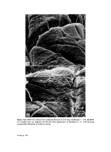
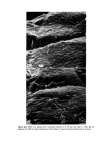
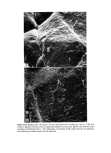
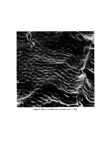
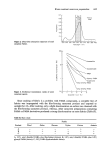
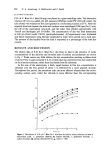
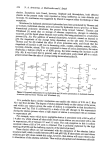
622 S. Nicholls, C. S. King and R. Marks SINGLE APPLICATION OF EMOLLIENT C Untreated Ih 2h 3h •'L '•.L 6 l.:/, -'./?•x• ..'!_ _• I. • •_, .:...,, • 1-1.. • •!, 5h ' . L ._ '•' '• • • •• i• • • ..: '• I •-- ' • '•• l•••••J•l_._J i..I i , • •,• .... L.• •, l Fig•e 2. Surfomctcr tracings of skin surface replicas from adjacent forearm sites of a 23 year old male. Scanning electron microscopy Figures 3a and b, 4a and b show examples of scanning electron micrographs of skin surface replicas from untreated forearms and forearms treated with a single application of Emollient C. Photographs taken at approximately x 200 revealed the general topo- graphy of the specimen. Surface features such as hairs, sweat orifices, lamellae of partially attached groups of corneocytes were revealed in some detail. Replicas taken from treated skin appeared to show a flattening of the major skin contours. This effect was still evident

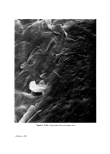
Figure 3 (a). SEM of a replica from untreated forearm of a 24 year old female ( x 173). (b) SEM of a replica from an adjacent site 60 min after application of Emollient C. (x 170) showing considerable flattening of surface contour. Facing p. 622
Purchased for the exclusive use of nofirst nolast (unknown)
From: SCC Media Library & Resource Center (library.scconline.org)