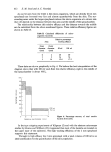
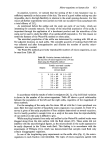
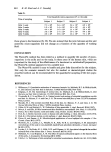
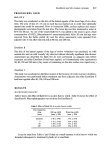
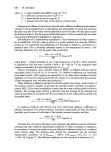
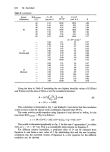
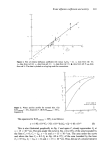
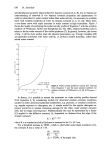
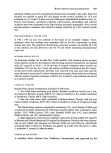
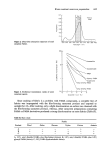
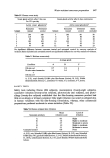
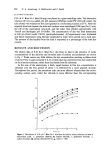
612 E. M. Staal and A. C. Noordzij As can be seen from the Table I, the micro-organisms, which are directly hit (2 mm sprayhead) are loosened very fast and almost quantitatively from the skin. The sur- rounding areas under the larger sprayheads release the micro-organisms at a slower rate that will depend on the distance between that area and the middle of the spraychamber. The relationship between this relative efficacy and the distance towards the middle can be calculated from the above mentioned figures. These relative efficiency figures are shown in Table II. Table II. Calculated efficiencies of micro- organism recoveries Relative percentage Area washing efficacy Inner Outer diameter diameter (mm) (mm) 50 ml 100 ml 0 2 69 89 2 5 56 76 5 14 12.6 17.5 These data are shown graphically in Fig. 6. We believe the best interpretation of the diagram shows that with 100 ml wash fluid the relative efficiency right in the middle of the spraychamber is about 100•o. 90 • 80 70 60 50 40 50 20 I0 0 2 5 14 Sampling area diameter (ram) I00 ml 50 ml Figure 6. Percentage recovery of total aerobic bacteria from axilla. In the tape stripping experiments of Kligman (2) and with the electron microscope studies by Montes and Willborn (25) it appeared that most of the bacteria are located on the upper layer of the epidermis. The high washing efficiency of the 2 mm sprayhead supports this statement. Through its high efficacy the 2 mm sprayhead with a wash volume of 100 ml is an ideal combination for the quantification of the skin population.

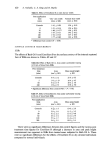
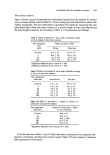
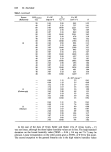
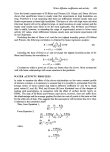
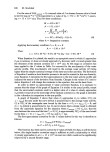
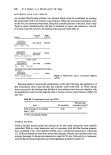
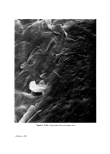
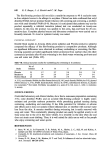
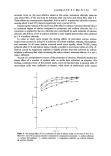
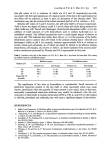
Micro-organisms on human skin 613 In practice, however, we noticed that the sealing of the 2 mm headpiece was in- sufficient, especially on hairy areas of the skin. The use of a good rubber sealing was also impossible, due to the high flexibility in relation to the small opening diameter. For this reason all further experiments were carried out with our standard 14 mm sprayhead with a total efficacy of 25•o. As mentioned before the axillae and the scalp are parts of our body, which are interesting for cosmetic research. The study of the microbial population of the axilla is important through the application of a deodorant product and the microflora of the scalp can be used to study the effect of an antidandruff preparation. For this reason we tested the features of the Water-Pik method on these areas. The microbial population of the axilla was determined by washing with 100 ml on five adjacent locations on each axilla. The complete quantity of washing fluid (500 ml) was collected and after homogenisation and dilution the number of aerobic micro- organisms was counted. The Water-Pik method gave fairly reproducible numbers of micro-organisms, as can be seen from Table III. Table Ill. Variation between individuals of the recovery of micro-organisms by a 14 mm head using the Water-Pik method Subject Totally recovered number of micro-organisms (14 mm head) 1 L 1-5 x 10 6 R 1.3 x 10 6 2 2.2 x 10 4 2.5 x 10 a 3 1.3 x 10 * 8.8 x 10 4 4 3'9 x 10 4 1'0 x 10 6 5 7'7 x 10 4 6'9 x 10 4 6 2'5 x 10 4 1'7 x 10 4 7 5'5 x 10 4 5'0 x 10 a In accordanee with the results of other investigators (26, 1), a big individual variation is shown in the number of the micro-organisms. Table III shows a good relationship between the population of the left and the right axilla, regardless of the magnitude of these numbers. For the sampling of the scalp also five times 100 ml with the 14 mm sprayhead was used. Here the total number of lipophylic micro-organisms was counted. In Table IV a survey is given of the scalp population of four subjects determined on several occasions. As it is hardly possible to sample twice on a scalp at the same time the reproducibility of our method on the scalp is difficult to give. While sampling bacteria from scalp and axillae by the Water-Pik method scales were dragged along from the skin surface with the fluid stream (27). These scales did not interfere with the microbiological figures, as the microcolonies in the scales appeared to be easily dispersed in the Triton wash fluid. This finding is in accordance with the experiments of Williams (1) in which was demonstrated that samples wash fluid only contain disaggregated organisms. In one of the long-lasting spray experiments on the axilla skin (Fig. 3), the micro- organisms in each fraction were identified. The types of micro-organisms agreed with
Purchased for the exclusive use of nofirst nolast (unknown)
From: SCC Media Library & Resource Center (library.scconline.org)