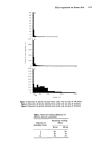
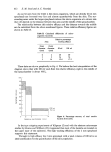
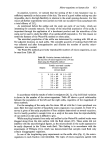
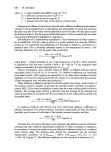
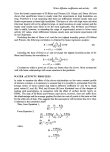
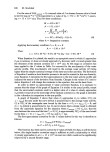
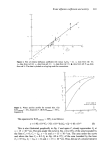
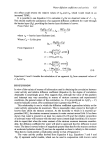
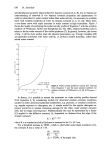
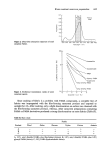
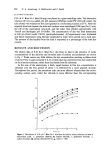
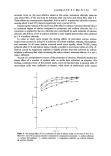
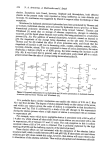
Water diffusion coefficients and activity 637 The above equation may be integrated, incorporating the functions for Fi and R. For the condition-of external relative humidity--0% and assuming again J (un- damaged) = 0.22 mg cm -• h -x, and K = 1.24, the following equation results: 1.84x 10 -5 1.24•ønx = 5.13x 10 -a Ci-8.73x 10-Sln(C0-Ci)-2.54x 10 -• (9) This equation is illustrated in Fig. 4 and the resultant profile of water content, incor- porating the water sorption isotherm, in Fig. 5. The usefulness of models such as this must be assessed in relation to their ability to explain observed properties of skin. In the case of the above model, the area of skin concerned had a dry, flaky, opaque appearance and had a hard and rough texture. This Figure 4. Model water activity profile for skin damaged by regular exposure to detergents derived from Equation 9. R.H.external = 0•o. 'E Go r / edge of stratum • corne•m • I i i I • , ,1 4 8 I 16 X x 10 4 (cm) Figure 5. Model water content profile for detergent damaged skin derived from Equation 9 and the water sorption isotherm of Wildnauer et al. (2). R.H.extema I = 0•. 9O 8O 7O GO E 50 o ,_40 30 2O Inneof / edge / stratum • corneum .- , ' ' x , 10 4 (cm)

638 M. Stockdale would be expected from the known relationships between water activity and visco-elastic properties (20) and light transmission (21). The above example of a model system for damaged skin is not intended as an ac- curate description of the actual water activity profile. It does illustrate however that, in general, the outer layers will have suffered most from environmental insult, and that the true situation in vivo is liable to deviate from that depicted in Figs 2 and 3. The deviation will be qualitatively similar to that depicted in Figs 4 and 5. The effect of a surface barrier layer will be to reduce the water activity difference across the stratum corneum, since some of the total water activity difference between ambient conditions and the viable epidermis will occur across the barrier layer. In terms of the effect on the water activity profile, this will be similar to raising the external relative humidity slightly. The size of the effect will depend on the effectiveness of the barrier. As can be seen from Fig. 2, this will have its greatest effect on the driest outer layers. This will be even more apparent in damaged skin where more layers will be relatively dry (Figs 4 and 5). These outer layers are those responsible for the 'dry' ap- pearance of damaged skin. This explains the effectiveness of comparatively weak surface barrier layers in improving the appearance of dry, damaged skin. It is worth noting that the principal effect of the other main class of moisturising ingredients, the hygroscopic humectants, will be on the water sorption isotherm and not on its water activity profile. The data presented and analysed here does not represent an exhaustive, or totally complete analysis of the situations occurring in human skin in vivo. No account has been taken in the calculations of the relatively less important diffusion barriers of the dermis, the viable epidermis, or the surface air boundary layers. Nor have the complicating factors of expansion of the stratum corneum, or the temperature coefficient of the diffusion constant been incorporated. The effect of the former means that x in Figs 2-5 should be regarded as being in units of skin layers rather than absolute distance. The effect of the temperature coefficient may be significant at low ambient temperatures, but less im- portant at around 25øC. The treatment, however, is sufficiently detailed to analyse important aspects of the water/stratum comeurn system in a fairly detailed qualitative manner. Hopefully a more complete, integrated experimental programme and diffusion theory treatment would enable a more accurate quantitative analysis to be achieved. REFERENCES 1 Blank, I. H. Factors which influence the water content of the stratum corneum. J. Invest. Dermatol. 18 433 (1952). 2 Wildnauer, R. H., Miller, D. L. and Humphries, W. T. A physicochemical approach to the char- acterisation of stratum comeurn. In: Applied Chemistry at Protein Interfaces, Advances in Chemistry Series No. 145 74 (1975) (American Chemical Society). 3 Idson, B. Water and the skin. J. Soc. Cosmetic' Chem. 24 197 (1973). 4 Rieger, M. M. and Deem, D. E. Skin moisturisers I. Methods for measuring water regain, mechanical properties and transepidermal moisture loss of stratum corneum. J. Soc. Cosmet. Chem. 25 239 (1974). 5 Cooper, E. R. and Van Duzee, B. F. Diffusion theory analysis of transepidermal water loss through occlusive films. J. Soc. Cosmet. Chem. 27 555 (1976). 6 Well, I. and Princen, H. M. Diffusion theory analysis of transepidermal water loss through occlusive films. J. Soc. Cosmet. Chem. 28 481 (1977). 7 Scheuplein, R. J. and Blank, I. H. Permeability of the skin. Physiol. Rev. 51702 (1971).
Purchased for the exclusive use of nofirst nolast (unknown)
From: SCC Media Library & Resource Center (library.scconline.org)