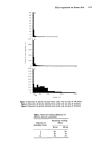
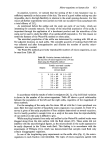
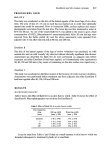
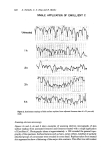
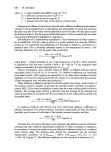
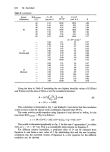
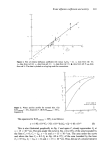
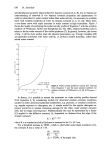
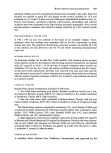
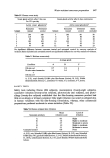
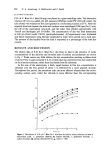
652 N. A. Armstrong, A. Bialkowska and J. Smith ELUTION STUDIES F.D. & C. Blue No 1 lake (50 mg) was placed in a glass centrifuge tube. The electrolyte solution (20 ml) was added, the pH measured (Phillips model PW 9418 pH meter), the tube closed with waterproof film and agitated in a horizontal position at 27øC. After the requisite time had elapsed, the tube and contents were centrifuged (3300 rpm) for 15 rain, the pH of the supernatant measured, and the latter then diluted appropriately with Teorell and Stenhagen pH 5.0 buffer. The concentration of dye was then determined at 628 nm (Cecil model CE272 spectrophotometer). All experiments were triplicated and blank experiments using the lake suspended in water were carried out in each case. The amount of dye leached from the lake is expressed as a percentage of the total dye present. RESULTS AND DISCUSSION The elution data of F.D. & C. Blue No 1 dye from its lake in the presence of molar concentrations of the chloride and bromide salts of sodium and potassium are shown in Fig. 1. Water causes very little elution, the dye concentration reaching a plateau level of about 0'3•o in approximately 6 h. It is likely that this represents free dye unadsorbed on the alumina substrate, rather than dye eluted from the substrate. In the case of the electrolytes, a fairly rapid increase in free dye concentration is obtained over the first period of about 1 h, followed by a more gradual increase. Throughout this period, the potassium salts are more effective eluents than the corres- ponding sodium salts, whilst the chloride is more effective than the corresponding I00 - 6O 4O 20 0 2 4 6 8 Time ( h ) Figure 1. The elution of F.D. & C. Blue No 1 dye from its lake by molar solutions of salts of monovalent acids. x, potassium chloride O, sodium chloride O, potassium bromide [], sodium bromide m, calcium chloride (0.5 M) ,, water (x 100).

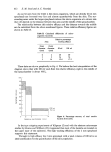
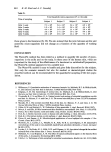
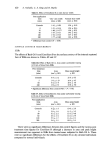
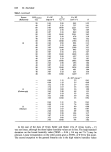
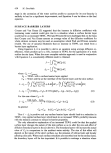
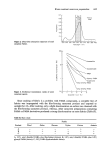
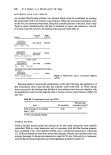
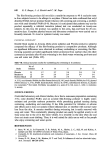
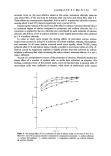
Leaching of F. D. & C. Blue No 1 dye 653 bromide. Even so, the most effective eluent in this series, potassium chloride, removes only about 40•o of the dye from its substrate after one hour and about 80•o after 8 h. These effects are concentration dependent, 0.01 m and 0-1 m potassium chloride solutions causing about 2 and 25•o elution respectively over a period of 8 h. Increasing the valency of the cation has little effect on elution. Calcium chloride shows an increased degree of elution compared to potassium and sodium chloride, but if a correction is applied for the two chloride ions contributed by each molecule of calcium chloride, the elution of 0.5 m calcium chloride is only slightly greater than that achieved by 1.0 M sodium chloride. In order to study more closely the eluting effects of polyvalent anions, elution studies were carried out using 0.5 m solutions of sodium sulphate, selenate, thiosulphate, and succinate. In all cases, elution occurred much more rapidly, about 70-80}/o being achieved after 0-5 h and elmion being virtually complete in most cases within 4 h (Fig. 2). Elution caused by magnesium sulphate is slightly quicker than that achieved by sodium sulphate confirming that while increasing the cation valency increases elution, it is not a major influence. As part of a comprehensive survey of the properties of alumina, Mutch (4) studied the eluant effect of a number of sodium salts on acidic dyes adsorbed on alumina. His findings contradict those of the present study, since he reported that in general salts of monovalent acids were ineffective as eluents, while those of multivalent acids caused ioo 8o • 60 ,8 -- 4O 2O I I I I I 2 3 4 Time (h) Figure 2. The eluting effect of 0-5 M solutions of salts of dibasic acids on the lake of F.D. & C. Blue No 1 dye (1.0 M sodium chloride is included for comparative purposes). El, sodium selenate A, sodium thiosulphate x, sodium suecinate O, magnesium sulphate •., sodium sulphate O, sodium chloride.
Purchased for the exclusive use of nofirst nolast (unknown)
From: SCC Media Library & Resource Center (library.scconline.org)