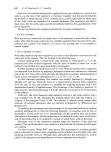
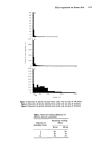
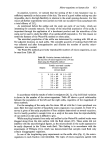
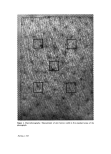
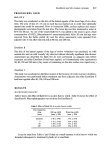
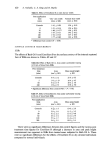
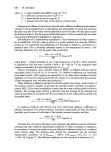
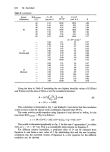
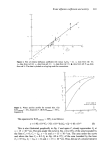
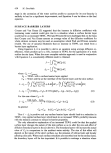
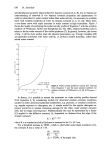
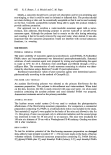
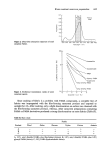
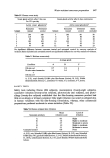
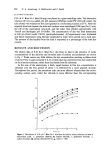
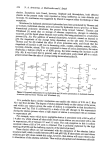
644 R. S. Berger, J. A. Mezick and C. M. Papa American Association of Textile Chemists and Colorists (AATCC) was used. This multifibre fabric consisted of 1.5 cm strips of wool, orlon 75, dacron 54, nylon 6.6, bleached cotton and acetate. Fabrics were impregnated with 0.05 ml of the following sunscreen preparations: 3.3•o octyl dimethyl PABA plus film-former (lotion) 3'0•o amyl dimethyl PABA plus 3'0•o glyceryl PABA (lotion) and 5.0% PABA (lotion). A glassine paper was applied over the fabric and a 2 kg weight placed on a glass plate over the paper was allowed to sit undisturbed for 60 s. Each fabric was exposed to direct sunlight for 4 h and 8 h later, washed with All © detergent in a 'normal' wash of 12 min in a washing machine. RESULTS AND DISCUSSION SUNSCREEN AGENT The sunscreen agent, octyl dimethyl PABA, was selected for the film-forming preparation because it fulfils many important features of a desired sunscreen agent. The presence of the octyl group and the two methyl groups (Fig. 1) make this derivative less reactive, less water soluble and more photostable than the parent compound, PABA. The water insolubility of octyl dimethyl PABA (Table I) promotes its water-resistance. o •-0 -CH•- iCH -CH• -CH• -CH= -CH• [• CH•, CH•, H •c/N'•*C H.• Figure 1. Structure of octyl dimethyl PABA. Table I. Water solubility of pure sunscreen agents Sunscreen agent Solubility (%) Octyl dimethyl PABA 0.0001 Homosalate 0.0003 Amyl dimethyl PABA 0.0005 Oxybenzone 0'0013 PABA 0.80 Glyceryl PABA 18.0 Sulisobenzone 40.0 Figure 2 shows that octyl dimethyl PABA absorbs energy in the sunburning range, having an absorption maximum at 312 nm, and transmits energy in the tanning range (320-400 nm), thus allowing the user to obtain a gradual tan. At 3•o concentration, octyl dimethyl PABA transmits less than 1 •o erythemal energy (Fig. 3).

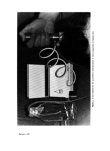
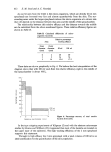
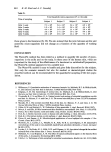
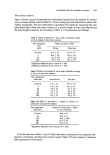
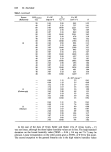
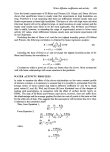
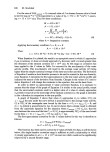
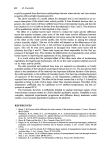
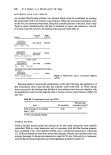
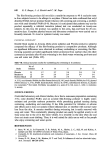
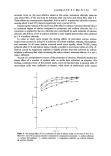
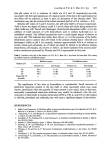
Figure 2. Ultraviolet absorption spectrum of octyl dimethyl PABA. Water-resistant sunscreen preparation 645 0'7 -- 0'6 -- 0'2 •'"i• J•"- t I: burning ::l Tonni ng -- 220 240 260 280 300 320 340 360 380 400 Wovelength (nm) I00 - Figure 3. Erythemal transmission values of pure 0'10 sunscreen agents. Homosalate I 2 3 4 5 Sunscreen (w/v %) Since staining of fabric is a problem with PABA compounds, a complete line of fabrics was impregnated with the film-forming sunscreen product and exposed to sunlight for 4 h. After washing, only a slight discolouration on cotton was observed with the film-forming sunscreen product, whereas, other sunscreen preparations containing PABA or PABA derivatives produced a strong discolouration on more fabrics (Table II). Table H. Stain study Fabric Product Wool Orlon Dacron Nylon Cotton Acetate B + + + + + + c - - - + - + A, 3'3•o octyl dimethyl PABA plus film-former (lotion) B, 3.0•o amyl dimethyl PABA plus 3'0•o glyceryl PABA (lotion) C, 5'0•o PABA (hydroalcoholic lotion).
Purchased for the exclusive use of nofirst nolast (unknown)
From: SCC Media Library & Resource Center (library.scconline.org)