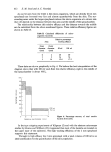
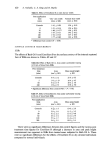
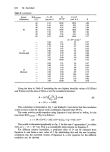
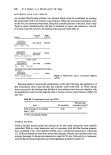
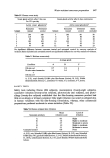
614 E. M. Staal and A. C. Noordzij Table IV. Time of sampling Total lipophylic micro-organisms/cm • on the scalp Subject 1 Subject 2 Subject 3 Subject 4 After 1 week 7'1 x 10 • 2-6 x 10⁶ 5.4 x 10 • 6-9 x 10 • After 2 weeks 1'9 x 10 • 1'4 x 10⁶ 5'8 x 10 • 4'4 x 10 • After 3 weeks 4-4 x 10 • 1-6 x 10⁶ 1.1 x 10 • 2-9 x 10 • After 4 weeks 3.8 x 10 • 1.7 x 10⁶ 1.9 x 10 • 9.4 x 10 • After 5 weeks 4.8 x 10 • 3.0 x 10 • 1.6 x 10 • 7.5 x 10 • those given in the literature (28, 29). We also noticed that the ratio between aerobic and anaerobic micro-organisms did not change as a function of the quantity of washing fluid. CONCLUSION The Water-Pik method has been tested as a method to quantify the number of micro- organisms in the axilla and on the scalp. In these areas of the human skin, which are important for the study of the effectiveness of a deodorant or antidandruff preparation, the Water-Pik method appeared to be a suitable tool. The Water-Pik method is easy to handle and gives little discomfort for the subjects. Not only for cosmetic research but also for medical or dermatological studies the described method can be recommended for the quantitative sampling of the skin popu- lation. REFERENCES 1 Williamson, P. Quantitative estimation of cutaneous bacteria. In: Maibach, H. I. & Hildick-Smith, G. Skin Bacteria and their Role in Infection. 3 (1965) McGraw Hill, New York. 2 Kligman, A.M. The bacteriology of normal skin. In: Maibach, H. I. & Hildick-Smith, G. Skin Bacteria and their Role in Infection. 13 (1965) McGraw Hill, New York. 3 Woodroffe, R. C. S. and Shaw, D. A. Natural control and ecology of microbial populations on skin and hair. In: Skinner, F. A. and Cart, J. G. The normal microbial flora ooeman. 13 (1974) Academic Press, London. 4 Marples, M. J. The normal microbial flora of the skin. In: Skinner, F. A. and Can', J. G. The Normal Microbial Flora of Man. 7 (1974) Academic Press, London. 5 Gibbs, B. M. and Stuttard, L. W. Evaluation of skin germicides. J. Appl. Bacteriol. 30 66 (1967). 6 Selwyn, S. and Ellis, H. Skin bacteria and skin disinfection reconsidered. Brit. Med. J. 1 136 (1972). 7 Parker, M. S. Skin bacteria: myth and reality. Soap, Perrum. Cosmet. 45 296 (1972). 8 Holt, R. J. Aerobic bacterial counts on human skin after bathing. J. Med. Microbiol. 4 319 (1971). 9 Holt, R. J. Pad culture studies on skin surfaces. J. Appl. Bacteriol. 29 625 (1966•, 10 Dixon, H. and Paneza, A. K. Microbiological applications of novel replipad skin sampler. J. Soc. Cosmet. Chem. 28 21 (1977). 11 McGinley, K. J., Leyden, J. J., Marpies, R. R., Path, M. R. C. and Kligman, A.M. Quantitative microbiology of the scalp in non-dandruff, dandruff and seborrheic dermatitis. J. Invest. Dermatol. 64 401 (1975). 12 Leyden, J. J., McGinley, K. J., Mills, O. H. and Kligman, A.M. Age related changes in the resident bacterial flora of the human face. J. Invest. DermatoL 65 379 (1975). 13 Shehadeh, N.J. and Kligman, A.M. The effect of topical antibacterial agents on the bacterial flora of the axilla. J. Investigative Dermatology 40 61 (1963) 14 Ulrich, J. A. Techniques of skin sampling for microbial contaminants. Health Lab. Sci. 1 133 (1964).

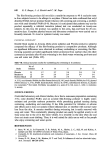
Micro-organisms on human skin 615 15 Stringer, M. F. and Marpies, R. R. Ultrasonic methods for sampling human skin micro-organisms. Brit. J. Dermatol. 94 551 (1976). I6 Kligman, A.M., Leyden, J. J. and McGingley, K. J. Bacteriology. J. Invest. Dermatol. 67 160 (1976). 17 Smith, R. F. Comparative enumeration of lipophilic and nonlipophilic cutaneous diphteroids and cocci. Appl. Microbiol. 19 254 (1970). 18 Voss, J. G. Effects of an antibacterial soap on the ecology of aerobic bacterial flora of human skin. AppL Microbiol. 30 551 (1975). 19 Bibel, D. J. and Le Brun, J. R. Changes in cutaneous flora after wet occlusion. Can. J. Microbiol. 21 496 (1975). 20 Green, J. H. and Ronsivalli, L. J. A cylinder template method for sampling fish surfaces. J'./lppl. Bacteriol. 43 171 (1977). 21 Williamson, P. and Kligman, A.M. A new method for the quantitative investigation of cutaneous bacteria. J. Invest. Dermatol. 45 498 (1965). 22 Troller, J. A. Model system for the investigation of dandruff. J. Soc. Cosmet. Chem. 22 187 (1971). 23 Brewer, J. H. Safe self-contained carbon dioxide-hydrogen anaerobic system. •lppl. MicrobioL 44 985 (1966). 24 Prince, H. N. and Rodgers, J. A. Studies on the aerobic axillary microflora employing a standardized swabbing technique. Cosmet. Perfum. 89 25 (1974). 25 Montes, L. F. and Willborn, W. H. Location of bacterial skin flora. Brit. J. Dermatol. 81 Suppl. 1, 23 (1969). 26 Evans, C. A. Persistent individual differences in the bacterial flora of the skin of the forehead: numbers of propionic bacteria. J. Invest. Derrnatol. 64 42 (1975). 27 Noble, W. C. Dispersal of organisms from human skin. Cosmet. Toiletries 92 38 (1977). 28 Kloos, W. E. and Musselwhite, M. S. Distribution and persistence of staphylococcus and micro- coccus species and other aerobic bacteria on human skin. •lppl. MicrobioL 30 381 (1975). 29 Bibel, D. J. and Lovell, D. J. Skin flora maps: a tool in the study of cutaneous ecology. J. Invest. Dermatol. 67 265 (1976).
Purchased for the exclusive use of nofirst nolast (unknown)
From: SCC Media Library & Resource Center (library.scconline.org)