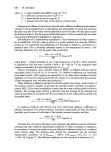
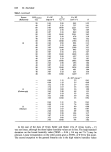
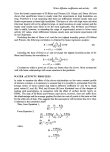
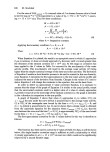
Water diffusion coefficients and activity 639 8 C.R.C. Handbook of Chemistry and Physics, 48th Edn. Eds. Weast, R. C. and Selby, S. M. (1967) (The Chemical Rubber Co. Cleveland, Ohio). 9 Goodman, A. B. and Wolf, A. V. Insensible water loss from human skin as a function of ambient vapour concentrations. J. Appl. PhysioL 26 203 (1969). 10 Lamke, L. O. and Wedin, B. Water evaporation from normal skin under different environmental conditions. Acta Dematovener, 51 111 (1971). 11 Grice, K., Salter, H. and Baker, H. The effect of ambient humidity on transepidermal water loss. J. Invest. Dermatol. 58 343 (1972). 12 Spruit, D. and Malten, K. E. Humidity of the air and water vapour loss of the skin. Dermatologica, 138 418 (1969). 13 EI-Shimi, A. F. and Princen, H. M. Some aspects of the stratum corneum: organic solvent system. J. Soc. Cosmet. Chem. 28 243 (1977). 14 Kligman, A.M. The biology of the stratum comeurn. In: Montayna, W. and Lobitz, W. C. The Epidermis 387 (1964) Academic Press, New York. 15 Willis, J.P. Personal communication. 16 Scheuplein, R. J. and Morgan, L. J. 'Bound water' in keratin membranes measured by a micro- balance technique. Nature 214 456 (1967). 17 Anderson, R. L., Cassidy, J. M., Hansen, J. R. and Yellin, W. Hydration of stratum corncure. Biopolymers 12 2789 (1973). 18 Walkley, K. Bound water in stratum corncure measured by differential scanning calorimetry. J. Invest. Dermatol. 59 225 (1972). 19 Foreman, M. I. A proton magnetic resonance study of water in human stratum corneum. Biochhn. Biophys. Acta, 437 599 (1976). 20 Papir, Y. and Wildnauer, R. The mechanical properties of stratum corneum. Bull. Am. Phys. Soc. 19 264 (1974). 21 Solan, J. L. and Laden, K. Factors affecting the penetration of light through stratum comeurn. J. Soc. Cosmet. Chem. 28 125 (1977). 22 Middleton, J. D. The mechanism of water binding in stratum corneum. Brit. J. Dermatol. 80 437 (1968). 23 E1-Shimi, A. F., Princen, H. M. and Risi, D. R. Water vapour sorption, desorption and diffusion in excised skin: Part I. Technique. In Applied Chemistry at Protein Interfaces, Advances in Chemistry Series, No. 145 125 (1975) American Chemical Society.

J. Soc. Cosmet. Chem. 29 641-649 (1978) Design and evaluation of a water-resistant sunscreen preparation RICHARD S. BERGER, JAMES A. MEZICK* and CHRISTOPHER M. PAPA Division of Dermatology, Rutgers Medical School, Piscataway, New Jersey and *Dermatological Division, Johnson & Johnson, New Brunswick, U.S.A. Presented at the joint Symposium with the Pharmaceutical Society of Great Britain, 'Cosmetic and Pharmacological Aspects of Colour', 11 November 1976 at Stratford upon Avon Synopsis A water resistant sunscreen preparation was formulated to function during swimming, exercising and sunbathing. The sunscreen agent, oetyl p-N,N-dimethylamino benzoate (PABA) and an ammonium aerylate/aerylate ester polymer were combined in a cosmetically pleasing oil-in-water, fugitive amine, lotion vehicle. When applied to skin, a substantive film forms which does not interfere with transepi- dermal water loss or normal sweat gland function. Double blind clinical studies showed that this water- resistant sunscreen preparation provided protection from sunburn after 60 min swimming in fresh or salt water. This water-resistant sunscreen preparation was found to be safe and of low irritancy, allergenic, sting and stain potential. INTRODUCTION Ultraviolet light (uvl) produces profound effects on human skin. This is especially true for the electromagnetic spectrum in the uv-B region of 290-320 nm. This radiation produces excitation of electrons which leads to chemical changes in DNA of epidermal cells and to the release of vasoactive substances, such as prostaglandins producing painful sunburn and cell destruction (1). This action spectrum is most likely responsible for the in- duction of skin cancers and ageing processes seen with prolonged solar exposure. With increased awareness of these sequelae and the popularity of out-door recreation, there is now a demand for effective products to protect individuals from these effects. In addition, there are a small number of individuals who require products to prevent sun-related exacerbation of underlying diseases, such as lupus erythematosus. Most available sunscreen preparations are removed by active swimming because of the incorporation of a water soluble sunscreen agent or a water-washable emulsifying system-. Our primary objective was to develop a sunscreen preparation for the mass market that would resist removal and provide effective uv-B protection during conditions of normal usage, such as swimming and exercising. Even if individuals are diligent about applying a sunscreen repeatedly, they may get burned while swimming, since water filters out very little uv-B. Therefore, the important feature of water-resistance is needed to protect people during and following swimming. 0037-9832/78/1000-0641 $02.00 ¸ 1978 Society of Cosmetic Chemists of Great Britain 641
Purchased for the exclusive use of nofirst nolast (unknown)
From: SCC Media Library & Resource Center (library.scconline.org)