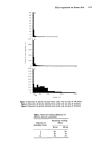
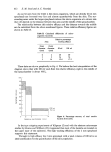
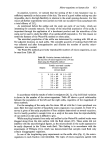
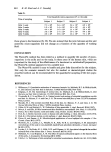
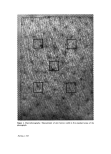
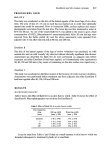
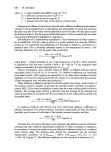
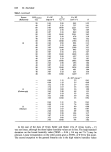
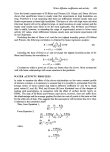
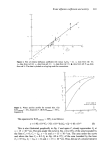
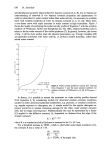
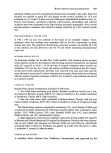
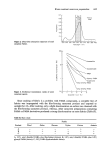
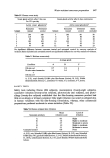
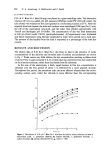
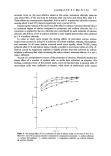
Ifater diffusion coefficients and activity 633 lO I 4o Figure 1. Plot of relative diffusion coefficient (R) versus Col(Co- C). ¸, data from ref. 10 A, data from ref. 12 +, data from ref. 11' ED, data from ref. 13 O, data from ref. 9 a,, data from ref. 4. The data is plotted on a log-log scale for convenience. Figure 2. Water activity profile for normal skin. (A) R.H.externa I = 0%, Equation 7. (B) R.I-I.external = 50•o, Equation 8. % 2 Co 0 4 8 12 16 x • i0 4 (cm) The equation for R.H.exter•a• = 50• is as follows' x = 1'92 x 10-•'Ci- 3'21 x 10 -• In (Co- Ci)--1'65 x 10 -a (8) This is also illustrated graphically in Fig. 2 and again Ci closely approaches Co at x •- 15 x 10 -• cm. The area under the curve in Fig. 2A is 65• of the area bounded by the lines Ci = 0 Ci = Co x = 0 and x = 15 x 10 -• cm. The area under the curve and above the line Ci = 0.5 Co in Fig. 2B is 72•o of the area bounded by the lines Ci = 0.5 Co Ci = Co x = 0 and x = 15 x 10 -• cm. Thus, the use of a second iterative

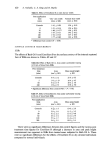
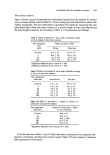
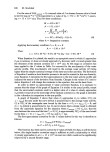
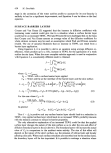
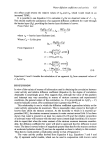
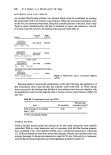
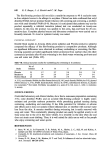
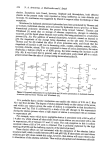
634 M. Stockdale stage in the correction of the water activity profile to account for its non-linearity is unlikely to lead to a significant improvement, and Equation 8 can be taken as the final equation. SURFACE BARRIER LAYERS Cooper and Van Duzee (5) suggested that the increase in diffusion coefficient with increasing water content could give rise to a situation where a surface barrier layer could lead to an increased TEWL. Weil and Princen (6) have challenged this on the basis that Cooper and Van Duzee assume an average value of the diffusion coefficient for whole stratum corneum may be used, an assumption which Well and Princen consider invalid. The use of calculus illustrates that no increase in TEWL can result from a barrier layer application. Using Equation 6, it is possible to derive an equation using average diffusion co- efficients, which predicts up to a 10% increase in TEWL for the application of a weak surface barrier layer. When the more complete calculus approach is used in conjunction with Equation 6, a c•nsiderably different result is obtained. fCo J = 7 dCe D(Ci) dCi 1 fCo D(G) dCi where CE = Cexternal JB = TEWL with a surface barrier layer applied Cn = Water activity at the interface of the barrier layer and the skin surface. Do E Co 1-0'46) dCi J-JB 5-' (.0'175 DofCo{O'175CoFo.46) = Co-C, -Td Do J- d• = •- { 0'46(C•- CE)--0.175 Co[In(Co- C•)-In (Co- CO]} (12) For the case where C E = 0: 0.46 CBDo CoDo J- J• -- -- 0.175 [ln (Co- C•)- In Co] (13) t t In general: Ca CE ln(Co-C•)ln(Co-COO Thus J - Ja is positive and any surface barrier layer should lead to a reduction in TEWL. Any applied surface layer which leads to an increased TEWL probably interacts with the stratum corneum to reduce its barrier properties. The only alternative explanation of an increased TEWL could be that the applied surface layer changes the nature of the skin surface so as to alter the size and effect of diffusion boundary layers in the air above it. The boundary layers will increase the actual value of CE in comparison to the ambient water activity. The size of this effect will depend on the nature of the skin's surface, e.g. the presence of yellous hairs and loosely adhering skin cells. Where such surface structures are smoothed out by the surface layer, the boundary layers will be less important. It is possible to envisage a situation where
Purchased for the exclusive use of nofirst nolast (unknown)
From: SCC Media Library & Resource Center (library.scconline.org)