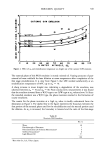
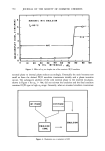
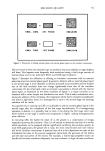
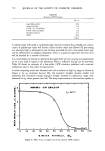
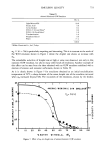
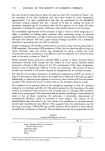
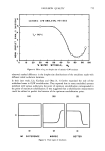
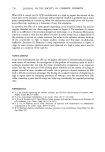
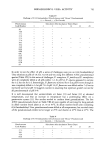
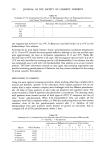
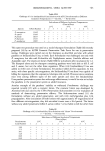
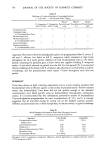
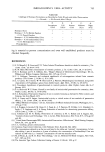
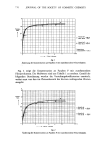
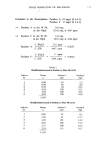
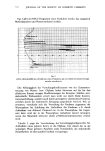
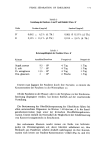
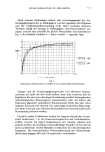
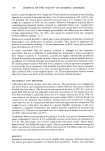
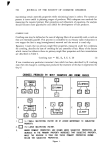
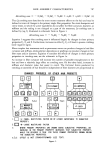
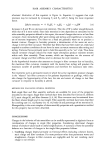
EMULSION QUALITY 755 o2 1 0 i I I I I • I I I I CATIONIC O/W EMULSION, REVISED T e = 80oc 20 30 40 50 60 70 80 90 I00 % WATER WITHHELD, o1# Figure 8. Effect of or.on droplet size of cationic O/W emulsion observed marked difference in the droplet size distributions of the emulsions made with different initial surfactant locations. In their later work, Lin, Kurihara and Ohta (4, 5) further examined the role of the solubilized water in O/W emulsification. They reported that in many emulsified systems stabilized with various surfactants, the point of optimum emulsification corresponded to the point of maximum solubilization. It was suggested that a solubilization measurement could be utilized to predict the location of the optimum emulsification point. (A) (B) (C) NO DIFFERENCE WORSE Figure 9. Three types of emulsions BETTER

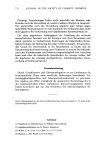
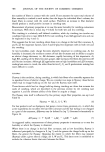
756 JOURNAL OF THE SOCIETY OF COSMETIC CHEMISTS When LEE is carried out for O/W emulsification in a high c• H region, the amount of the initial water in the emulsion concentrate will be relatively small. It is probable that at some point corresponding to a certain c•H value, the mechanism mentioned above will function most effectively, resulting in a formation of very fine emulsions. In summary, the effect of c• varies greatly depending on the emulsion system, but may be roughly classified into the three categories shown in Figure 9. The emulsion (A) shows little or no difference in the emulsion droplet size with respect to c•. Emulsion (B) becomes coarse at a certain c• value due to a phase inversion. In some systems such a degradation of the emulsion is not due to a phase inversion, but rather to the excessive viscosity build-up of the concentrate in high c• region making mixing and first-stage emulsification ineffective. Emulsion (C) illustrates a sharp improvement of emulsification in higher c• range. In some systems, optimum points were observed at a high c• value, which may be regarded as a variation of the type (C). CONCLUSIONS It has been demonstrated that LEE can be applied effectively in commercially processing a wide variety of emulsions. An investigation of the qualities of emulsions made by such a technique revealed that not only the initial emulsification temperature is an important factor, but also the amount of the diluting phase withheld and the extent of mixing. A proper control of these variables will enable one to process a desired emulsion by LEE with a definite economical advantage. The finding of a marked reduction of droplet size in high c• region opens an intriguing possibility of making a very fine emulsion with LEE while conserving a great deal of energy and reducing considerably the required processing time. REFERENCES (1) T.J. Lin, Process engineering for cosmetic emulsion, part III, semi-cold processing of emulsion, Amer. Perfum. Cosmet. 80, 35-9 (1965). (2) T.J. Lin, Low-energy emulsification, J. Soc. Cosmet. Chem., 29, 117-126 (1978). (3) T.J. Lin, H. Kurihara and H. Ohta, Effects of phase inversion and surfactant location on the formation of o/w emulsions, J. Soc. Cosmet. Chem., 26, 121-39 (1975). (4) T. J. Lin, H. Kurihara and H. Ohta, Prediction of optimum o/w emulsification via solubilization measurements, J. Soc. Cosmet. Chem., 28 457-79 (1977). (5) W. R. Markland, Aqueous solubilization and phase inversion in o/w emulsification, Norda BriejS, No. 480, April-May, 1977.
Purchased for the exclusive use of nofirst nolast (unknown)
From: SCC Media Library & Resource Center (library.scconline.org)