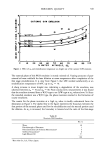
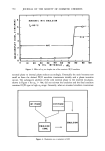
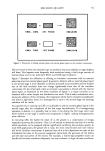
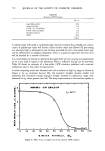
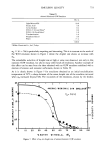
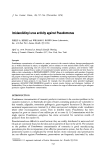
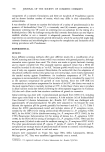
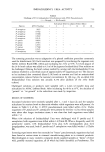
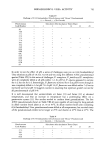
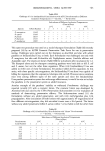
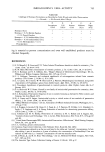
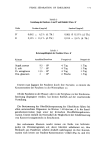
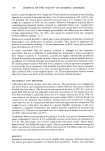
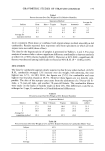
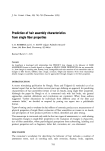
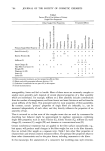
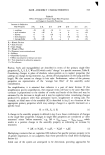
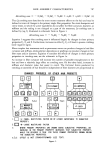
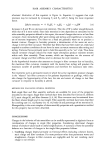
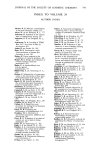
IMIDAZOLIDINYL UREA ACTIVITY 761 Table IV Challenge of 0.3 % Imidazolidinyl Urea Solutions with "House" Pseudomonads (+ = Growth, - = No Growth) Pseudomonas Subculture After Incubation Times (Days) Code Number 1 2 3 7 14 21 28 34A - - - 37-1 - - - 37-2 - - - 37-3 + + + 37-4 - - - 38-1 + + + 38-2 - - - 41A + + + 82A + - - 82B - - - 82C - - - 83A + + + 83B - - - 87A - - - 87B - - - 99 - - - + + + + In order to test,the effect of pH, a series of challenges were run on 0.3% Imidazolidinyl Urea solutions at pHs of 5.0, 6.0, 7.0, 8.0 and 9.0, using five different ATCC pseudomonad species (Table VII). In this series of challenges, P. aeruginosa, P. putida and P. auerofaciens were all completely killed at all pHs within 1 d. At pH 5.0, P. cepacia appeared to survive for 1 d, but not for 2 d. Interestingly, P. fluorescens survived for 3 d at pH 5.0 even though it was completely killed in 1 d at pH 7.0. At pH 5.0, P. fluorescens was killed within 7 d, but its increased survival at pH 5.0 suggests caution in assuming that optimum growth occurs for all pseudomonads at pH 6-8. It is well documented that antimicrobials act faster (21) and better (22) at elevated temperatures, and that an increase in temperature has a potentiating effect on a preservative system (23). Our studies tended to confirm these generalizations. The five ATCC pseudomonads shown in Table VIII all were capable of surviving for long periods in dilute nutrient broth alone at 25, 35 or 45øC. In dilute nutrient broth also containing 0.3% Imidazolidinyl Urea, pseudomonads were killed at all temperatures, but survival times of the pseudomonads tended to be longer at 25øC and shorter at 45øC than at 35øC. The Table V Challenge of 0.5 % Imidazolidinyl Urea Solutions with "House" Pseudomonads (+ = Growth, - = No Growth) Pseudomonas Subculture After Incubation Times (Days) Code Number 1 2 3 7 14 21 28 37-3 + + + 38-1 + + + 41A - - - 83A - - -

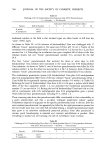
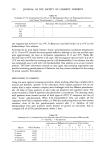
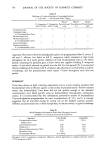
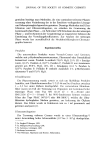
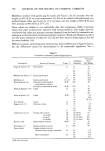
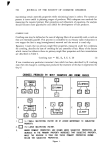
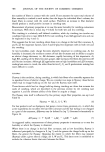
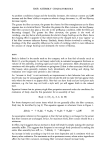
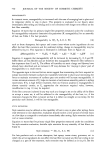
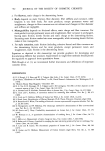
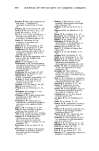
762 JOURNAL OF THE SOCIETY OF COSMETIC CHEMISTS Table VI Challenge of 0.3 % Imidazolidinyl Urea Plus 0.2 % Methylparaben Plus 0.1% Propylparaben Solutions with "House" Pseudomonads (+ = Growth, - = No Growth) Pseudomonas Subculture After Incubation Times (Days) Code Number 1 2 3 7 14 21 28 37-3 + 38-1 - 41A - 83A - one organism that survived 7 d at 25øC, P. fluorescens, was killed within 3 d at 25øC in 0.5% Imidazolidinyl Urea solution. Screening the six most highly resistant "house" pseudomonads at incubation temperatures of 25, 35 and 45øC showed the same general behavior, although in this case survival times were approximately the same at incubation temperatures of 25 and 35øC (Table IX). Survival times at 45øC were shorter in all cases. The one organism that survived 7 d at 25 or 35øC not only was killed in screening tests by 0.5% Imidazolidinyl Urea solution, but also was surprisingly easy to kill with 0.3% Imidazolidinyl Urea solution in an actual cosmetic product. This latter observation reminds us once again that screening experiments may provide interesting general patterns of behavior, but they cannot substitute for the testing of actual cosmetic formulations. APPLICATIONS TO COSMETICS Using this same rigorous screening procedure, where anything other than complete kill is survival and therefore "growth" in the subculture, three cosmetic products now on the market from a major cosmetic company were challenged with five different pseudomon- ads. All three of these products as sold today are preserved with parabens alone. The results recorded in Table X represent subcultures after 2 d incubation. The cleansing cream with parabens alone showed survival of both types of ATCC P. aeruginosa and two of three "house" pseudomonads. When 0.3% Imidazolidinyl Urea was added, all five organisms were killed completely within 2 d. With the moisturizing lotion and the nutrient emulsion, three of the five pseudomonads survived after 2 d. Addition of 0.3% Imidazolidinyl Urea gave products which showed no growth on subculture, that is, complete kill of all five pseudomonads, within 2 days. Table VII Challenge of 0.3% Imidazolidinyl Urea Solutions with ATCC Pseudomonads at Different pHs (+ = Growth, - = No Growth) Species ATCC Number 1 Subcultures of Different pH Incubations (Time in Days) 5.0 6.0 7.0 8.0 9.0 2 3 7 1 2 3 ! 2 3 1 2 3 ! 2 P. aueruginosa 15442 P. cepacia 25416 P. putida 12633 P. fluorescens ! 3525 P. aureofaciens 13985 + + +
Purchased for the exclusive use of nofirst nolast (unknown)
From: SCC Media Library & Resource Center (library.scconline.org)