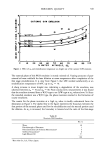
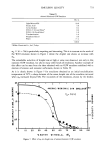
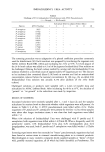
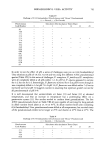
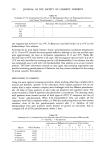
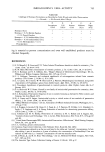
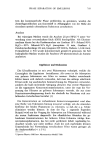
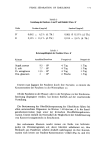
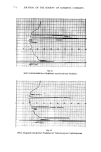
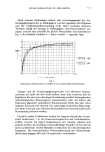
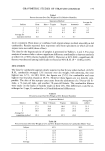
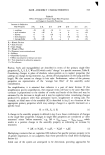
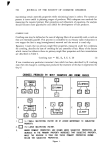
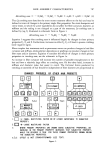
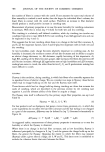
EMULSION QUALITY 753 Table IV Anionic/Nonionic O/W Emulsion Wt. % Light Mineral Oil 10.0 Stearic Acid 5.0 Cetyl Alcohol 0.2 P.O.E. (5.5) Cetyl Ether a 0.6 P.O.E. (10) Cetyl Ether a 1.0 Triethanolamine 1.0 Propylene Glycol 5.0 Water 77.2 100.0 Nikko Chemicals Co., Ltd., Tokyo. all -- 50 "-- 70% is particularly surprising and interesting. This is in contrast to the result of the W/O emulsion shown in Figure 3 where the droplet size shows an increase with •O' The remarkable reduction of droplet size at high a value was observed, not only in this nonionic O/W emulsion, but also in many other kinds of emulsions. Another example of this effect can be seen from the data obtained with an O/W emulsion stabilized with a mixture of anionic and nonionic surfactants, shown in Table IV. As it is clearly shown in Figure 7 for emulsions obtained at an initial emulsification temperature of 70øC, a sharp decrease of the mean droplet size of the emulsion occurred when a. increased beyond 50%. The viscosities of the emulsions, shown by the broken Zõ [ • ] [ ] I [ ] ' NIC/NONIONI•O/300•-'EMULSIøC70T. .......... .. % % o z 0.5 I 20,-, o o i o 20 30 40 50 60 70 80 90 o ioo % WATER WITHHELD, •1• H Figure 7. Effect of a u on droplet size of anionic/nonionic O/W emulsion

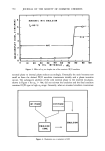
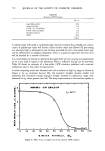
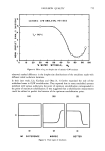
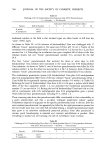
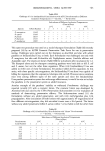
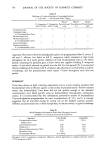
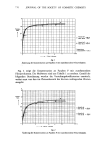
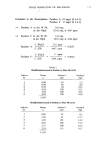
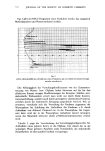
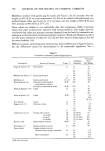
754 JOURNAL OF THE SOCIETY OF COSMETIC CHEMISTS line, also showed a sharp drop at about the same c• H value. The viscosities in Figure 7 are the viscosities of the final emulsions after they were cooled to room temperature approximately 2 hr after emulsification and they are represented by the Brookfield viscometer reading obtained with No. 3 spindle at 30 rpm. In making this series of emulsions, propylene glycol was placed with the first portion of the water. All other ingredients, including the nonionic surfactants, were initially placed in the oil phase. The remarkable improvement of the emulsion at high c• values is rather intriguing as it offers a possibility of making better emulsion while conserving energy. In practical applications, emulsification at a high c• value means there is practically no need for cooling the batch after dilution. Not only a great saving of energy is possible, but a substantial reduction in processing time can also be achieved. Further investigation of this effect revealed that it occurred in many systems, particularly in O/W emulsions. The cationic O/W emulsion of Table I did not show the effect at high c• H values. However, when this system was reexamined by using a similar but more concentrated cationic surfactant, a very different result was obtained. The revised formula used in this study is shown in Table V. Stearyl dimethyl benzyl ammonium chloride (80%) is similar to stearyl dimethyl benzyl ammonium chloride (21%), except that the content of active stearyl dimethyl benzyl ammonium chloride is 80% instead of 21%. The constituents of the other components, however, may be significantly different in these two surfactants. The amount of stearyl alcohol was increased in the revised formula to compensate for the lowered viscosity. The data for this emulsion obtained at emulsification temperature of 80øC are shown in Figure 8. Here again a sharp decrease in the droplet size is observed in the high c•H region. Interestingly, an optimum point appears to exist at c•H value of about 83% for this cationic emulsion. This means that above or below 83% c•H, the emulsions became coarser. The existence of an optimum point is not completely surprising in view of a previous finding by Lin, Kurihara and Ohta (3). The authors pointed out the importance of a small amount of solubilized water present in the oil phase prior to forming O/W emulsions under a low mixing speed. They discovered that by initially solubilizing a small amount of water in the oil phase containing the surfactant, a remarkable improvement of emulsification efficiency could be achieved in some systems. The amount of the presolubilized water was found to be very critical, as an insufficient or excessive amount would make emulsification less efficient. They suggested that the solubilization was the first step in forming a (W/O)/W type double emulsion which allowed a more efficient emulsification mechanism to function. This mechanism was said to be responsible for the Table V Cationic O/W Emulsion, Revised Wt. % Stearyl Dimethyl Benzyl Ammonium Chloride (80% active) a Light Mineral Oil Stearyl Alcohol Water 2.0 4.0 2.5 91.5 100.0 a Toho Chemical Industry Co., Ltd., Tokyo, Japan.
Purchased for the exclusive use of nofirst nolast (unknown)
From: SCC Media Library & Resource Center (library.scconline.org)