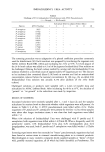
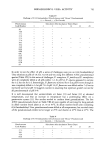
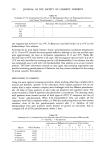
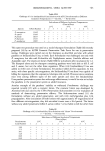
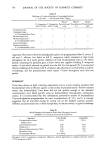
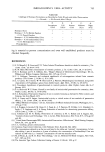
GRAVIMETRIC STUDIES OF STRATUM CORNEUM 781 significant variability among individuals from whom samples are taken was seen at 62% R.H. Cantharidin seems to be a superior method, but experimental design does not allow direct comparison of the data due to the different age groups and body sites. Anderson et al. found that the most hygroscopic stratum corneum samples contained the greatest amount of water soluble components (14). It seems reasonable that can- tharidin would contain more of these components than other methods the stratum corneum spends less time in water when prepared by the cantharidin technique, except for the ammonia method. These water soluble materials are also a logical mechanism for the greater hygroscopicity that the cantharidin specimens demonstrated here and make cantharidin a most attractive method for in vitro studies. ACKNOWLEDGMENTS We wish to thank SP4 Chris Linamen for his technical assistance in conducting these studies. REFERENCES (1) A.M. Kligman and E. Christophers, Preparation of isolated sheets of human stratum corneum, Arch. Dermatol., 88, 702-705 (1963). (2) H. D. Onken and C. A. Moyer, The water barrier in human epidermis, Arch. Dermatol, 87, 584-590 (1963). (3) F. F. Foley and B. Aftonomos, The use of pronase in tissue culture: a comparison with trypsin, J. Cell Physiol., 75, 159-161 (1970). (4) J. D. Middleton, The mechanism of water binding in stratum corneum, Brit. J. Dermatol., 80, 437-450 (1968). (5) I. C. Mackenzie and J. E. Linder, An examination of cellular organization within the stratum corneum by silver staining method, J. Invest. Dermatol., 61,245-250 (1973). (6) D. Gilbert, P. D. Mier and T. Jones, An improved technique for isolation of epidermis from human skin, J. Invest. Dermatol., 40, 165-167 (1963). (7) F. N. Marzulli, Barriers to skin penetration, J. Invest. Dermatol., 39, 387-394 (1962). (8) S. Rothbert and G. D. Axilrod, The action of trypsin on insoluble epidermal keratin and the nature of the epidermal proteins solubilized, Biochem. Med., 2, 1-11 (1968). (9) H. M. Jensen and N. K. Mottet, Ultrastructoral changes in keratinizing epithelium following trypsiniza- tion, epidermal detachment, and apposition to mesenchymes, J. Cell. Sci., 6, 511-534 (1970). (10) G.J. Singer and L. J. Vinson, The water-binding properties of skin, Proc. Toilet Goods Assoc 46, 29-33 (1966). (11) R.J. Scheuplein, Molecular structure and diffusional processes across intact epidermis, Clearinghouse, U.S. Dept Commerce, AD822655, Oct. 1966. (12) M. K. Polano, M. Ponec, G. Smeenk and J. C. M. Hendrikse, Factors influencing the penetration of corticosteroids through the epidermis, in "Advances in Biology of the Skin," W. Montagna, E. J. VanScott, R. B. Stoughton, Eds., Appleton-Century-Crofts, New York 1972, Vol. XII, pp 325-328. (13) T. S. Spencer, C. E. Linamen, W. A. Akers and H. E. Jones, Temperature dependence of water content of stratum corneum, Brit. J. Dermatol, 93, 159-164 ( 1975). (14) R. L. Anderson, J. M. Cassidy, J. R. Hansen and W. Yellin, The effect of in vivo occlusion on human stratum corneum hydration in vitro,. J. Invest. Dermatol., 61,375-379 (1973). (15) C. Fox, J. A. Tassoff, M. M. Rieger and D. E. Deem, Modification of the water holding capacity of callus by pretreatment with additives, J. Soc. Cosmet. Chem., 13,263-279 (1962). (16) I. H. Blank and E. B. Shappirio, The water content of stratum corneum III. Effects of previous contact with aqueous solution of soaps and detergents, J. Invest. DermatoL, 25, 391-400 (1955). (17) J. D. Middleton and B. M. Allen, The influence of temperature and humidity on stratum corneum and its relation to skin chapping, J. Soc. Cosmet. Chem., 24, 239-243 (1973).

782 JOURNAL OF THE SOCIETY OF COSMETIC CHEMISTS (18) P. Flesch and E. C. J. Esoda, Deficient water-binding in pathological horny layers, Nature, 178, 211- 212 (1956). (19) K. Laden and R. Spitzer, Identification of a natural moisturizing agent in skin,.]. Soc. Cosmet, Chem., 18, 351-360 (1966). (20) K.J.K. Buettner, The moisture of human skin as affected by water transfer,.]. Soc. Cosmet. Chem., 16, 133-144 (1965).
Purchased for the exclusive use of nofirst nolast (unknown)
From: SCC Media Library & Resource Center (library.scconline.org)