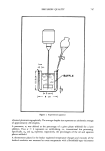
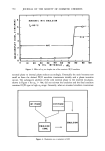
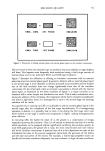
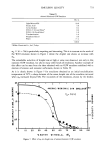
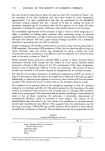
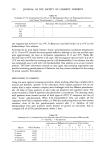
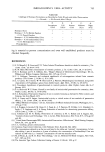
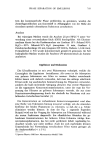
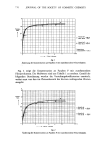
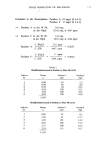
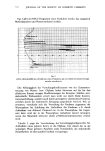
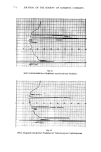
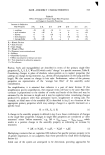
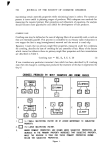
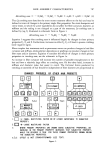
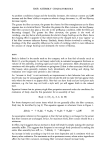
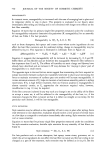
HAIR ASSEMBLY CHARACTERISTICS 787 ACombing ease = -- NiAF k -- N2AFs -- N3AE + nlAS -[- n2AD -- N4AC (4) Thus A combing ease describes the most recent treatment effects on the hair and may be defined in terms of changes in the primary single fiber properties. For most shampoos and creme rinses, in which the active ingredients do not affect the fiber curvature, diameter, or stiffness and the styling is not changed as a part of the treatment, A combing ease is defined by (eq 5), illustrated in schematic form in Figure 1. ACombing ease = -- N•AF k -- N•AF s -- N3AE (5) Equation 5 suggests that combing ease is influenced largely by changes in three primary properties Fk, F s and E. Furthermore, increases in either Fk, F, or E lead to poorer combing (note negative signs). More complex hair treatments such as permanent waves can produce changes in hair fiber curvature and stiffness, while polymer depositions or graftings can produce changes in hair fiber mass and/or diameter. Equation 4 considers the effects of changes in these primary properties on combing ease, see the schematic in Figure 2a. An increase in fiber curvature will increase the number of possible entanglements in the hair and have a relatively large effect on combing ease. On the other hand, increases in stiffness and diameter make hair easier to comb. The frictional forces produced by combing an assembly of hair should be independent of fiber diameter yet proportional to CHANGES PRODUCED BY OTHER HAIR PRODUCTS • .AC d l^ MANAGE-I STYLE RETENTIONJ ,Ac ,AC =n = SMALL MULTIPLYING FACTOR OR OF LESSER IMPORTANCE TO SUBJECTIVE PROPERTY. :N" LARGE MULTIPLYING FACTOR. WHERE PRIMARY PROPERTIES ARE DRAWN ABOVE SUBJECTIVE PROPERTIES, AN INCREASE IN THE PRIMARY PROPERTY INCREASES THAT SUBJECTIVE PROPERTY, WHILE THE REVERSE IS TRUE FOR THOSE PRIMARY PROPERTIES DRAWN BELOW THE SUBJECTIVE PROPERTIES. EFFECT IS NOT STRAIGHTFORWARD (SEE TEXT}. Figure 2.

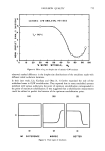
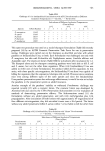
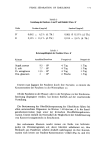
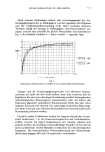
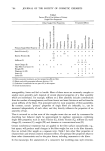
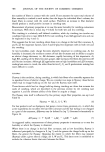
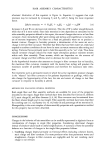
788 JOURNAL OF THE SOCIETY OF COSMETIC CHEMISTS the number of fibers in contact with the comb. If one assumes the same total volume of fiber assembly is combed in each stroke, then the larger the individual fiber's volume, the fewer fibers in contact with the comb surface. Therefore an increase in fiber diameter should produce a small positive increase in combing ease. Measurement of primary properties at or near the same humidity for combing evaluations is necessary. With this in mind, (eq 3-5) hold for both wet and dry combing. Wet combing is a relatively well defined condition, while dry combing can involve any condition from zero to near 100% R.H. For wet combing, E and AE approach zero and can be neglected in (eq 4 and 5). This suggests that for wet combing, where there is no change in the hair fiber curvature, F k and F s are the important factors, since S and D play less important roles in both wet and dry combing. At low humidities, static charge becomes relatively important to combing ease. As the humidity is increased, the moisture content of hair also increases and its ability to acquire an electric charge decreases, i.e., AE decreases, rapidly becoming of less importance. At high RH, swelling of the fibers becomes greater, (AD increases) the fibers become less stiff and friction increases. Although AE approaches zero at high humidities and AD increases, making hair easier to comb, the other three factors Fs, Fk and S predominate making hair more difficult to comb. FLYAWAY Flyaway is the condition, during combing, in which hair fibers of an assembly separate due to repulsive forces of electric charge. We can consider two steps in flyaway: those factors which lead to charge build-up on the hair and the flyaway state itself. Those factors which lead to charge build-up during combing are those that increase the work of combing, which are described in the previous section by the combing ease equation 4, and the inherent ability of the fibers to acquire a charge. The flyaway state itself is influenced by five primary single fiber properties, see eq 6 and Table II. Flyaway = f(E, F•, S, C, W) (6) For hair products such as shampoos, hair sprays, creme rinses, groomers, etc., in which the active ingredients do not affect the hair fiber curvature and the hair styling is not changed as a part of the treatment, Aflyaway may be defined by (eq 7), illustrated schematically in Figure 2b. &Flyaway = + N1AE -- nlAF• -- n2AW -- n3AS (7) As suggested earlier, measurement of these primary properties is necessary at or near the humidity at which the flyaway is observed. Where there is no change in the hair fiber curvature, and at low humidities, flyaway is influenced principally by changes in E, (eq 7), and the greater the charge build-up on the fibers, the greater the flyaway. Opposing the extent to which the fibers may separate (flyaway) under a given electric charge, are S, W and F,. This latter term is considered to include the cohesive forces that exist between the fibers.
Purchased for the exclusive use of nofirst nolast (unknown)
From: SCC Media Library & Resource Center (library.scconline.org)