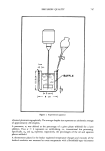
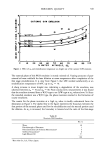
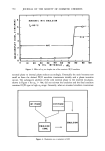
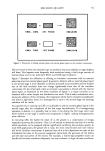
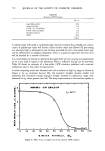
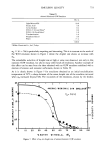
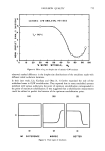
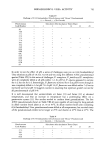
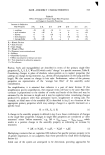
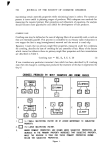
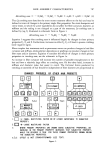
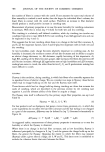
HAIR ASSEMBLY CHARACTERISTICS 789 As ambient conditions change and the humidity increases, the moisture content and AW increase and the fibers' ability to acquire an electric charge decreases, i.e., AE and flyaway decrease rapidly. The greater the fiber curvature, the greater the chance for fiber entanglements as the fibers separate due to electrical forces. Therefore the greater the fiber curvature, the less flyaway. Hair fiber curvature also plays a key role in the preflyaway condition, while the fibers are becoming charged. The greater the fiber curvature, the greater is the work of combing--one key factor which promotes the electric charge build-up on the fibers. Since the charging effect is opposite to that which exists at the charged state, it may "appear" as if hair fiber curvature enhances flyaway. Similarly, kinetic friction involved in combing or brushing of the fiber assembly influences the work of combing which in turn influences the amount of charge build-up and ultimately the extent of flyaway. BODY Body is defined in the textile trade as the compact, soft or firm feel of textile stock or fabric (2), a tactile property. In our beauty salon body is evaluated as apparent thickness or volume of the assembly, involving sight and touch for assessment. Both descriptions are consistent with the quality of liveliness or springiness (3) that is often associated with body. Our beauty salon generally evaluates body immediately after setting and drying, but evaluation over longer time periods is also relevant. An "increase in body" is not necessarily an improvement in hair behavior: hair with too much body may be unmanageable the stylist should be able to make the hair appear thick only where she wants it to appear thick. Also hair can have body and yet have poor style retention, e.g. the hair may not hold a style well, yet will appear thick in the relaxed Equation 8 states that six primary single fiber properties measured under the conditions for evaluation of body, describe this parameter for an assembly of hair. Body • f(Fs, Fk, S, C, D, W) (8) For those shampoos and creme rinses which do not generally affect the fiber curvature, body may be described by (eq 9). This equation appears in schematic form in Figure 2. &Body = + NIAF s -'}- N2AF k + N3AS + N4AD -- nlAW (9) An assumption inherent in this equation is that the hair styling is unchanged to the extent that fiber contacts are unchanged. In fact, for maximum body, fiber contact should be at a minimum. In effect, (eq 9) suggests that an increase in body will result by simply making the total hair assembly stiffer. This suggests that limpness is not enough body produced by making the entire fiber assembly less stiff, i.e., +ABody = --ALimpness. An increase in body according to (eq 9) is not time dependent and is consistent with our beauty salon evaluation. For treatments such as permanent waves, whose active ingredients affect the hair fiber curvature, increasing fiber curvature should increase body.

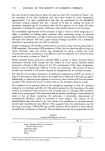
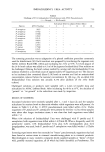
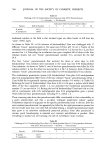
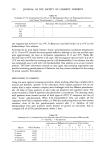
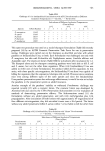
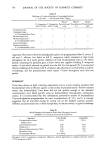
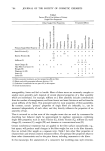
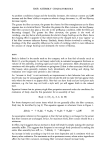
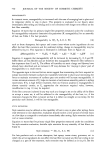
790 JOURNAL OF THE SOCIETY OF COSMETIC CHEMISTS MANAGEABILITY In cosmetic terms, manageability is concerned with the ease of arranging hair in place and its temporary ability to stay in place. This property is evaluated in our beauty salon immediately after setting and drying and is not concerned with longer term effects on the hair fiber assembly. Equation 10 states that six primary single fiber properties measured under the conditions for manageability evaluation determine this parameter (K manageability) for an assembly of hair, see Table I. For hair products Manageability • f(Fs, Fk, S, E, C, W) (10) such as those shampoos, hair sprays and creme rinses whose active ingredients do not affect the hair fiber curvature and for unaltered styling, change in manageability may be defined by (eq 11). This equation is illustrated in schematic form in Figure 2d. AManageability -- Nz/kF k + N2AFs -- n•AS -- N3/kE -- n2AW (11) Equation 11 suggests that manageability will be increased by decreasing Fk, E, S and W. Stiffer fibers are less flexible and are therefore less manageable. However fiber stiffness is less important than E and F k. The effects of humidity on static charge and flyaway have already been described and an increase in W may decrease the "staying in place" part of manageability to a small extent. The opposite signs in the two friction terms suggest that maximizing the force required to initiate movement between surfaces (to transiently hold style in place) and minimizing the force to maintain movement of surfaces past one another will increase manageability. A certain minimum amount of F k helps to maintain a harmonious assembly pattern in styling movements. If F k is high before treatment, then our friction analysis in manageability is almost certainly correct as F k approaches the minimum required value, however, modification to (eq 11) may be required. If the fiber curvature is altered in any way such as a change in set or the ability of the fibers to accept a water set, it will be reflected in the manageability of the hair, i.e., if the treatment changes the fiber curvature so that it is either too straight or too kinky, for the particular style desired, it will be less manageable. STYLE RETENTION Style retention may be defined as the capability of hair to stay in place after styling. Since style retention is time dependent, evaluation should involve a time period of several hours to a few days as compared to evaluation immediately after setting. Style retention includes curl or wave retention. Equation 12 states that five primary single fiber properties measured under the conditions for style retention evaluation, describe style retention for any assembly of hair fibers, see Table II. Style retention = f(Fs, Fk, S, C, W) (12) For hair products such as those shampoos, hair sprays, creme rinses, groomers, etc. in which the active ingredients do not affect the hair fiber curvature and the hair styling is not changed as a part of the treatment, style retention may be defined as in (eq 13). See the
Purchased for the exclusive use of nofirst nolast (unknown)
From: SCC Media Library & Resource Center (library.scconline.org)