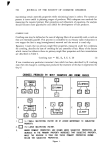
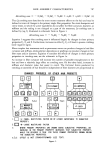
HAIR ASSEMBLY CHARACTERISTICS 791 schematic illustration of this equation in Figure 2e. Equation 13 suggests that style retention may be increased by increasing F s and Fk, with Fs being the more important factor. &Style retention = q- N•AF s -3- n•AF k -- n2AS -- n3AW (13) Increases in S and W can decrease style retention. The role of W is rather straightforward, while that of S is more subtle. Since style retention is time dependent as contrasted to the other assembly properties defined in this report, the natural changes that occur to hair fiber curvature--from immediately after water setting and styling until equilibrium is reached-- are of extreme importance. The fibers on a head are generally water set to produce a desired contour. Changes in humidity promote a deterioration of the water set and a change in the hair fiber curvature. Therefore hair fibers that have been water set, styled and exposed to ambient conditions do not have the same curvature stresses as after setting and styling. Frictional forces primarily tend to hold the assembly in the "set" style. Thus these natural curvature changes induced by water vapor absorption produce transient stresses within each fiber assembly. These stresses, which are dependent on the amount of curvature change and fiber stiffness, tend to decrease the style retention. In the hypothetical situation that assumes no changes in fiber curvature due to humidity, the maximum fiber curvature consistent with the desired hair styling will produce the maximum number of possible entanglements and therefore the maximum style reten- tion. For treatments such as permanent waves in which the active ingredients produce changes in the "relaxed" hair fiber curvature or for polymer depositions or graftings, which may also change the hygroscopicity of the hair, the rate and extent of change in hair fiber curvature in response to humidity is altered. METHODS FOR EVALUATING PHYSICAL PROPERTIES Both single fiber and fiber assembly methods are available for most of the properties described in this report. Single fiber methods have been described for friction (5), stiffness (6,7), static charge (8), and fiber diameter (3, 9, 10). Fiber curvature may be estimated from the fibers relaxed length and its taut length. Fiber assembly methods have been described for combing ease (11, 12), flyaway (13, 14, 15), body (3) and percentage of set retention (3). Manageability is the most complex of these assembly properties and a quantitative method for this property has not been described. CONCLUSIONS Changes in the behavior of hair assemblies can be usefully represented in algebraic form as combinations of changes in single fiber properties. Considering directional changes instead of absolute values leads to useful simplifications. A summary of how the assembly behaves as a function of changes in the single fiber properties follows. 1. Combing changes depend primarily on frictional effects (including cohesive forces), static charge and fiber curvature. For most products other than permanent waves and straighteners, changes in fiber curvature are negligible and for wet combing, static charge is not relevant.

792 JOURNAL OF THE SOCIETY OF COSMETIC CHEMISTS 2. For flyaway, static charge is the determining factor. 3. Body depends on static friction, fiber diameter, fiber stiffness and curvature, while limpness is too little body. For most products, except permanent waves and straighteners, changes in fiber curvature are not relevant and changes in fiber diameter and stiffness are negligible. 4. Manageability depends on frictional effects, static charge and fiber curvature. For most products except permanent waves and straighteners, fiber curvature is unchanged, leaving static friction, kinetic friction and static charge as the determining factors. Increasing static friction makes hair more manageable, while increasing kinetic friction makes it less manageable. 5. For style retention, static friction (including cohesive forces) and fiber curvature are the determining factors and for most products, except permanent waves and straighteners, static friction is the determining factor. Equations as depicted in this manuscript can provide guidance for developing and documenting different hair products. Improvement in single fiber methods should permit the equations to approach more quantitative forms. With Hough et al. (1), we recommend further discussions and definitions of important cosmetic terms. REFERENCES (1) P.S. Hough, J. E. Huey and W. S. Tolgyesi, Hair body, J. $oc. Cosmet. Chem., 27,571 (1976). (2) M. Harris, "Handbook of Textile Fibers," 1st Ed., Harris Research Laboratories, Inc. Washington, D.C. (1954). (3) "Modern Beauty Shop Magazine," December 1957. (4) N. E. Yin, R. H. Kissinger, W. S. Tolgyesi and E. M. Cottington, The effect of fiber diameter on the cosmetic aspects of hair, J. Soc. Cosmet. Chem., 28, 139 (1977). (5) A. Schwartz and D. Knowles, Frictional effects in human hair, J. Soc. Cosmet. Chem., 14, 455 (1%3). (6) G. Scott and C. Robbins, A convenient method for measuring fiber stiffness, Text. Res. J., 39, 975 (1%9). (7) G. Scott and C. Robbins, Stiffness of human hair fibers, J. Soc. Cosmet. Chem., in press. (8) S. Hersh, Static Electrification of Fibrous Materials, Ph.D. Thesis, Princeton University (April 1954). (9) N. Barnard and H. White, The swelling of hair and a viscose rayon monofil in aqueous solution, Text. Res. J., 24, 695 (1954). (10) D. Montgomery and W. Milloway, The vibrascopic method for determination of fiber cross-sectional area, Text. Res. J., 22, 729 (1952). (11) M. Garcia and J. Diary, Combability measurements on human hair, J. Soc. Cosmet. Chem., 27, 379 (1976). (12) W. Newman et al., A quantitative characterization of combing force, J. $oc. Cosmet. Chem., 24 773 (1973). (13) C. Mills et al., Measurement of static charge on hair, J. $oc. Cosmet. Chem., 7, 466 (1956). (14) R. Barber and A. Posner, A method for studying the static electricity produced by hair on combing,J. $oc. Cosmet. Chem., 10, 236 (1959). (15) A. Lunn and R. Euano, The electrostatic properties of human hair, J. $oc. Cosmet. Chem., 28, 549 (1977). (16) N. Gralen and B. Olofsson, Measurement of friction between single fibers, Text. Res. J., 17, 488 (1947).
Purchased for the exclusive use of nofirst nolast (unknown)
From: SCC Media Library & Resource Center (library.scconline.org)