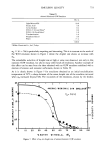
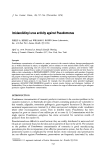
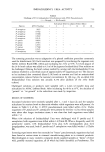
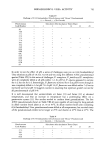
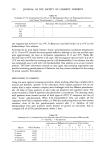
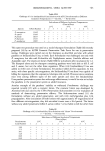
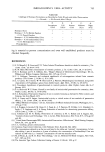
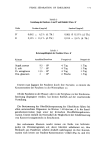
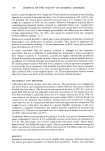
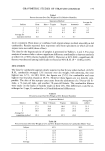
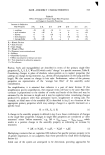
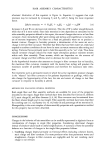
GRAVIMETRIC STUDIES OF STRATUM CORNEUM 779 Table I Percent Increase Over Dry Weight at 62% Relative Humidity Separation Method Subject Heat Heat + Trypsin Trypsin Ammonia Average for subject 1 5.4 5.4 4.8 4.95 2 4.6 2.3 4.2 6.9 3 8.1 10.0 8.1 8.3 Average for separation method 6.0 5.9 5.7 6.7 5.1 4.5 8.6 more consistent. Heat alone or combined with trypsin always worked smoothly as did cantharidin. Results reported here represent only those specimens in which all tech- niques were successful (three of five). The data for the hygroscopicity of samples is presented in Tables 1, 2 and 3. Two-way analysis of varience fails to show a significant difference attributable to harvest methods at either 62 or 90% relative humidity (R.H.). However at 62% R.H. a significant dif- ference was detected among individuals not found at 90% R.H. (F = 10.06 p 0.05). DISCUSSION The data for cantharidin appears clearly superior to that for any other method. At 62% R.H., cantharidin averaged 12% increase over dry weight with ammonia, the next highest was 6.7%. At 90% R.H., the figures are 35.5% for cantharidin and next highest was heat plus trypsin at 28.5%. However these figures are not directly com- parable. The skin of the autopsy cases came from the abdomens of a 70-year-old fe- male, a 72-year-old male, and another 70-year-old female. The cantharidin blisters were made on the backs of healthy males in their 20's. The differences could be at- tributged to 1) age, 2) cantharidin or 3) back/abdominal differences. Table II Percent Increase Over Dry Weight at 90% Relative Humidity Separation Method Average for Subject Heat Heat + Trypsin Trypsin Ammonia subject 1 17.5 21.9 18.0 27.3 2 21.9 28.5 26.0 25.2 3 18.0 35.0 23.6 20.4 Average for separation method 19.1 28.5 22.5 24.3 21.2 25.4 24.2 Table III Percent Increase Over Dry Weight at 62% and 90% Relative Humidity by Cantharidin Blister Tops Subject 62 % 90% 1 12.8 36.3 2 10.9 41.3 3 11.5 36.2 4 12.1 31.3 5 12.5 32.6 Ave rage 12.0 35.5

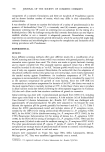
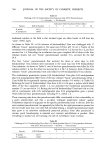
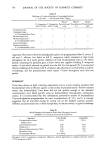
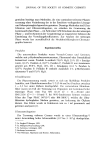
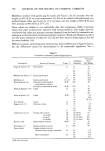
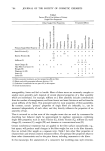
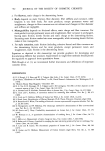
780 JOURNAL OF THE SOCIETY OF COSMETIC CHEMISTS Middleton worked with guinea pig foot pads and found a 28.2% increase over dry weight at 90% R.H. at room temperature (4). Fox et al. worked with pulverized, un- washed human callus and found an 11% increase over dry weight at 60% R.H. and 34% increase at 90% R.H. at 23øC (15). These values are similar to our cantharidin data. For comparison, Table 4 presents values that other workers have reported with various methods. One might draw the conclusion that callus and stratum corneum obtained from the back by cantharidin are analogous in their physical chemical properties however, Blank and Shappirio pointed out that water extraction of callus for 2 hr did not alter water holding capacity, but did decrease flexibility (16). Different stratum corneum harvest methods may lead to differences in hygroscopicity, but the differences cannot be demonstrated to be statistically significant. Yet, a Table IV Comparison of Stratum Corneum Hygroscopicity % Increase % Relative Over Investigator Source of Corneum Temp. øC Humidity Dry Weight Singer & Vinson (10) Neonatal rat Middleton & Allen (17) Guinea pig footpad Middleton (4) Flesch & Esoda (18) Blank & Shappirio (16) Guinea pig footpad Pulverized, ether defatted, nonhydrolysed callus & Psoriasis & erythroderma scales Callus Laden & Spitzer (19) Callus Fox, Tassoff, Rieger et al. (15) Callus Pulverized callus Anderson et al. (14) Buetmer (20) Scheuplein (11) Present study Human calf (control) (occluded) (control) (occluded) Tape stripped corneum Human stratum corneum Human stratum corneum Abdomen (heat, trypsin, ammonia) Back (cantharidin) 25 57 11 71 16 81 23 93 6O 4 86 26.1 22 81 20.6 21-24 9O 38.2 N.R. a 100 28 N.R. a 100 19 23 71 20 88 38 97 60 N.R. • 37 9.2 70 16.8 95 78-123 23 45 5 23 45 6.9 57 11.2 90 34.0 37 40 4.1 30 95 (24 hr) 65 30 95 (24 hr) 61 30 95 (14 days) 309 30 95(14 days) 384 N.R. • 76 30 95 110 25 100 50 20 62 6.1 90 23.6 20 62 12.0 90 35.5 • N.R.-Not recorded.
Purchased for the exclusive use of nofirst nolast (unknown)
From: SCC Media Library & Resource Center (library.scconline.org)