j. Soc. Cosmet. Chem., 29, 783-792 (December 1978) Prediction of hair assembly characteristics from single fiber properties C. R. ROBBINS and G. V. SCOTT Colgate-Palmolive Research Center, 909 River Road, Piscataway, NJ 08854. Received March 17, 1978. Synopsis An hypothesis is developed with relationships that PREDICT how changes in the behavior of HAIR ASSEMBLIES (tresses or heads) depend on changes in SINGLE FIBER PROPERTIES that are measurable, i.e., how changes in combing ease, flyaway, body, managability and style retention of hair assemblies relate to changes in fiber friction, stiffness, static charge, curvature, weight and diameter. From these relationships desired changes in assembly characteristics may be approached through changes in the fiber properties. INTRODUCTION A recent stimulating publication by Hough, Huey and Tolgyesi (1) reminded us of an internal report that we had written several years ago defining an approach for predicting characteristics of hair assemblies (tresses or hair on heads), using single fiber properties. Although the paper by Hough et al. is concerned only with hair body, our general approaches, essential definitions and conclusions are consistent. When these authors suggested "further discussions by individuals from different areas of the fiber and cosmetic fields," we decided to respond by putting our report into a publishable format. Types of testing used to evaluate the hair effects of cosmetic products are: measurement of physical properties of single fibers evaluation of fiber assemblies on tresses or on heads and perceptions of how products perform in blind, identified and sales testing. This manuscript is concerned only with the first two types of assessments, i.e., with relating measurable changes in single-fiber properties to the evaluation of changes in characteris- tics of fiber assemblies, where psychological perceptions from advertising, labelling and product properties such as fragrance, lather feel, viscosities, etc., are eliminated. DISCUSSION The consumer's vocabulary for describing the behavior of hair includes a number of assessment terms, such as combing ease, style retention, flyaway, body, raspiness, 783

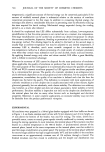
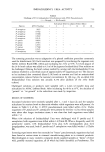
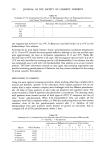
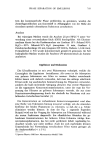
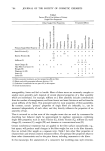
784 JOURNAL OF THE SOCIETY OF COSMETIC CHEMISTS Table I Factors Which Can Influence Primary Single Fiber Properties Other Single Fiber Properties Treatment Effects Primary Single Fiber Property Static Friction (Fs) x Kinetic Friction (Fu) x Stiffness (S) x Static Charge (E) x x Hair Fiber Curvature (C) Weight (W) x Diameter (4) (D) x Luster (I) Color (H) x x x (2) x (2) x x x x x x x x x x (3) X X X X X X X X X X X (t) (t) (t) X X X X X X X X X X X X X X X X X X X X X X X X X X (I) Only excessive treatment, and wet properties affected first. (2) Elastic and yield properties influence friction. (16) (3) Cohesion is considered as one part of F• in this report. (4) Cross-sectional areas. manageability, luster and feel or handle. Most of these terms are extremely complex to analyze since generally each depends of several physical properties of a fiber assembly which are interrelated. For example, stiffness on a fiber assembly includes contributions from the number of entanglements, and from kinetic and static friction as well as from the actual stiffness of the fibers. This principle holds for most properties of fiber assemblies. By contrast, certain "primary" properties of single fibers are isolatable, i.e., can be measured independently of each other, and they directly influence the properties of an assembly of hair. Thus it occurred to us that most of the complex terms that are used by consumers for describing hair behavior might be approximated by algebraic expressions combining single fiber properties, such as: static friction (Fs) , kinetic friction (Fk) , stiffness (S), static charge (E), curvature (C), weight (W) and diameter or cross-sectional area (D). Certain nonchemical treatments that are applied to the fiber surface nonuniformly, e.g., hair sprays, will produce small changes in the fiber weight but not in the fiber diameter, thus we include fiber weight as a separate term. Table I lists other fiber properties or characteristics and several cosmetic treatment effects. The primary fiber properties relate to these other characteristics and to the prior history including treatments to the fibers. In this manuscript, five assessments of a consumer's hair (combing ease, style retention,
Purchased for the exclusive use of nofirst nolast (unknown)
From: SCC Media Library & Resource Center (library.scconline.org)