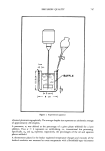
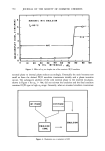
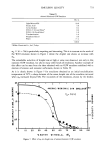
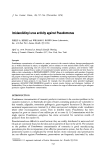
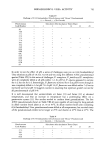
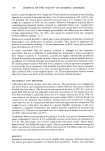
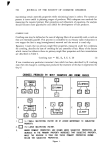
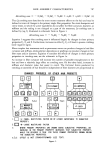
EMULSION QUALITY 747 FFLE Figure 1. Experimental apparatus obtained photomicrographically. The average droplet size represents an arithmetic average of approximately 200 droplets. A parameter, o•, was defined as the percentage of a given phase withheld for a later addition. Thus o• = 0 represents no withholding, i.e., conventional hot processing. Specifically, o• o and oq_ I represent, respectively, the percentages of the oil and aqueous phases withheld. A thermometer placed in the beaker registered temperature changes and viscosity of the finished emulsion was measured at room temperature with a Brookfield-type viscometer

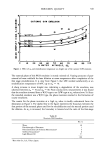
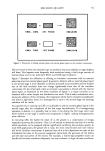
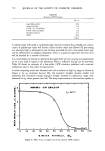
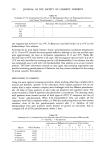
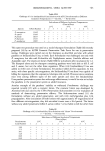
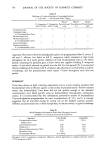
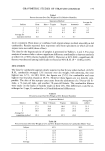
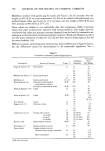
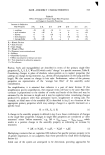
748 JOURNAL OF THE SOCIETY OF COSMETIC CHEMISTS (Type B Viscometer, Model BL, by Tokyo Keiki Seizosho, Tokyo, Japan) at 30 rpm using spindle No. 3. Viscosity measurements were taken after a l-rain rotation. All emulsifica- tion operations were done carefully to assure good reproducibility. All surfactants, oils and waxes used in the formulations were cosmetic grade materials without further purification, and &ionized water was used in all experiments. RESULTS AND DISCUSSIONS Although a great number of formulations representing a wide range of cosmetic emulsions and nonemulsions were tested by LEE in this series of investigations, because of the space limitation only the results from several representative formulations will be shown. These formulations are simplified prototype cosmetic emulsions including a cationic O/W emulsion, a nonionic W/O emulsion, a nonionic O/W emulsion and an anionic/nonionic O/W emulsion. The cationic O/W emulsion shown in Table I represents a prototype cationic hair rinse emulsion stabilized with a popular quaternary surfactant, stearyl dimethyl benzyl ammonium chloride. The results obtained with this cationic O/W emulsion are shown in Figure 2 where the arithmetic mean droplet diameters are plotted against c•H, the percentages of water withheld for second-stage dilution. The initial temperatures of first-stage emulsification, Te, are also indicated in the figure. It is clear from Figure 2 that the emulsion becomes coarser as the emulsification temperature, Te, is lowered. The mean droplet size also increases somewhat as c•H is increased beyond 50%. Below 50% c•H, the variation in the mean droplet sizes was within the experimental error. The result is not surprising since it is expected that as emulsification temperature is lowered, emulsification becomes less efficient due to a viscosity build-up. However, for this system, no significant increase in the mean emulsion droplet size is observed until c•H is well over 50%. This means that as much as 50% of the external phase (water) of this emulsion could be withheld for a later addition at room temperature to save a considerable amount of thermal energy without adversely affecting the emulsion quality. In general, it is easier to carry out LEE on O/W emulsions containing low solids such as a moisturizer with 70% or more external, aqueous phase. However the applicability of LEE is by no means restricted to O/W emulsions. It also works satisfactorily for W/O emulsions containing a large amount of mineral oil. An example of such a W/O emulsion is given in Table II. Table I Cationic O/W Emulsion Wt. % Stearyl Dimethyl Benzyl Ammonium Chloride (21% activep Light Mineral Oil Stearyl Alcohol Water 4.0 4.0 1.6 90.4 100.0 a Rohm & Haas Co., Philadelphia, Pennsylvania.
Purchased for the exclusive use of nofirst nolast (unknown)
From: SCC Media Library & Resource Center (library.scconline.org)