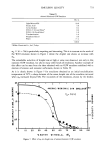
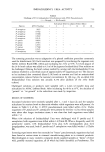
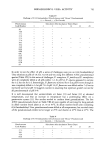
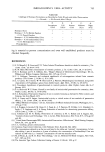
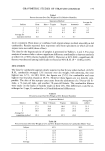
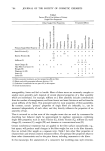
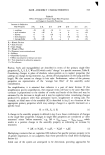
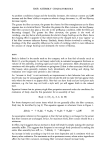
HAIR ASSEMBLY CHARACTERISTICS 785 Table II Effect of Changes in Primary Single Fiber Properties on Changes in Assembly Properties Increase in Subjective Hair Property A Fu AFs AE AW AD AS AC + combing -N + style retention + n + flyaway 0 ñ body limpness + n + manageability - N -N -N 0 +n +n -N +N 0 -n 0 -n ñN -n +N -n 0 -n -n +N 0 -n +N +N +N +N -N -n 0 -n ñN F• = Kinetic Friction Fs = Static Friction E = Static Charge W = Weight of Fiber D = Diameter (cross-sectional area) S -- Stiffness C = Hair Fiber Curvature ñ = Effect may improve or detract (see text) N = Very important to subjective property 0 = No influence flyaway, body and manageability) are described in terms of the primary single fiber properties (Fk, Fs, S, E, C, W and D) which could "change" in a specific treatment, Table II. Considering changes in place of abso!ute values permits us to neglect properties that undergo no change during treatment, e.g., density of hair population on the scalp and fiber length. We also assume no change in hair style. Furthermore, values of the primary properties are representative of the "average hair fiber" of the assembly under consideration. For simplification, it is assumed that cohesion is a part of static friction. If this simplification proves unsatisfactory, then separate terms will have to be used. Hair fiber curvature is proportional to the number of crooks and bends of the fiber and may be estimated by the decrease in length and it may be neglected when considering changes produced by products other than permanent waves, straighteners or setting aids. For example, an initial state of the assembly (K) is described in (eq 1) as a function Of the appropriate primary properties which may undergo change in a specific treatment on a specific head. f(L, Fk, S, E) (1) A change in the assembly propertylis defined in (eq 2) as a linear combination of changes in the single fiber properties. Changes in single fiber properties are considered as "after treatment" minus "before treatment," e.g., AS ----- S^fter Treatment -- S•fo•e Treatment, which results in a positive change in the assembly property as indicating an increase by treatment. + AK -, N•AF u + n•AF, -- N2AS -- n2AE (2) Multiplying constants that are capitalized (N) indicate that specific primary property to be of greater importance, in our judgment, than those preceded by small letter multiplying factors (n). Initial uses of the system are anticipated to be directional, providing approaches for

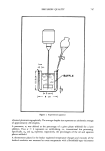
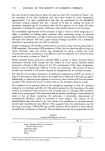
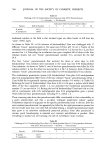
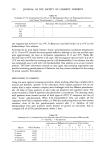
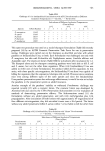
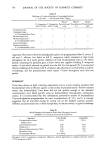
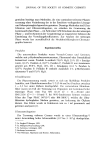
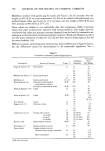
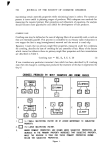
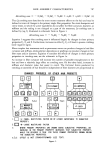
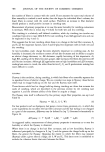
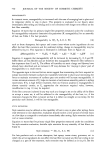
786 JOURNAL OF THE SOCIETY OF COSMETIC CHEMISTS maximizing certain assembly properties while minimizing losses in others. The system at present is more useful in planning stages of products. With adequate test methods for measuring the required primary fiber properties and refinement of equations, the analysis should become more quantitative and useful for development of hair products. COMBING EASE Combing ease may be defined as the ease of aligning fibers of an assembly with a comb so they are essentially parallel. This process is considered in our beauty salon evaluations in two stages: the first is snag (entanglement) removal and the second is comb slip. Equation 3 states that six primary single fiber properties, measured under the conditions for combing, describe the ease of combing for any assembly of hair. Many of the factors which control or influence these six primary single fiber properties and their interrelations are described in Table I. Combing ease = f(F,, Fk, S, E, C, D) (3) If one considers any particular consumer's hair which has been described by K combing ease, then the change in combing ease produced by treatment of this hair is represented by (eq 4.) CHANGES PRODUCED BY MOST SHAMPOOS AND CREME RINSES Q. Ii• MANAGE'I BILIT•_• I/\LIMPNESI I. f'• =n = SMALL MULTIPLYING FACTOR OR OF LESSER IMPORTANCE TO SUBJECTIV PROPERTY. 2. • =N = LARGE MULTIPLYING FACTOR. 3. WHERE PRIMARY PROPERTIES ARE DRAWN ABOVE SUBJECTIVE PROPERTIES, AN INCREASE IN THE PRIMARY PROPERTY INCREASES THAT SUBJECTIVE PROPERTY, WHILE THE REVERSE IS TRUE FOR THOSE PRIMARY PROPERTIES DRAWN BELOW THE SUBJECTIVE PROPERTIES. Figure 1.
Purchased for the exclusive use of nofirst nolast (unknown)
From: SCC Media Library & Resource Center (library.scconline.org)