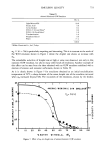
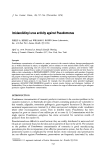
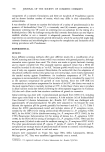
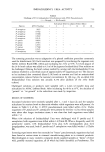
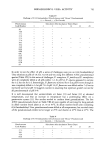
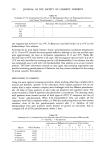
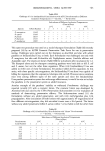
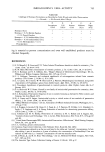
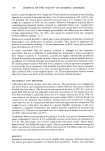
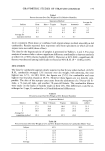
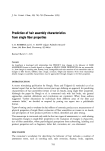
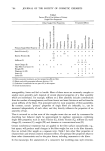
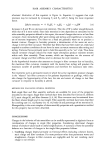
IMIDAZOLIDINYL UREA ACTIVITY 759 Table I Challenge of 0.3 % Imidazolidinyl Urea Solutions with ATCC Pseudomonads (+ = Growth, - = No Growth) Subculture After Incubation Times (Days) Species ATCC Number 1 2 3 7 14 21 28 P. aeruginosa 9027 - - - P. aeruginosa 15442 - - - P. aeruginosa ! 3388 - - - P. aeruginosa 14502 - - - P. aeruginosa 10145 - - - P. cepacia 10856 - - - P. cepacia 25416 - - - P. putida 12633 + + + P. stutzeri 17588 - - - P. fluorescens 13525 - - - P. aureofaciens 13985 + + + The screening procedure was an adaptation of a phenol coefficient procedure commonly used for disinfectants (10). Each inoculum was prepared by inoculating the organism into AOAC Letheen Broth (BBL 10914) and incubating for 24 hr at 35øC. A 0.5-ml aliquot of the 24-hr broth culture was added to 4.5 ml of the aqueous Imidazolidinyl Urea solution to be challenged. Diluting the broth culture tenfold by mixing with the Imidazolidinyl Urea solution resulted in a microbial count of approximately 106 organisms per mi. The mixture to be incubated also contained dilute (1:10) broth as nutrient and had an antimicrobial concentration reduced below the nominal concentration by 10% (e.g., the so-called 0.3% Imidazolidinyl Urea solution was actually 0.27% after addition of the 24-hr broth culture). Challenged solutions or products were sampled with a 4-mm id transfer loop and subcultured in AOAC Letheen Broth. After incubating for 48 hr at 35øC, the decision of "growth" vs. "no growth" in the subculture was made by inspection. RESULTS OF SCREENING Inoculated solutions were routinely sampled after 1, 2 and 3 days (d), and the samples subcultured in nutrient broth to determine whether viable organisms were still present. As shown in Table I, 9 of the 11 ATCC pseudomonads were killed within 24 hr. Viable organisms of P. putida and P. aureofaciens were present for the first 3 d, but when samples were taken after longer incubation times, it was clear that both organisms were killed within 7 d. When 0.5% solutions of Imidazolidinyl Urea were challenged with P. putida and P. aureofaciens, both organisms were killed within 2 d (Table II). When a frequently used (20) preservative system, 0.3% Imidazolidinyl Urea plus 0.2% methylparaben plus 0.1% propylparaben, was used, both P. putida and P. aureofaciens were killed within 1 d (Table iii). Screening experiments were then extended to "house" pseudomonads, organisms that had been found at various times in cosmetic manufacturing plants or in cosmetic products. Microbiologists in many cosmetic companies kindly supplied samples or "slants" of these wild, possibly mutated organisms, all of which had been identified as Pseudomonas. The

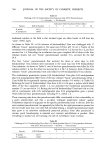
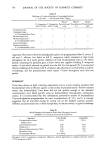
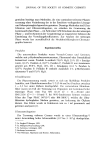
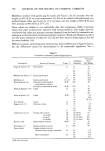
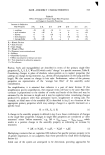
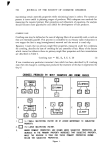
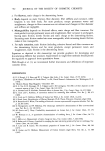
760 JOURNAL OF THE SOCIETY OF COSMETIC CHEMISTS Table II Challenge of 0.5 % Imidazolidinyl Urea Solutions with ATCC Pseudomonads (+ = Growth, - = No Growth) Subculture After Incubation Times iDays) Species ATCC Number 1 2 3 7 14 21 28 P. putida 12633 + - - P. aureofaciens 13985 + - - traditional wisdom in the field is that mutated types are often harder to kill than the "tame" ATCC types. As shown in Table IV, a 0.3% solution of Imidazolidinyl Urea was challenged with 17 different "house" pseudomonads in the usual way (106/ml, pH 7.0, etc.). Twelve of the seventeen were completely killed within 1 d, one survived for 1 d, but not for 2 d, and four survived for 3 d. Extending the incubation time gave complete kill of three of the four resistant strains, but one "house" pseudomonad, number 37-3, survived for the full 28 d. The four "house" pseudomonads that survived for three or more days in 0.3% Imidazolidinyl Urea solution were inoculated in the usual way into 0.5% Imidazolidinyl Urea solutions. As shown in Table V, two of the four pseudomonads were killed by 0.5% solution within 1 d, but the other two survived for 3 d. By 7 d, however, both of these two resistant "house" pseudomonad were also killed by 0.5% Imidazolidinyl Urea solution. The combination preservative system 0.3% Imidazolidinyl Urea plus 0.2% methylparaben plus 0.1% propylparaben killed three of the four resistant "house" pseudomonads within ! d and killed the exceptionally resistant pseudomonad number 37-3 within 2 d (Table VI). Reducing the level of Imidazolidinyl Urea from 0.3% to 0.2% gave a system which killed three of the four organisms within 1 d, but permitted the exceptional pseudomonad number 37-3 to survive for 3 d. Raising the level of Imidazolidinyl Urea from 0.3% to 0.5%, still in combination with 0.2% methylparaben plus 0.1% propylparaben, gave a system which killed all four pseudomonads, including 37-3, within 1 d. These screening tests show that pseudomonads differ considerably in their vulnerability to a given antimicrobial, and that a so-called "adequate preservative system" against Pseudomonas depends in large part on the specific pseudomonad used in the test. Even the most resistant pseudomonad can apparently be killed by the right preservative system but the test results warn that, even after full microbial testing, a mutated pseudomonad might later grow in an otherwise satisfactorily preserved product. Even after production is routine, good housekeeping is essential and constant watchfulness is prudent. After everything is worked out and running, the job of surveillance must continue. Table III Challenge of 0.3 % Imidazolidinyl Urea Plus 0.2 % Methylparaben Plus 0. ! % Propylparaben Solutions with ATCC Pseudomonads(+ = Growth, - = No Growth) Subculture After Incubation Times (Days) Species ATCC Number 1 2 3 7 14 21 28 P. putida 12633 - - - P. aureofaciens !3985 - - -
Purchased for the exclusive use of nofirst nolast (unknown)
From: SCC Media Library & Resource Center (library.scconline.org)