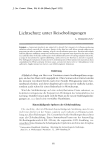
90 JOURNAL OF THE SOCIETY OF COSMETIC CHEMISTS Literatur {1} |tmg, E.G., die chronischen Lichtschiiden der Haut, •rztl. Kosmetolo. gie 7, 97-101 {1977}. {2} Schulze, R., Strahlenklima der Erde, Wissenschaftliche Forschungsberichte Bd. 72, D. Steinkopff Verlag Darmstadt 1970. {3) Ippen, H., Hoppe, U., Wiskemann, A., und Tronnier, H., Biologische Bewertung von Sonnenschutzmitteln, •rtzliche Kosmetologie 7, 102-106 {1977}. {4} Tronnier, H., Feldversuche zur Bestimmung der Lichtschutzwirkung, •rztliche Kosme- tologie 8, 138- 143 (1978}. {5} L'finger in der Sonne, test {Zeitschrift der Stiftung Warentest}, 13, Heft 7, S. 26-32 {1978). {6} Charlet, E., und Finkel, P., Hauttypen - Wirksamkeit von Lichtschutzmitteln, )•rztl. Kosmetologie 8, 160- 163 {1978).

j. Soc. Cosmet. Chem., 30, 91-104 (March/April 1979) Psychophysical measurement as a tool for perfumery and the cosmetic industry HOWARD R. MOSKOWITZ and JOHN CHANDLER MPi Sensory Testing, Inc., New York, NY 10021,' RICHARD MOLDAWER and ROBERT LATERRA Chesebrough Pond's, Inc., Greenwich, Conn. Received December 7, 1977. Synopsis This paper illustrates the scaling methods of modern psychophysics, which is the branch of psychology concerned with relating private, subjective sensory perceptions to physical measurements of stimuli. Experimental evidence from two studies of odor perception illustrates some of the possible uses of PSYCHOPHYSICAL MEASUREMENT as a QUANTIFICATION TOOL for COSMETIC CHEMISTS. The results of psychophysical measurement allow the product development chemist to better understand (a) how individuals perceive stimuli and (b) the perceptual effects which may result when odors are blended together. INTRODUCTION For several decades a gap has existed between the development of fragrances and cosmetics by R&R bench scientists and the subsequent sensory evaluation of these products by consumers or other panels. As the process is currently constituted, sensory evaluation proceeds along a path of typical steps as follows: initially, the bench or development chemist may test the product informally to determine whether the product being developed fulfills specific screening requirements and whether the prototype is worthy of being further developed and modified. If the prototype passes the initial bench screen, then the chemist or developer may submit it to informal test among colleagues. Finally, if the product so warrants, it may be tested with a small, informally recruited "church panel" or "research guidance panel" comprising volun- teers. These volunteers test one or a few modifications of the product. If the product successfully passes this test, and if other development plans have proceeded appropriately, then a larger scale investment is made in the market research testing, with much larger sized groups (e.g., 100-+-). Rarely, if ever, in this development scheme, are the methods and data banks of psychophysics used properly or to the best advantage. Psychophysics is the branch of psychology whose aim is to relate private sensory experience to physically measured 91
Purchased for the exclusive use of nofirst nolast (unknown)
From: SCC Media Library & Resource Center (library.scconline.org)