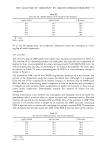
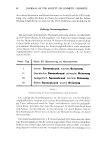
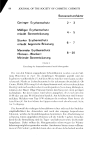
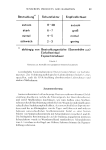
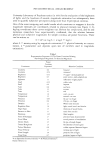
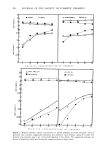
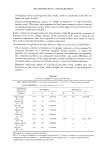
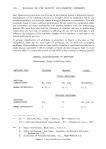
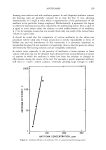
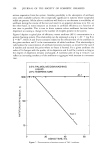
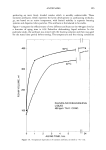
94 JOURNAL OF THE SOCIETY OF COSMETIC CHEMISTS The values for n range from very low ones (around 0.2-0.3 for some odorants in a liquid diluent) to very high ones (more than 2.0 for the perceived shock produced by electric current). Table I presents a summary of some of the power function exponents (2). USING FUNCTIONAL RELATIONS Psychophysical equations, such as the power function obtained by direct magnitude estimation, provide the cosmetic chemist with a powerful tool for correlating known physical modifications in a product with subjective responses to those changes. For example if the experimenter has systematically varied the concentration of a fragrance in a base (e.g., aerosol base), he can develop a curve relating the concentration of the fragrance versus the perceived odor intensity (or even versus the perceived strength of one or another specific note in the fragrance, as well as liking/disliking of the fragrance). Furthermore, if the experimenter allows the panelist to apply a fragrance to her arm or to her face, and then has the panelist evaluate the fragrance intensity over a period of several hours, he can trace out, quantitatively, the loss of fragrance intensity with increasing time on the skin. The curves can be used to indicate the following: the expected sensory shift (in percentage or ratio value) for a given percentage increase (or decrease) in the concentration of fragrance oil and the expected percentage sensory shift in fragrance intensity for a given percentage increase in the time that the fragrance remains on the skin. Table II Some Power Function Exponents Odorant Exponent Diluent 1. Amyl Acetate 0.13 Liquid 2. Anethole 0.16 Liquid 3. 1-Butanol 0.31 Liquid 4. 1-Butanol 0.64 Air 5. 1-Butanol 0.66 Air 6. Butyl Acetate 0.58 Air 7. Butyric Acid 0.22 Liquid 8. Coumarin 0.33 Air 9. Citral 0.17 Liquid 10. Ethyl Acetate 0.21 Liquid 11. Eugenol 0.27 Liquid 12. Eugenol 0.64 Air 13. Geraniol 0.20 Air 14. Guaiacol 0.20 Liquid 15. 1-Heptanol 0.16 Liquid 16. 1-Hexanol 0.15 Air 17. D Menthol 0.24 Liquid 18. Methyl Salicylate 0.20 Liquid 19. 1-Octanol 0.24 Liquid 20. 1-Pentanol 0.21 Liquid 21. Phenylethyl Alcohol 0.19 Liquid 22. Phenyl Acetic Acid 0.12 Liquid 23. 1-Propanol 0.52 Air 24. Iso-valeric Acid 0.21 Liquid Source: Berglund, Berglund, Ekman & Engen (3) and Moskowitz (4).

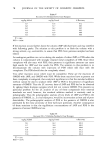
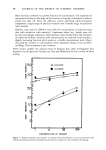
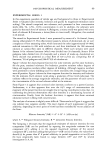
PSYCHOPHYSICAL MEASUREMENT 95 Furthermore, because functional relations or equations are often developed, the experimenter can employ these functions to obtain the following parametric data on performance: the same fragrance with different fixative levels the same fixative with different concentrations of fragrance oils, and the same fragrance in bases of different composition. Table II provides a number of representative power functions governing odor intensity for different odorants, which experimenters have investigated and published (3, 4). These odorants represent simple, pure chemicals. However, recent studies by Mosko- witz (4, 5) suggest that dose-response functions (or psychophysical relations) for complex food odors (comprising commercial flavors of complex constitution) can also be described by similar power functions. EXPERIMENTAL RESULTS To illustrate the application of psychophysical methods, the results of two studies on fragrance and odor perception are discussed below. They represent only one direction in the thrust to develop better methods for describing and modeling how people respond to external, well defined stimuli (the same approach is useful for sensations as well). The experiments investigated the following: 1) intensity and hedonic scaling of a number of pure chemicals and mixtures and 2) intensity and quality scaling for a set of two component mixtures in which the stimuli were presented at different concentra- tions. EXPERIMENTAL SERIES 1 In this experiment, panelists (women, ages 18-39, from Massachusetts) evaluated varying concentrations of single odorants for intensity and liking/disliking. The stimuli were reagent grade chemicals, procured from commercial flavor/fragrance houses. The stimuli were diluted to yield five levels (100%--undiluted, 25%, 6.25%, 1.56% and 0.39%). This covered a physical concentration range of 256/1 in liquid. The diluent in all cases was diethyl phthalate, an almost odorless solvent commonly used in psychophysical experiments on odor perception. The stimuli were presented in sets of 30. Each set comprised six odorants of diverse qualities. The stimuli were presented in random order of concentration and quality and were tested by a double-blind procedure. Neither the panelists nor the experimenter knew which stimuli corresponded to which material, and at what concentration. Furthermore, the stimuli were presented in small scintillation bottles (wide-mouthed), in which the solution of odorant in diethyl phthalate partially covered a cotton ball. Liquid and cotton provided a relatively large surface area from which the odorant could evaporate. The panelist uncapped the scintillation bottle, waited about 5 sec, and then held it close (approximately 1.5-3 inches) to her nose and sniffed quickly. Then the respondent evaluated the following attributes: Overall estimate of odor intensity by magnitude estimation in which ratios of ratings reflect ratios of odor intensity. Magnitude estimation allows panelists to use their own frame of reference allows ratios of numbers to be meaningful and
Purchased for the exclusive use of nofirst nolast (unknown)
From: SCC Media Library & Resource Center (library.scconline.org)