106 JOURNAL OF THE SOCIETY OF COSMETIC CHEMISTS their rapid destruction. Such needs can be visualized for a wide spectrum of systems ranging from waste water treatment, industrial fermentation, textile or paper process- ing, pharmaceutical manufacture, and various filling operations, to domestic machine dishwashing, laundering and cooking. In general, foam control is achieved either by destroying the existing foam, i.e., defoaming, or by preventing the formation of the foam. This is generally accomplished through mechanical, thermal or chemical means. Of these three techniques, chemical means are by far the most efficient for reasons which will be presented in some detail, and are the most widely used. Accordingly, the present paper will deal exclusively with foam prevention or destruction as achieved by chemical means. We define an antifoam as a chemical compound or mixture of chemical compounds which, when added in small amounts to a foaming system, either reduces or destroys its foaming tendency and so achieves a degree of foam control. Antifoams are, typically, highly surface active compounds having low solubility in the foaming solutions. A large number of fluids have been used in formulating antifoams, and they include naturally occurring oils and fatty materials, petroleum products and silicone oils. Traditionally, fatty acids and alcohols, and oils and fats have been used as foam inhibitors. These antifoams are able to perform very well for specific systems under particular conditions. Their main limitation is their large variation in performance with slight changes in the physical and chemical conditions prevailing in the foaming system. For example, lard oil and similar products can perform excellently as long as the operating temperatures are close to their melting point. However variation in the operating temperature can have a serious effect on their activity.' On the other hand, antifoams based on silicone oil are effective in a large number of systems under a broad range of operating conditions. Their versatility is, in fact, the major reason for their wide acceptance in the field. Accordingly, they will receive chief emphasis in this review. THEORETICAL TREATMENT OF FOAMING AND ANTIFOAMING In describing the essentials of this type of foam control, we will put appropriate emphasis on the fundamentals of foaming also. It is important to point out 1) that the fundamentals of both foaming (1-7) and antifoaming (8-20) are incompletely under- stood and 2) that the two phenomena have largely been treated independently with little attempt to understand the one in relation to the other. Our attempt is to treat foaming and antifoaming together so as to obtain an improved understanding of the total phenomenon. FOAMING A freshly formed foam passes through several different states before rupture and eventual collpase. During its lifetime, the bubble size and size distribution contin- uously change. The shape of the bubbles correspondingly changes from spherical to pentagonal-dodecahedral in the fully drained state. During drainage, the thickness of the lamellae and the foam density decrease in a rather complex manner. In addition to the force of gravity, films will thin in consequence of the well known capillary suction

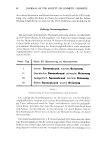
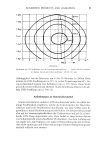
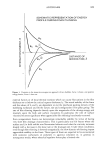
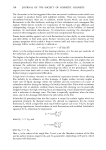
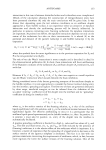
ANTIFOAMS 107 force which results from the pressure drop across the curved interface of the bubbles. For lamellae separating bubbles of radius R, the pressure drop, Ap, is given by the LaPlace equation, Ap = 2'y/R, and this results in suction of the liquid into the Plateau borders of the foam. Thinning will continue until the bubbles rupture, or until an "equilibrium" film thickness is reached when the suction force is balanced by the film's "disjoining pressure" (2) which is made up of the residual forces in the film. We will now consider these in terms of energy, distance (thickness) profiles, writing them in summation as ETotal = Ev + Es + EE where E v is the contribution from van der Waals' interaction E s is the entropic or steric stabilization energy and E E is the electrical or coulombic interactional energy between the neighboring bubbles. While E v is generally attractive and promotes film thinning, E s and E E generally oppose and •eta•d el&ming. Actual estimatio,• of these energies can b•mad•inffre following way: Van der lVaals' Energy Ev is the van der Waals' energy of interaction between two foam bubbles which, in a conventional foam, are surrounded by a layer of adsorbed surfactant molecules. An estimate of this interaction energy can be made using Vold's (21) treatment, according to which Ev = --542 ((As •/2-- AM•/2)2Hs -3- AsHy d- 2Asl/•(AM 1/2-- As•/•)Hvs) In the above equation As and AM are the Hamaker constants of the foam stabilizing surfactant and the surrounding liquid medium, respectively. Hs, H? and Hvs are geometric functions, H(x,y), which are related to the distance of separation and the radius of the bubbles involved such that H(x,y) = y/(x•d-xyd-x) + y/(x2+xy+y+x) + 2In ((x•d-xyd-x)/x2-+-xyd-x-+-y) where x is the ratio of the minimum distance of separation between the bubbles and the diameter of the smaller bubble y is the ratio of bubble diameters, R1/R2, chosen for generality to be unequal so that y • 1, i.e., R 1 • R 2. Individual values of the H parameters are given by H s = H(A/2(R2 q- 15), (R, q- 15)/(R 2 -•- 15)) Hv = H((A d- 215)/2R2, R1/R2) nvs = H((A -f 15)/R2, (R• -f 15)/R2) where 15 and A are the thickness of the surfactant film adsorbed on the bubble surface and the thickness of the solution between the bubbles, respectively. From the above equations it is evident that the van der Waals' interactions will always be attractive as long as AM • As. However, under conditions where AM As, one can observe repulsive van der Waals' interactions. Thus the actual nature and magnitude of the van der Waals' interactions will be dependent not only on the 15 and A values, but also on the relative values of AM and A s.
Purchased for the exclusive use of nofirst nolast (unknown)
From: SCC Media Library & Resource Center (library.scconline.org)