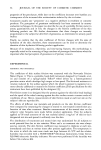
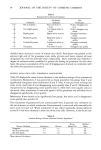
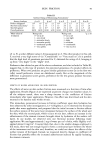
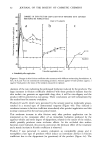
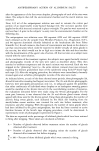
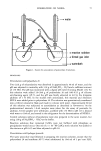
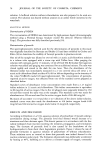
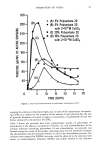
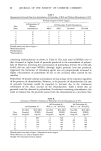
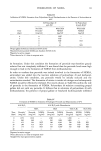
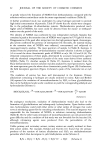
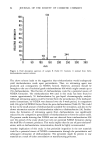
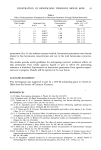
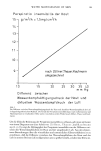
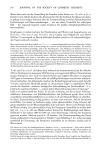
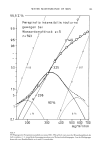
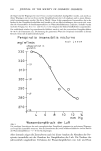
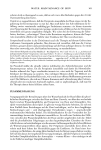
ANTIPERSPIRANT ACTION OF ALUMINUM SALTS 69 after the appearance of the first sweat droplets, photographs of each of the sites were taken. The subjects then left the environmental chamber and the starch mixture was removed. Next, 0.35 ml of the antiperspirant solution was used to saturate the cotton pad portion of an impermeable mylar-backed bandage (10). The occlusive patches were applied to the skin sites and remained in place overnight. The patches were removed at not less than 3 h prior to the subjects' re-entry into the environmental chamber on the following day. The antiperspirant test solutions were 20% aqueous ACH and 10% aqueous AZAP (each obtained as the dry powder from Wickhen Products, Inc., Hugeuenot, N.Y.), and 8% aqueous aluminum chloride (obtained as the hexahydrate salt from Fisher Scientific Co.). In each instance, the choice of concentration was based on the desire to use that concentration which could be expected to inhibit virtually all sweat glands in the test site, but which would not be so high as to irritate the skin and thus interfere with the determination of the agent's site of action. All four test sites on a subject were treated with the same solution. At the conclusion of the treatment regimen, the subjects were again thermally stressed and photographic records of the sites were taken as described above. They then returned to ambient temperature and the starch mixture was removed. Each site was stripped to the "glistening" layer (i.e., the entire stratum corneum layer was removed, exposing the stratum granulosum layer of the epidermis) using Scotch © brand high tack tape (11). After the stripping procedure, the subjects were immediately thermally stressed again and, as before, photographic records of the sites were made. As indicated above, at each of the three thermal stress periods, three photographs (20, 40 and 60 min after sweating had begun) were taken. The 20- and 60-min photographs, however, were principally precautionary only (i.e., to safeguard against the possibility that either coalescence of individual sweat droplets or an inadequate sweating pattern would be manifest at the 40-min interval). In the overwhelming number of instances, the evaluations discussed below were made using the 40-min photographs. For the most part, however, it was observed that the 20- and 60-min gland counts closely agreed with those seen for the 40-min period. Using these photographs, the number of actively firing sweat glands, each indicated by the black dot resulting from the starch/iodine--sweat reaction, was counted for each site before treatment, after treatment, and after stripping. With this approach, the number of sweat glands which had been inhibited by the given antiperspirant, but then had been restored to active function because of the Scotch tape stripping procedure, could be determined. A representative series of photographs is presented in Figure 1. The data are expressed as the percentage of inhibited glands which have been restored to firing after stripping. These values are calculated as follows: A = Number of glands observed before treatment minus the number of glands observed after treatment. B = Number of glands observed after stripping minus the number of glands observed after treatment but before stripping. B -- x 100 = Percent of those inhibited glands which were restored to firing. A

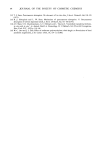
70 JOURNAL OF THE SOCIETY OF COSMETIC CHEMISTS : Before Treatment After Treatment, Before Stripping Figure 1. The effect of cellophane tape stripping on sweat gland function following occlusive application of 1096 aqueous AZAP.
Purchased for the exclusive use of nofirst nolast (unknown)
From: SCC Media Library & Resource Center (library.scconline.org)