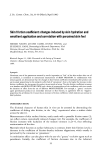
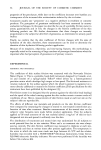
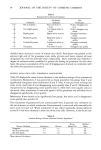
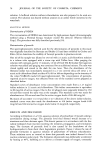
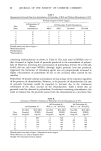
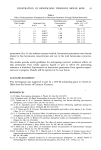
ANTIPERSPIRANT ACTION OF ALUMINUM SALTS 71 Table I The Effect of Scotch © tape Stripping on Sweat Gland Function Following Occlusive Treatment with 20% ACH • • q- S.E. Median Percentage of glands inhibited 95 + 2 98 Percentage of inhibited glands restored to firing 51 _+ 6 50 •N = 25 subjects For example, if the pre-treatment, post-treatment, and post-stripping values were 100, 20 and 40 respectively, then 40- 20 20 -- X 100 = 25% of the inhibited glands were restored to firing. 100- 20 80 RESULTS For the subjects studied, the number of sweat gland droplets in an experimental site prior to treatment ranged from about 100 in the less dense proximal areas to as many as 500-600 in the heavily populated distal areas. Most subjects, however, had an average of 200-300 sweat glands per site. The effect of Scotch © tape stripping on these sites subsequent to their overnight occlusive treatment with either 20% ACH, 10% AZAP or 8% A1CI 3 was as follows. ACH The occlusive application of 20% ACH resulted in virtually total inhibition of sweat gland function, with only 5% of the treated glands able to fire under thermal stress (Table I). After Scotch tape stripping away the stratum comeurn layer of the skin, however, half the number of those glands which had been inhibited were now restored to normal firing. AZAP As had been seen for ACH, the overnight occlusive application of AZAP also resulted in nearly total inhibition of sweat gland function. The effect of stripping on these glands resulted in restoration, on average, of two-thirds of them to function (Table II). Table II The Effect of Scotch © tape Stripping on Sweat Gland Function Following Occlusive Treatment with 10% AZAP • • q- S.E. Median Percentage of glands inhibited 93 -+ 2 97 Percentage of inhibited glands restored to firing 67 + 9 66 •N = 25 subjects

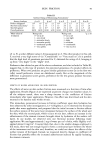
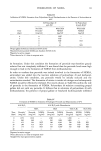
72 JOURNAL OF THE SOCIETY OF COSMETIC CHEMISTS Table III The Effect of Scotch © tape Stripping on Sweat Gland Function Following Occlusive Treatment with 8% A1C13 • • q- S.E. Median Percentage of glands inhibited 92 -+ 3 97 Percentage of inhibited glands restored to firing 11 _+ 3 2 •N = 33 subjects AICI 3 Once again, 18 h of occlusive treatment nearly completely abolished sweating. However, in distinct contrast to the observations described above for ACH and AZAP, removal of the stratum corneum had little effect on restoring gland function. In fact, for 13 of the 33 subjects studied, no restoration of function whatsoever in the population of inhibited sweat glands was observed, that situation explaining the relatively large discrepancy between the average and median values for the percentage of restoration of inhibited glands (Table III). DISCUSSION Not unexpectedly, the overnight occlusive application of each of the three aluminum- based antiperspirant solutions resulted in virtually complete inhibition of sweat gland function. For ACH, however, despite the high level of effectiveness, the penetration of the polymer into the sweat gland duct is not extensive, as evidenced by the finding that half the inhibited glands are restored to normal function when the 25-35 /•m thick stratum corneum layer is removed. Similarly, AZAP's site of action is also quite superficial, with two-thirds of the inhibited glands being restored to firing following the stripping away of the horny layer. Statistical evaluation of the data demonstrated that the difference between the percentage of restored AZAP-inhibited glands (67%) and ACH-inhibited glands (51%) is significant (p .01). For both ACH and AZAP, the two most widely used commercial antiperspirant agents, the location of the inhibition of eccrine sweat gland function in the duct is relatively near the skin surface. On the other hand, in stark contrast to the observations made for ACH and AZAP, removal of the stratum corneum had little effect on attempts to restore the function of those sweat glands inhibited by A1C13, indicating that the primary site of action in the sweat duct for A1CI 3 is deeper than the level of the stratum corneum in nearly all instances. The difference in restoration between A1C13-inhibited glands (11%) and ACH- or AZAP-inhibited glands is significant (p .001). Similar findings for A1C13, although less precisely determined, have been reported by others (4,7). One possible reason for this difference in the primary sites of action between AIC13 and ACH or AZAP is that the aluminum species of A1CI 3, being smaller, are able to diffuse down the sweat duct more rapidly than the larger polycationic species of ACH and AZAP.
Purchased for the exclusive use of nofirst nolast (unknown)
From: SCC Media Library & Resource Center (library.scconline.org)