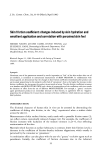
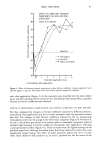
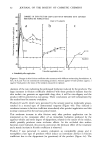
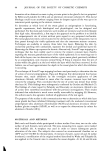
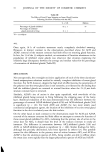
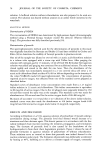
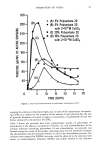
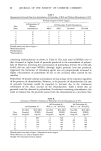
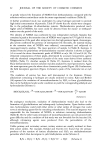
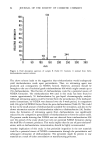
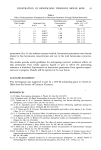
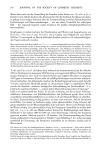
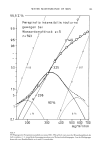
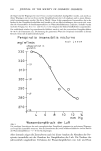
80 JOURNAL OF THE SOCIETY OF COSMETIC CHEMISTS Table I Representative Peroxide Data from Autoxidation of Polysorbate 20 With and Without Ethanolamine at 50øC Peroxide (mcg/ml of active oxygen) 3% Polysorbate 20 • Time Without (days) Ethanolamine MEA 2 3% Polysorbate 20 with Ethanolamine DEA 3 TEA 85% 4 TEA 98% 0 12 2 3 10 0 6 37 0 13 53 0 20 27 0 27 24 0 2 2 4 1 0 0 0 0 0 0 3 0 0 0 0 0 0 0 •Partially taken from data in Figure 2 2Monoethanolamine 3Diethanolamine 4Triethanolamine containing diethanolamine as shown in Table II. The total yield of NDEIA over 27 days increased at higher levels of peroxide produced in the autoxidation of polysor- bate 20. However, increasing the concentration of polysorbate 20 from 3% to 10% with CuSO4 did not yield more NDEIA, although higher peroxide level was produced. Apparently the formation of nitrosating agents was not proportionally increased in higher concentration of polysorbate 20 due to the inclusion effect exerted by the micelies. Polysorbate 20 should undergo autoxidation during storage of the solutions regardless of the presence of ethanolamines. However, in the presence of ethanolamines, the rate of peroxide formation would be expected to decrease due to the continuous termination of the chain reaction by the ethanolamines. Table I shows that no peroxide could be detected in polysorbate 20 solutions containing ethanolamine, this tends to indicate that the peroxide reacted with the ethanolamine at a rate faster than Table II Formation of NDEIA in Solutions of Polysorbate 20 and Diethanolamine at 50øC 3% Polysorbate 20 3% Polysorbate 20 With 2 x 10 -4 M Cu$O 4 10% Polysorbate 20 With 2 x 10 -4 M CuSO 4 No DEA With DEA No DEA With DEA No DEA With DEA Time Peroxide • NDEIA Peroxide • NDEIA Peroxide • NDEIA (days) (mcg/ml) (ng/ml) (mcg/ml) (ng/ml) (mcg/ml) (ng/ml) 0 12 ND • 14 ND 4 162 6 37 116 112 ND 285 290 13 53 186 110 334 125 310 20 27 218 75 416 67 288 27 24 224 33 462 57 382 34 -- -- 35 A 3 -- -- •Partially taken from data in Figure 2. Reported as active oxygen. •None detected at 3:1 noise-to-response ratio. 3Sample A for mass-spectrometric analysis.

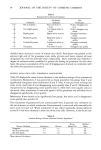
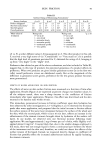
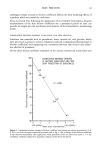
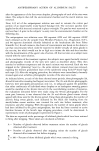
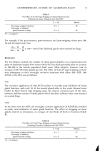
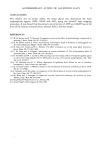
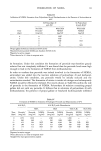
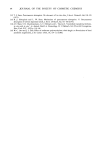
FORMATION OF NDEIA 81 Table III Inhibition of NDEIA Formation from Polysorbate 20 and Diethanolamine in the Presence of Antioxidants at 50øC 3% Polysorbate 20 3% Polysorbate with PG • 20 with BHA 2 No DEA With DEA With DEA Time Peroxide3 NDEIA NDEIA (days) (mcg/ml) (ng/ml)' (ng/ml) 0 0 ND 4 -- 6 0 ND -- 13 0 ND ND 20 0 72 -- 27 0 92 ND •Propyl gallate (0.02%) and disodium EDTA (0.1%) 2Butylated hydroxyanisole (0.04%) and disodium EDTA (0.1%) 3Reported as active oxygen 4None detected at 3:1 noise-to-response ratio its formation. Under this condition the formation of peroxide was therefore greatly reduced but not completely inhibited. It was found that the peroxide levels were high enough to lead to the formation of NDE1A from diethanolamine. In order to confirm that peroxide was indeed involved in the formation of NDE1A, antioxidant was added into the reaction solutions of polysorbate 20 and diethanoi- amine. Under this condition, any peroxide would be initially reduced and the autoxidation retarded. The formation of nitrite or oxides of nitrogen and subsequently NDEIA would be effectively inhibited. The results shown in Table III confirm the role of peroxide in the formation of NDEIA. Polysorbate 20 solution containing propyl gallate did not yield any peroxide. It follows that in solutions of polysorbate 20 with diethanolamine, the presence of propyl gallate or butylated hydroxyanisole inhibited Table IV Formation of NDEIA in Solutions of Hydrogen Peroxide and Ethanolamine at 50øC 0.3% H202 0.3% H202 with Ethanolamine MEA DEA TEA (A.R.) TEA (85%) Time Peroxide • Peroxide NDEIA Peroxide NDEIA Peroxide NDEIA NDEIA (days) (mcg/ml) (mcg/ml) (ng/ml) (mcg/ml) (ng/ml) (mcg/ml) (ng/ml) (ng/ml) 0 1,570 1,520 -- 1,560 -- 1,560 -- -- 6 860 860 -- 830 1,094 1,000 -- -- 13 455 564 ND 2 590 4,582 780 ND ND 20 280 415 ND 417 3,600 620 ND ND 27 175 312 ND 307 5,3003 510 ND ND 40 ........ •Reported as active oxygen 2None detected at 3:1 noise-to-response ratio 3Sample B for mass-spectrometric analysis
Purchased for the exclusive use of nofirst nolast (unknown)
From: SCC Media Library & Resource Center (library.scconline.org)