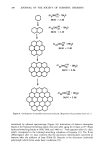
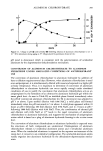
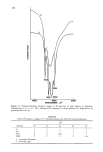
j. Soc. Cosmet. Chem., 33, 281-295 (September/October 1982) Conversion of aluminum chlorohydrate to aluminum hydroxide DIRK L. TEAGARDEN*, STANLEY L. HEM, Dept. of Industrial and Physical Pharmacy, and JOE L. WHITE, Dept. of Agronomy, Purdue University, IVest Lafayette, IN 47907. *Present address.' The UpJohn Co., Kalamazoo, M149001. Received October 22, 1980. Presented at the SCC Annual Scientific Meeting, New York, NY, Dec. 11-12, 1981. Synopsis The structure of aluminum chlorohydrate, a highly soluble anti-perspirant, and aluminum hydroxide, an insoluble antacid, are discussed in relation to the mechanism of conversion of aluminum chlorohydrate to aluminum hydroxide. X-ray, IR, and 27A1 NMR spectroscopic data indicate that aluminum chlorohydrate is composed of a central aluminum in tetrahedral configuration surrounded by 12 aluminums each in octahedral configuration. This highly .charged complex is neutralized by 7 chloride counterions. In contrast, aluminum hydroxide has a polymer-like structure whose basic unit is a ring of six aluminums in octahedral configuration joined by double hydroxide bridges. Bayerite, an aluminum hydroxide polymorph, readily forms when the hydroxyl to aluminum ratio of aluminum chlorohydrate is raised to 3 by titration with sodium hydroxide. Dilution of aluminum chlorohydrate solutions with water or 0.9% NaCI leads to the formation of gibbsite, another aluminum hydroxide polymorph. Conversion of aluminum chlorohydrate occurs rapidly enough under simulated conditions of antiperspirant use to just!fy the conclusion that one mechanism of aluminum chlorohydrate's antiperspirant action is the formation of an obstructive aluminum hydroxide gel within the sweat duct. INTRODUCTION The similarity between the empirical formulas for aluminum chlorohydrate, AI2(OH)sCI ß 2H20 (1), and a type of aluminum hydroxide, which is used an an antacid, AI(OH)z55CI0.45 (2), suggests a relationship between these aluminum compounds. However, the extreme difference in aqueous solubility of these materials indicates different structural arrangements. A relationship between aluminum chlorohydrate a:•Jd aluminum hydroxide is also suggested by recent studies on the mechanism of action •6f antiperspirants (3-6), which reveal an aluminum-containing plug in the duct of eccrine sweat glands following application of aluminum-containing antiperspirants. This observation supports the hypothesis that aluminum-containing antiperspirants act by forming an obstructive aluminum hydroxide gel within the sweat gland duct. It is thus important to examine the structure of aluminum chlorohydrate and aluminum hydroxide to determine if conversion is possible under the conditions encountered during the use of an antiperspirant. 281

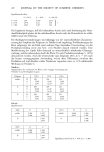
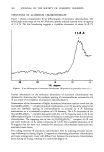
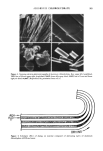
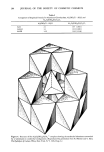
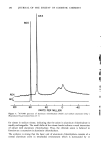
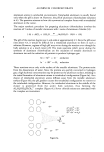
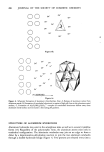
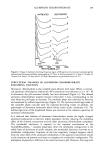
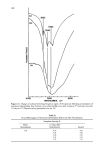
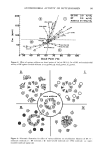
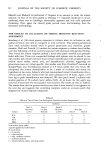
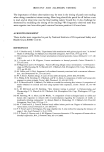
282 JOURNAL OF THE SOCIETY OF COSMETIC CHEMISTS STRUCTURE OF ALUMINUM CHLOROHYDRATE Figure 1 shows a characteristic X-ray diffractogram of aluminum chlorohydrate. The broad peak in the range of 4 to 10 ø 20 shows a poorly ordered material with a d-spacing of 11.8 fit. The line broadening suggests a crystallite dimension of about 50 fit (7). 11.8 A ! I I I I I 28 22 16 I0 4 26, degrees Figure 1. X-ray diffractogram of aluminum chlorohydrate. (Reproduced by permission from ref. 7.) Further information on the molecular dimensions of aluminum chlorohydrate was obtained by observing that the interlayer spacing of montmorillonite increased by 8.9 fit as a result of intercalation of aluminum chlorohydrate (7). Examination of the dimensions of highly hydrolyzed aluminum species reveal that the AI•304(OH)24(H20)•27+ complex proposed byJohansson, et al., (8) would be expected to cause the interlayer spacing of montmorillonite to increase by 9 fit following intercalation, as it is essentially a sphere of 9 fit diameter. The 9 fit dimension of the AI•304(OH)24(H20)•27+ complex also agrees with the 11.8 fit d-spacing seen in the X-ray diffractogram (Figure 1) if a layer of water of hydration is associated with the aluminum chlorohydrate. The repeating unit of one Al•304(OH•4(H•O)•27+ complex, 8.9 fit, and one water molecule, 2.9 fit, yields a d-spacing of 11.8 A. The crystallite dimension of 50 fit suggests that the basic unit contains five aluminum chlorohydrate layers and their associated water layers. The curling behavior of aluminum chlorohydrate seen by scanning electron micros- copy following air drying (Figure 2) supports an alternating aluminum chlorohydrate and water arrangement water will diffuse from between the aluminum chlorohydrate layers during air drying, resulting in a curled film (Figure 3).
Purchased for the exclusive use of nofirst nolast (unknown)
From: SCC Media Library & Resource Center (library.scconline.org)