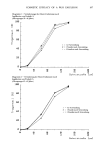
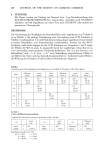
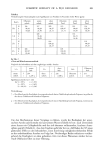
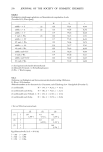
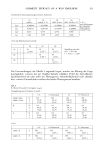
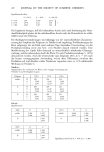
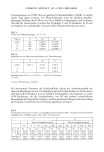
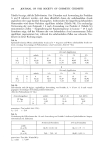
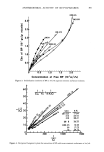
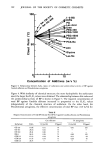
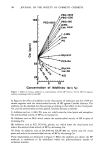
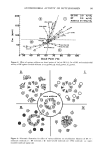
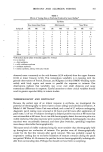
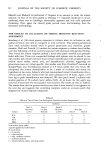
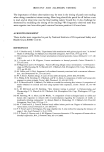
IRRITANT AND ALLERGEN TESTING 313 The importance of these observations may be seen in the timing of patch test reading when doing cumulative irritant testing. How long should the patch be off before a test is read, and at what time was the final reading taken? Could the 21 day challenge be shortened by modifying the timing of the reading? We frequently observed tests that were negative one hour after patch removal become positive 6-8 hours later. ACKNOWLEDGEMENT These studies were supported in part by National Institute of Occupational Safety and Health Grant #OHO 1124-03. REFERENCES (1) E. V. Buehler andJ. F. Griffith, "Experimental skin sensitization with guinea pig and man," in Animal Models in Dermatology, H. Maibach, Ed. (Churchill Livingston, New York, 1975), pp 56-66. (2) H. Lindemayr and M. Drobil, Contact sensitization to benzoyl peroxide, Contact Dermatitis 7, 137-140 (1981). (3) J. J. Leyden and A.M. Kligman, Contact sensitization to benzoyl peroxide, Contact Dermatitis 3, 273-274 (1977). (4) B. Magnusson and A.M. Kligman, "Factors affecting allergic contact sensitization," in Dermatotoxi- cology and Pharmacology, M. N. Marzulli & H. I. Maibach, Eds. (Hemisphere Pub. Corp., Washington, 1977), pp 289-304. (5) M. Uehara and S. Ofuji, Suppressed cell-mediated immunity associated with eczematous inflamma- tion, Acta Dermatovener 57, 137-139 (1977). (6) W. F. Schorr, Paraben allergy: A cause of intractable dermatitis,JAMA 204, 859 (1968). (7) L. Phillip, II, M. Steinberg, H. I. Maibach, and W. A. Akers, A comparison of rabbit and human skin response to certain irritants, Toxicol. Appl. Pharmacol. 21,369-382 (1972). (8) F. N. Marzulli and H. I. Maibach, The rabbit as a model for evaluating skin irritants: A comparison of results obtained on animals and man using repeated skin exposures, Cosmet. Toxicol. 13, 533-540 (1975). (9) A.M. McCreesh and M. Steinberg, "Skin irritation testing in animals" in Dermatoxicology and Pharmacology, F. N. Marzulli & H. I. Maibach, Eds. (Hemisphere Pub. Corp., Washington, 1977), pp 193-210. (10) M. Steinberg, W. A. Akers, and M. Weeks, "A comparison of test techniques based on rabbit and human skin responses to irritants with recommendations regarding the evaluation of mildly or moderately irritating compounds," in Animal Models in Dermatology. H. I. Maibach, Ed. (Churchill Livingstone, New York, 1975), pp 1-11. (11) M. V. Dahl and R.J. Trancik, Sodium lauryl sulfate irritant patch test: Degree of inflammation at various times, Contact Dermatitis 3, 263-266 (1977). (12) P. F. Frosch and A.M. Kligman, The soap chamber test: A new method for assaying the irritancy of soaps,J. Am. Acad. Dermatol. 1, 35-41 (1979). (13) P. F. Frosch, S. Duncan, and A.M. Kligman, Cutaneous biometrics I. The response of human skin to dimethyl sulphoxide, Brit. J. Dermatol. 102,263-274 (1980).

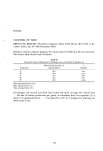
Erratum CLEANING OF HAIR MIKLOS M. BREUER, The Gilette Company, Gilette Park, Boston, •lA 02106. J. $oc. Cosmet. C/•em., 32, 437-458 (December 1981). Owing to a faulty computer program, the values stated in Table II, p. 442 are erroneous. The correct table should read as follows: Table II Numerical Values of Parameters of Reoiling Curve as Calculated by Equation (2) Sebum Production Rate, A k Experiment (mg/head/hair) (mg/hair) A x 45.0 0.03 B x 48.5 0.02 C 2 51.9 0.03 D 2 26.4 0.02 E 3 60.5 0.035 XData determined from ref. 8 2Data obtained from ref. 7 •Data obtained from ref. 6 Accordingly, the second and third lines below the table on page 442 should read "...the rate of sebum production per gland, as calculated from our equation (2), is about 2-6 ng/gland/minute, .. "I am grateful to Dr. G. Compeau for pointing out these errors to me. 315
Purchased for the exclusive use of nofirst nolast (unknown)
From: SCC Media Library & Resource Center (library.scconline.org)