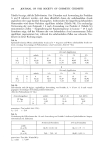
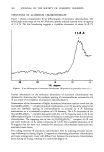
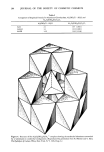
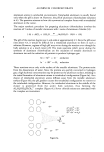
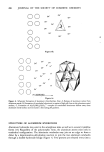
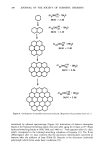
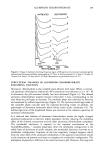
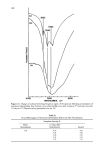
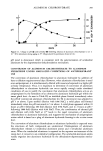
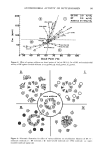
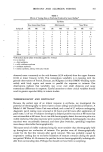
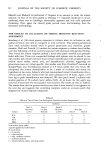
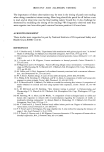
ALUMINUM CHLOROHYDRATE 289 Figure 7. Dimeric cation A12(OH)2(H20)84+. (Reproduced by permission from ref. 16.) double hydroxide bridge forms. The basic unit comprising aluminum hydroxide is a six member ring of aluminum octahedra joined by 6 double hydroxide bridges (16). Aluminum hydroxide in this state is amorphous and reacts rapidly with acid as all of the hydroxyls are accessible to protons. Crystallinity develops as the six member rings combine (Figure 8). This growth first occurs in one plane, but stacking gives rise to X-ray diffraction patterns which are identified as gibbsite, bayerite, norstrandite, or boehmite (15). The development of order in aluminum hydroxide may be illustrated by infrared spectroscopy (17). Deuterium is heavier than hydrogen. Thus, O-D stretching occurs at a lower frequency than O-H stretching. When a freshly precipitated aluminum hydroxide gel is air dried and exposed to D20 vapor, all of the hydroxyls are converted to deuteroxyls, indicating that all of the hydroxyls are accessible for exchange (Figure 9a). As the aluminum hydroxide gel ages, the hydroxyls incorporated into ordered or crystalline phases become unavailable for exchange with D20 (Figure 9b). The hydroxyls which are not accessible for exchange begin to show the characteristic infrared spectrum of gibbsite (Figure 9f). Thus it is clear that aluminum hydroxide is composed exclusively of aluminum in octahedral configuration and that the basic unit is a six member ring of octahedral aluminum joined by double hydroxide bridges. STRUCTURAL CHANGES IN ALUMINUM CHLOROHYDRATE FOLLOWING ADDITION OF BASE The addition of sufficient sodium hydroxide to aluminum chlorohydrate to bring the hydroxyl to aluminum ratio from 2.5 to 3.0 initiated structural changes which were

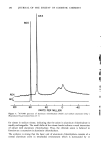
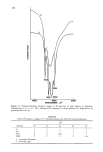
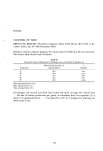
290 JOURNAL OF THE SOCIETY OF COSMETIC CHEMISTS +6 A16(OH)12 . 12H20 OH./A1 : 2.00 OH/A1 = 2.2O OH/A1 = 2.5O A1 OH' +14 32 ( J82 ' 28H20 OH/A1 = 2.56 .+18 A154(OH}144 ß 36H20 OH/A1 -- 2.66 Figure 8. Development of crystalline aluminum hydroxide. (Reproduced by permission from ref. 2.) monitored by infrared spectroscopy (Figure 10). Indications of distinct absorption bands in the hydroxyl-stretching region were seen after aging for 10 days at 25 ø . Sharp hydroxyl-stretching bands at 3650, 3540, and 3460 cm -• were apparent after 111 days, which correspond to the hydroxyl-stretching vibrations of bayerite (11). The X-ray diffractogram after 111 days confirms that the aluminum chlorohydrate converted to bayerite after the addition-of base (Table II). Bayerite is the aluminum hydroxide polymorph which forms under basic conditions (15).
Purchased for the exclusive use of nofirst nolast (unknown)
From: SCC Media Library & Resource Center (library.scconline.org)