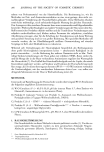
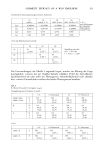
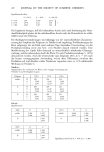
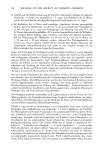
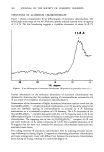
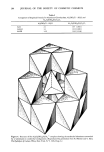
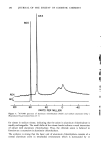
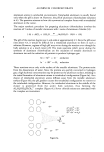
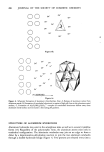
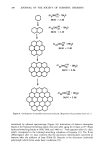
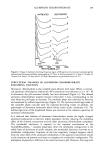
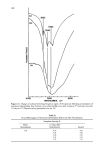
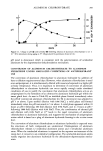
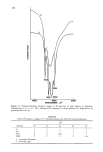
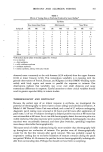
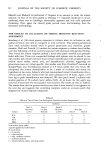
ALUMINUM CHLOROHYDRATE 285 The empirical formula of aluminum chlorohydrate, AI2(OH)sCL. 2 H20 (1), compares favorably to the formula of the AI•304(OH)=4(H=O)•27+ complex if seven chloride anions are assumed present to neutralize the charge of the complex and it is realized that the 4 oxygen atoms in the proposed complex will appear as 8 hydroxyl anions by the techniques used to establish the stoichiometry of aluminum compounds (Table I) (10). The small differences between the generally accepted empirical formula and the AI•304(OH)24(H20)•27+ complex may be due to the presence of other aluminum species in aluminum chlorohydrate, and to the relatively nonspecific methods used for establishing the empirical formula. The structure of the AI•304(OH)24(H20)•27+ complex (Figure 4) is unusual because it contains a central aluminum in a tetrahedral environment surrounded by 12 aluminum atoms in octahedral environments. Aluminum in a tetrahedral environment is character- ized by aluminate anion, AI(OH)4-, which exists only at high pH conditions (11). Aluminum in octahedral configuration occurs at neutral and acidic pH, and is the configuration of aluminum in aluminum hydroxide (2). The presence of aluminum in both octahedral and tetrahedral environments can be determined by infrared and 27A1 NMR spectroscopy. The infrared spectrum of aluminum chlorohydrate shows a broad band between 3100 and 2500 cm -•, which represents the hydroxyl-stretching vibrations' of aluminum in octahedral configuration (7). Infrared bands for aluminum in tetrahedral configuration occur at 345 (AIO4 antisymmetric bending), 640 (AIO4symmetric stretching), and 780 cm -• (AIO4 antisymmetric stretching) (7). These bands agree closely with the infrared bands of sodium aluminate which occur at 325, 625, and 725 cm -• (12). The occurence of the AIO4 symmetric- and antisymmetric-stretching frequencies at higher frequencies in aluminum chlorohydrate than in sodium aluminate indicates that a slightly longer AI-O bond is present in the tetrahedral aluminum of aluminum chlorohydrate. The AI-O bonds would be expected to be longer in a tetrahedral aluminum in which each oxygen was shared by an octahedral aluminum. The 27AI-NMR spectrum of aluminum chlorohydrate at pH 4.8 has 3 distinct signals: a sharp peak at 63.5 ppm and two broad peaks at 1.7 and -0.4 ppm (Figure 5) (7). The relative chemical shift differences were referenced to an external standard of AI(H20)63+ at pH 1. For comparison, the 27A1 NMR spectrum of sodium aluminate is also shown in Figure 5. The peak at 63.5 ppm indicates an AI-O bond in an AIO 4 tetrahedral configuration. The peak width of less than 40 Hz suggests that the tetrahedral aluminum is not in equilibrium with the aqueous environment. Conse- quently, the tetrahedral AIO 4 group is believed to be bonded to other aluminum atoms. The broad resonances at 1.7 and -0.4 ppm suggest the presence of aluminum atoms in octahedral environments which are in rapid equilibrium with the aqueous solution. The degree of interaction of the anion with the positively charged aluminum chlorohydrate complex could be studied by infrared spectroscopy if the anion were infrared active (13). Thus, aluminum chlorohydrate was treated with silver nitrate to replace the infrared-inactive chloride with nitrate. Nitrate was chosen because it is the same approximate size and charge as chloride, but it is also symmetrical so any perturbations in symmetry due to interaction with the aluminum complex will cause a shift in the infrared spectrum. The infrared spectrum of aluminum chlorohydrate was not affected by the replacement of chloride by nitrate except for the appearance of bands at 1380 and 830 cm -• (9). Both bands correspond to the 1358 and 836 cm -• bands

286 JOURNAL OF THE SOCIETY OF COSMETIC CHEMISTS 80.5 ACH 120 80 6:3.5 40 0 -40 PARTS PER MILLION Figure 5. 27A1-NMR spectrum of aluminum chlorohydrate (ACH) and sodium aluminate (A104-). (Reproduced by permission from ref. 7.) for nitrate in sodium nitrate, indicating that the anion in aluminum chlorohydrate is readily exchangeable. The small shifts of the nitrate bands indicate a weak interaction of nitrate with aluminum chlorohydrate. Thus, the chloride anion is believed to function as a counterion in aluminum chlorohydrate. The evidence is strong that the basic unit of aluminum chlorohydrate consists of a central aluminum atom in tetrahedral environment which is surrounded by 12
Purchased for the exclusive use of nofirst nolast (unknown)
From: SCC Media Library & Resource Center (library.scconline.org)