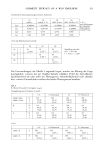
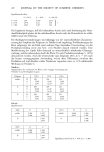
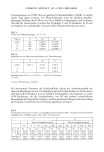
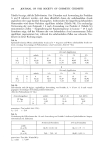
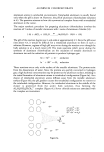
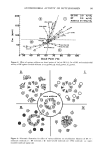
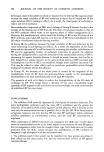
ALUMINUM CHLOROHYDRATE 287 aluminum atoms in octahedral environments. Tetrahedral aluminum is usually found only when the pH is above 10. However, the pH of aluminum chlorohydrate solutions is 4.5. The question arises as to how this symmetrical complex forms with a tetrahedral aluminum in the center. The major synthetic procedure for preparing aluminum chlorohydrate involves the reaction of 5 moles of metallic aluminum with 1 mole of aluminum chloride (14). 5 AI + AICI 3 + 15 H20 800 , AI2(OH)2C1 ß 2H20 + 15112 The pH of the reaction begins near 3 and ends at approximately 4.5. Since the pH never rises above 4.5, it would be difficult for a tetrahedral aluminum to form in such a solution. However, regions of high pH may occur during the reaction even though the bulk solution is at a much lower pH. The main reactions which occur during the synthesis of aluminum chlorohydrate are the oxidation of metallic aluminum to aluminum ion and the reduction of protons to produce hydrogen gas. A1 • AI 3+ -t- 3e - oxidation 2e - -I- 2H + • 82 reduction These reactions occur only at the surface of the metallic aluminum. The protons arise from the dissociation of water. Since the protons are quickly converted to hydrogen gas, a high hydroxyl concentration may be present at the aluminum surface, resulting in the initial formation of aluminum atoms in tetrahedral configuration (Figure 6a). As a cluster of tetrahedral aluminum atoms diffuses away from the metallic aluminum surface (Figure 6b), the pH gradient causes the tetrahedral configuration to convert to the octahedral configuration. However, the tetrahedral aluminum in the middle of the cluster is protected from the acidic bulk solution, thus forming the AIt304(OH)24(H20)127+ complex (Figure 6c). Seven chloride anions are associated with the complex as counterions. (• OH- OH- AI'""' OH- OH- Figure 6a. OH- OH- AIø-',--AI •+ + 3e- H•O•--•-- H + + OH- 2H++2e ---,,,- H a !

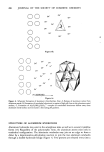
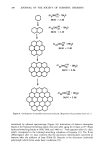
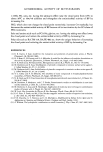
288 JOURNAL OF THE SOCIETY OF COSMETIC CHEMISTS oo oo Figure 6b. OH- OH- OH- OH- OH- oo oo o oo oo OH- OH- OH- OH- OH- OH- OH- OH- OH- OH- pH DECREASES OH- H* H + H + H + / Figure 6c. Figure 6. Schematic formation of aluminum chlorohydrate. Key: A, Release of aluminum cation from aluminum metal. B, Formation of tetrahedral aluminum in region of high pH close to the aluminum metal surface. C, Formation of AI•30•(OH)2•(H20)•27+ complex as tetrahedral aluminums diffuse away from aluminum metal surface and encounter a decreasing pH gradient. STRUCTURE OF ALUMINUM HYDROXIDE Aluminum hydroxide may exist in the amorphous state as well as in several crystalline forms (15). Regardless of the polymorphic form, the aluminum atoms exist only in octahedral configuration. The aluminum octahedra may join at an edge to form a dimer by a deprotonation-dehydration reaction to join the two aluminum octahedra through a double hydroxide bridge (Figure 7). Two protons are released every time a
Purchased for the exclusive use of nofirst nolast (unknown)
From: SCC Media Library & Resource Center (library.scconline.org)