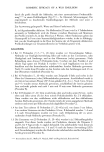
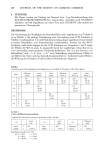
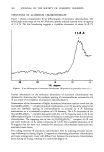
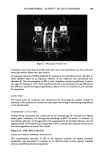
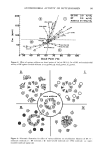
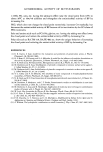
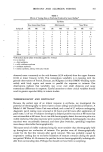
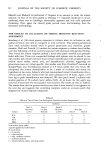
298 JOURNAL OF THE SOCIETY OF COSMETIC CHEMISTS nonionic surfactants was investigated in relation to its antimicrobial activity. The effect on the activity caused by the addition of the various water-soluble materials and water-insoluble materials was examined. EXPERIMENTAL MATERIALS Butylparaben (BP) used as a preservative was of reagent special grade. The nonionic surfactants and the additives used are listed in Table I. All of them were used without further purification. Table I Grade and Abbreviation of Nonionic Surfactant and Additive Compound *Grade Abbreviation Preservative Butyl P-hydroxybenzoate R BP Nonionic Surfactant POE (10 moles)Oleyl Ether C OE-510 POE (15 moles) C OE-515 POE (20 moles) C OE-520 POE (25 moles) C OE-525 POE (8 moles) Dodecyl Ether C DE-8 POE (16 moles) 2-octyl Dodecyl Ether C ODE-16 POE (20 moles) C ODE-20 POE (25 moles) C ODE-25 Water-Solu ble Polyethyleneglycol-6000 R PEG4000 Additive Polyethyleneglycol-4000 R PEG-4000 Polyethyleneglycol- 1500 R, PEG-1500 Polyethyleneglycol-400 R PEG -400 Di-propyleneglycol R Di-PG 1.3-butanediol R 1.3-BG Glycerin R -- Lactic Acid R Lac. Acid Urea R -- Sodium Pyrrolidone Carboxylate R PCA-Na Sodium Lactate R LaoNa Glycine R -- Potassium Chloride R KCI Water-Insoluble Trimethylpropanol Isostearate C RA. TM-318 Additive Pentaerythrytol Tetra 2-ethylhexanate C RA. Pe-408 *C: Commercially Available. R: Reagent EQUILIBRIUM DIALYSIS The concentration of free BP (i.e., the fraction incorporated within the surfactant micelies) was determined by an equilibrium dialysis. The dialysis technique followed in principle one reported by Patel and Foss (7). The dialysis cell consists of two pyrex-glass chambers A and B, each having a cavity of 40ml capacity, as is shown in Figure 1. The dialysis membrane (nylon-6, thickness 20/•m, Toyo Gosei Film Co., Japan) was placed between the two cham,b•ers with the cavities facing each other. The chambers were held firmly together by four stainless steel bolts and wingnuts. This

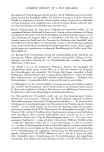
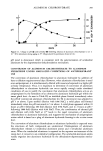
ANTIMICROBIAL ACTIVITY OF BUTYLPARABEN 299 Figure 1. Photograph of dialysis cell. membrane can be permeated by BP molecules, but resists permeation by the surfactant molecules within about two days dialysis. An aqueous solution of BP solubilized by surfactant was introduced into chamber A, while distilled water or an aqueous solution of the additives was introduced into chamber B. The concentration of BP in both chambers reached equilibrium in about two days of shaking at 25øC. After equilibration, the concentrations of total BP and of free BP were determined spectrophotometrically at 257nm in chamber A and chamber B respectively. CLOUD POINT The cloud point of surfactant was determined by observing the sudden change of turbidity of the solution in a sealed test tube upon increasing or decreasing temperature in the thermo-bath. ANTIMICROBIAL EVALUATION Antimicrobial evaluation was conducted by (a) introducing the solution into tightly sealed glass containers, (b) heating and sterilizing at 80øC for about 15 minutes, (c) inoculating with the microorganisms (104 organisms/ml of Candida albicans and l0 s organisms/ml of Pseudomonas aeruginosa) at 30øC, and (d) observing the extinction of the microorganisms in one to four weeks. RESULTS AND DISCUSSIONS EFFECT OF VARIOUS NONIONIC SURFACTANTS The solubilization behavior of BP in the aqueous solution of various nonionic surfactants was examined in relation to its antimicrobial activity against Candida albicans and Pseudomonas aeruginosa.
Purchased for the exclusive use of nofirst nolast (unknown)
From: SCC Media Library & Resource Center (library.scconline.org)