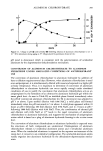
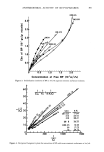
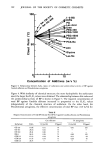
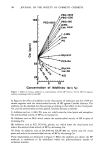
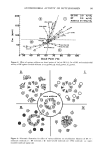
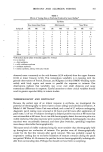
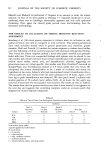
306 JOURNAL OF THE SOCIETY OF COSMETIC CHEMISTS In Group I, most of the additives which are dissolved in the intermicellar aqueous phase increase the water solubility of BP and surfactant in water due to breakdown of the water-structure (10,11) (salting-in effect). As a result, the cloud point of surfactant is raised, and Cw is increased. Macromolecular compounds of PEG which belong to Group II increase Cw due to the transfer of the binding site of BP from the EO-chain of surfactant micelies to that of the PEG molecule which exists in the aqueous phase in coiled configuration (6,7). However, this transformation, which means the binding of BP to the EO-chain of the PEG molecule, also makes BP inactive as in the case of BP bound (solubilized) to the EO-chain of surfactant molecule forming micelies. In Group III, the additives decrease the water solubility of BP and surfactant by the water-structuring (11,12) (salting-out) effects. As a result, the depression of the cloud point and the decrease of Cw will be caused by increasing the miceliar solubilization of BP and the aggregation number of surfactant molecules. In general, the additives having the salting-out effect cause the reduction of the antimicrobial activity of BP by decreasing Cw against Candida albicans. It should be noted, however, that LaoNa or KCI behaved in a unique manner, as the antimicrobial activity of BP increased with increasing the Lac-Na or KCI concentration, though these additives decreased Cw. This may be related to other effects such as membrane permeability action through biological membrane of Candida albicans. In Group IV, the increase of the cloud point is caused by the migration of the solubilization locus of BP from the polyoxyethylene mantle to the hydrophobic (hydrocarbon) core with solubilized polar oil of high BP solubility. The presence of such oil is likely to reduce the hydr0phobicity of the EO-chain of surfactant by BP. This brings about a decrease of Cw, since considerably larger quantities of BP migrate to the solubilized oil, and accordingly, the total concentration of solubilized BP becomes larger. CONCLUSIONS 1. The addition of BP markedly depresses the cloud point of nonionic surfactant. The more hydrophobic surfactant used, the more BP is solubilized and the greater the reduction of its antimicrobial activity against Candida albicans. This is because in this case only the antimicrobial activity is possibly due to the free BP. With Pseudomonas aeruginosa, however, not only the free BP, but also BP solubilized within surfactant micelies contributes to antimicrobial activity, and the total BP concentration is important. When surfactants of different structures are compared, the ODE type of side-chains show the antimicrobial activity at the lower required concentration of total BP against the microorganisms rather than the straight-chains type. Such behaviors can be easily predicted from the K•K 2 values, because the solubilization of BP conforms to Langmuir's type adsorption in all the surfactants used. 2. The additives used in this system can be classified into four groups according to their effects on the cloud point, Cw, and the antimicrobial activity of BP against Candida albicans.

ANTIMICROBIAL ACTIVITY OF BUTYLPARABEN 307 1.3-BG, PG, urea, etc. having the salting-in effect raise the cloud point from 10øC to about 30øC at 10w/v% addition and strengthen the antimicrobial activity of BP by increasing Cw. PEG, which does not change the cloud point extensively, increases Cw markedly, but decreases the antimicrobial activity of BP because of its inactivation by the EO-chain of PEG molecules. Salts and amino acids such as PCA-Na, glycine, etc. having the salting-out effect lower the cloud point and reduce the antimicrobial activity of BP by decreasing Cw. Polar oils such as RA.TM-318, RA.PE-408, etc. show the unique behavior of increasing the cloud point and reducing the antimicrobial activity of BP by decreasing Cw. REFERENCES (1) E. R. Garret, A basic model for the evaluation and prediction of preservation action, J. Pharm. Pharmacol., 18, 589-601 (1966). (2) H. S. Bean, G. H. Konnig, and S. A. Malcolm, A model for the influence of emulsion formulation on the activity of phenolic preservative,J. Pharm. Pharmacol., 21, Suppl., 173S-181S (1969). (3) N. K. Patel andJ. M. Ramanowsky, Hetrogeneous systems II,J. Pharm. Sci., 59, 372-376 (1970). (4) M. Donbrow and E. Azaz, Solubilization of phenolic compound in nonionic surface-active agents I, j. Colloid Interface Sci., 57, 11-19 (1976). (5) M. Donbrow and E. Azaz, Solubilization of phenolic compounds in nonionic surface-active agents II, j. Colloid Interface Sci., 57, 20-27 (1976). (6) T. C. Cobby and P. H. Elworthy, The solubility of some compounds in hexadecylpolyoxethylene monoether,J. Pharm. Pharmacol., 23, Suppl., 39S-48S (1971). (7) N. K. Patel and N. E. Foss, Interaction of some pharmaceuticals with macromolecule I,J. Pharm. Sci., 53, 94-97 (1964). (8) M. Donbrow, P. Molyneux, and C. T. Rodes, Potentiometric studies on solubilization in non-ionic miceliar solutions,J. Chem. $oc., (,d) 561-563 (1967). (9) M. Donbrow, E. Azaz, and R. Hamburger, Application of molecular sieve technique in solubilization studies of benzoic acid,J. Pharm. Sci., 59, 1427-1430 (1970). (10) W. Luck, Zur ,dssoziation des l•assers II, Bet. Bunsenges, Physik. Chem., 69, 69-76 (1965). (11) E.G. Finer, F. Frank, and M.J. Tait, Nuclear magnetic resonance studies of aqueous urea solutions, j. Am. Chem. Soc., 94, 4424-4429 (1972). (12) P. H. Elworthy, A. T. Florence, and C. B. Macfalance, Solubilization by Surface Active Agent and its Application in Chemistry and Biological Sciences ( Capman and Hail, London, 1968). (13) A. Wishnia, The hydrophobic contribution to micell formation,J. Phys. Chem., 67, 2097-2082 (1963).
Purchased for the exclusive use of nofirst nolast (unknown)
From: SCC Media Library & Resource Center (library.scconline.org)