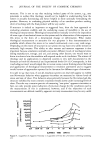
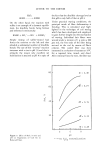
STABILITY ASSESSMENT OF EMULSIONS 347 the attractive forces represented by the primary minimum of the typical potential energy diagram in Figure 1. It, therefore, is necessary to provide a barrier to coalescence at the droplet surface using appropriate surfactants, polymers, or other agents which accumulate at the interface. Our attention, therefore, is strongly directed toward the development of repulsive barriers, electrostatic and/or steric, as seen in Figure 1, to keep the droplets as far apart as possible. In reality we know that this picture of discreet droplets separated from one another is highly oversimplified. Rather, we recognize that at just about any level of phase volume ratio discreet droplets are in a state of flocculation with an energy of interaction associated with the secondary minimum in Figure 1. It is this state of flocculation which is responsible for the rheological properties of the emulsion, giving it a higher apparent viscosity than would occur with completely separated particles. It is this flocculation, and the level of rheological structure produced, which also gives emulsions their desirable characteristics as cosmetic products and which assists in resisting instability. Of considerable importance in determining the extent to which such structuring occurs without coalescence are phase volume ratio the nature of the interfacial barrier and the physical state of the system making up the external phase. The greater the coverage of internal phase droplets, the better the chance that highly flocculted emulsions will not coalesce on standing. Important considerations here are surface charges (zeta potential) polymer molecular weight and level of hydration. Also of considerable importance is the surface rheology of the interfacial barrier and its ability to respond to stresses at the interface which bring about coalescence. The state of the bulk phase external to the droplets is also of considerable importance in stabilizing an emulsion. Higher bulk viscosity occurs because of excess polymer and surfactant dissolved in the external phase. In the case of concentrated surfactant and polymer solutions the possibility of stabilization because of liquid-crystalline phases must also be considered (1). Such complex highly ordered phases produce a high bulk viscosity, as well as influencing the state of flocculation. To this we must also add situations where solid materials are present to improve the overall rheological character of the system. Whether these represent highly hydrated networks of hydrophilic solids, such as clays, or crystalline waxes and other fatty substances, the result is an enhanced level of particle-particle interaction and an overall increase in apparent viscosity and stability. The picture presented for a typical liquid or semi-solid cosmetic emulsion, thus, is one in which the system is in a high state of flocculation. This flocculation literally "freezes" the emulsion particles into a network which resists creaming/sedimentation or coalescence, and produces significant mechanical structure leading to high apparent viscosities in the absence of significant external stresses. Based upon this picture, therefore, I would argue that any approach to the assessment of physical stability must deal with the total emulsion as it sets up after preparation, and must take into account all ingredients, their physical state and their location, i.e., in the bulk or interfacial phases. Studying isolated parts of the system or diluting the emulsion to look at individual drops is of limited significance in stability assessment. Subjecting emulsions to any set of conditions during evaluation which alters the physical or chemical state of ingredients, or their location, likewise will lead to assessments which may not reflect the situation which the evaluation is supposed to indicate. This idea will be developed more fully later in the discussion.

348 JOURNAL OF THE SOCIETY OF COSMETIC CHEMISTS WHAT CAUSES PHYSICAL INSTABILITY OF EMULSIONS? Physical instability of disperse systems in general, and that of emulsions in particular, is caused by a physical phase separation of some type which leads to changes in appearance consistency redispersability and performance. Of most critical signifi- cance in cosmetic emulsion systems are the changes in appearance and consistency, which affect product acceptance and performance. Phase separation of emulsions occurs basically by one of two mechanisms, coalescence and creaming/sedimentation. It is important to stress the difference between these phenomena, because the methodology we use to detect instability often does not differentiate between them and misinterpretation often follows. Creaming and sedimentation in liquid products depend primarily on such factors as bulk phase density differences bulk phase viscosity particle size the state of particle aggregation and the phase volume ratio. Coalescence, on the other hand, in addition to depending on particle size, viscosity and phase volume ratio, uniquely depends on the nature of the emulsifier barrier and the physical chemical nature of the external phase situated between the droplets which are most often in a flocculated state. Consequently, in evaluating creaming or sedimenta- tion we should be looking at factors which relate most to particle movement and to the floc structure. For coalescence these are also important, but we must also concern ourselves with those factors which influence the emulsifier film and its ability to resist the mechanical stresses which lead to exposure of bare surface and subsequent coalescence (2). APPROACHES TO PHYSICAL STABILITY ASSESSMENT Before dealing more specifically with emulsion stability assessment, it is important to ask one more general question. What are we trying to accomplish with such assessment? I see three different goals which require somewhat different strategies. First, we can use physical stability assessment to diagnose problems which may occur during preliminary formulation evaluation. In such cases the changes we are looking for have to be very significant over a relatively short time period and/or the techniques used must be extremely sensitive to small changes. Second, we seek to monitor potential long-term problems which might arise during the desired shelf-life, under the environmental conditions normally expected to be encountered. Thus, for example, one may subject the product to a range of temperatures to which the product might be expected to be exposed and test the product periodically over a period of weeks, months, and even years. This is obviously the safest approach toward establishing long term stability, but it is also the costliest and most time-consuming approach. In the third strategy we can use stability assessment under accelerated conditions to shorten the time over which tests are conducted. We would hope that the stresses applied to accelerate instability would allow us to then extrapolate our results to normal storage and use conditions for the purpose of predicting long-term stability. In all of these cases the importance of knowing what stability mechanisms we are testing is critical, and in the predictive test we have the additional concern of being sure that the accelerated conditions have not introduced new and unanticipated mechanisms of instability, bearing little relationship to the long-term situation. Much has been written on the various approaches which can be used to assess physical instability of emulsions (3,4,5), so I will limit my comments to a more critical evaluation
Purchased for the exclusive use of nofirst nolast (unknown)
From: SCC Media Library & Resource Center (library.scconline.org)