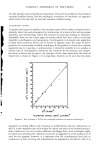
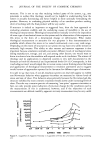
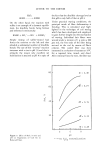
STABILITY ASSESSMENT OF EMULSIONS 349 of a few specific issues of significant importance. These are the problems of accelerated emulsion stability testing, and the rheological evaluation of emulsions, an approach which I feel is the best way to deal with emulsion stability testing. ACCELERATED TESTING To predict the long-term stability of an emulsion system from studies conducted over a relatively short time period requires the introduction of a stress which will accelerate instability, and methodology which will measure the processes leading to instability. Essentially, there are two major types of stresses which have been used to accelerate instability, centrifugation and temperature. Centrifugation is obviously only applicable to fairly fluid emulsions which can be forced to separate under the range of forces produced in commercially available centrifuges. If the problem is clearly one of phase separation due to creaming or sedimentation, it should be possible to run samples at various rates of centrifugation, determine rate constants for the process, and extrapo- late these to forces due to gravity. An example of such data, taken from the work of Garrett (6), is shown in Figure 2. It is important, however, to be sure that the phase 2o o} 18 ,,, 16 '"' 14 • I0 " 6 • 4 0 2 4 6 8 I0 12 14 I6 FLOTATION RATES (SE• '1) vs.(R.P.M.) 2 Figure 2. Rate Constant rs. R.P.M. for centrifugal evaluation of emulsion creaming (6). separation occurring reflects only creaming or sedimentation and not coalescence, as well. It is also important that such studies be carried out only on the finished product. Since coalescence can occur under sufficient centrifugal force, such techniques might be useful in accelerating the coalescence process, as suggested in a few studies (6,7). If used for this purpose, however, it is important that the centrifugation lead only to coalescence or that creaming and sedimentation be separated out as factors. Also, it is

350 JOURNAL OF THE SOCIETY OF COSMETIC CHEMISTS important to be sure that the mechanisms involved in causing coalescence under ultracentrifugal forces are the same as those operating under normal conditions. In my opinion it is really doubtful that this is ever the case since ultracentrifugal forces can distort droplets and place stresses on the emulsion barrier in a way not normally encountered. It may be argued that survival under such high stress assures survival under other less strenuous conditions, and thus assures an acceptable shelf-life. There is no doubt that the barrier at the droplet interface must be very good if it prevents coalescence under ultracentrifugal forces. However, it tells us nothing about the time period over which we can be assured of stability and it actually may eliminate normally acceptable emulsions. This is an example of a situation which exists in any accelerated test, i.e., a tendency to "overkill" the emulsions because the test used introduces a new mechanism of instability or causes an unreasonably high stress. By far the most widely used stress in emulsion testing is temperature. The rationale for increasing temperatures to predict instability comes from the well known relationship between the rate constant, k, for a chemical reaction and temperature, T, expressed as the Arrhenius equation. Simply plotting k vs. 1IT allows one to determine k at any temperature, as long as the mechanism of the reaction has not changed. Herein lies the critical question concerning the use of high temperatures to accelerate instability in emulsions. Is it proper to assume that high temperatures don't change some of the basic mechanisms involved in the instability process? Consider first some of the ways in which temperature may affect emulsions. These include changes in the viscosity of liquid phases solubility partitioning of molecules between both phases the melting and freezing of various materials, particularly waxes and the hydration of polymers and colloidal solids. Given that one or more of these processes is the primary factor in stabilizing the emulsion, it would not be surprising if a higher temperature abruptly eliminated this as the important stabilizing factor normally observed at lower temperatures. An example of this is seen in Figure 3, where an o 40,000 •'0,000 -- I0,000 - tu 6,000 - o• 4.,0oo - • 2,000 '"' 1,000 - 60O 4OO 2OO I00 • 0.04 tO øG • 25 øG 5oC oC 0.1 0.4 I 4 I0 40 I00 ELAPSED TIME (DAYS) Figure 3. Logarithm of Apparent Viscosity vs. Logarithm of Time for an o/w lotion at various temperatures (22).
Purchased for the exclusive use of nofirst nolast (unknown)
From: SCC Media Library & Resource Center (library.scconline.org)