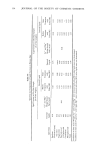
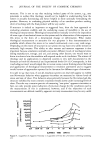
HAIR OILINESS 325 contribute to the sensory impression of hair, and prior to the isolation of the internal lipids, they have to be removed together with the external sebum by successive extractions with water-saturated ether as described before and ethereal HC1. In Table VI the liquid chromatographic results of a dry and an oily hair sample are compiled. In both cases our standard extraction procedure for external lipids with boiling water-saturated ether had yielded only little more than half of the total lipids present on and in the hair. The additional extraction with ether/hydrochloric acid at room temperature removed a considerable quantity of free fatty acids (plus Ca 2+ and Mg 2+) and some other lipids from the only hair and a minor amount from the dry sample.* However, even after these rather drastic extraction conditions the oily hair had still retained approximately 20% of its total lipid content, the dry hair approximately 35%. These were liberated only after enzymatic digestion of the hair keratin. This observation supports the assumption that these lipids are actually locked up in the hair. Therefore, the term "internal lipids" seems to be justified. Concerning the origin of these lipids it was interesting to observe that the wax ester(WE)/cholesterol ester(CE) fraction consists mainly of CE, whereas the corre- sponding fraction of the external lipids always contains 95-98% WE. According to references 16, 18-20, CE are structural lipids and are not synthesized in the sebaceous gland. On the other hand, the content of triglycerides and squalene prove that internal sebum at least partly includes sebaceous lipids which have either diffused into or associated within the hair. In the light of other results obtained in our laboratory (21) on migration of lipids through synthetic polymers, it may be expected that the hair keratin does discriminate between different lipid species w.r.t. permeability with the effect that internal sebum differs in composition from external sebum, although both are of the same origin. ACKNOWLEDGEMENT The authors are indebted to Mrs. U. Siebert for expert assistance. REFERENCES (1) D. A. Shaw, Hair lipid and surfactants. Extraction of lipid by surfactants and lack of effect of shampooing on rate of re-fatting of hair, Int. J. Cosmet. Sci., 1,317 (1979). (2) G. Hopf and A. Winkler, Untersuchungen iiber die Spreitwirkung des Hauttalges, Fette, Seifen, Anstrichm., 61,974 (1959). (3) F. Neuwald, K. E. Fetting, and A. Szakall, Untersuchungen iiber die Fi/higkeit der Spreitung yon Lipoiden und der Permeation yon Wasserdampf durch die lebende Haut, Fette, Seifen, Anstrichm, 64, 465 (1962). (4) H. Eberhardt, The regulation of sebum excreti.9n in man, Arch. Dermatol. Forsch., 251,155 (1974). (5) M. Gloor, J. Breitinger, and H. C. Friederich, Uber die Zusammensetzung der Hautoberfli/chenlipide bei Seborrhea oleosa und Seborrhea sicca, Arch. Dermatol. Forsch., 247, 59 (1973). (6) K. Aitzetmiiller and J. Koch, Liquid chromatographic analysis of sebum lipids and other lipids of medical interest,J. Chrom., 145,195 (1978). (7) J. Swift and B. Bews, The isolation of membranes from keratin fibres with papain and dithiothreitol,J. Text. Inst., 65,222 (1974). *This coincidence is accidental. In part II of this paper it will be demonstrated that the quantity of Ca- and Mg-carboxylates on a hair example does not correlate with its degree of oiliness.

326 JOURNAL OF THE SOCIETY OF COSMETIC CHEMISTS (8) K. V. Curry and S. Golding, Hair lipids I. The extraction of fatty materials from hair clippings,J. Soc. Cosmet. Chem., 22, 681 (1971). (9) A. W. Weitkamp, A.M. Smiljanic, and S. Rothman, The free fatty acids of human hair fat, J. Am. Oil Chem. Soc., 69, 1936 (1947). (10) B. Krotoszynski, L. L. Gershbein, and S. B. Needleman, Properties of hair fat from adult males according to race and hair condition,J. Invest. DermatoL, 26, 311 (1956). (11) N. Nicolaides and S. Rothman, Studies on the chemical composition of human hair fat I. The squalene-cholesterol relationship in children and adults,J. Invest. DermatoL, 19, 389 (1952). (12) M. Gloor, J. RietkiStter, and H. C. Friederich, Entfettung und Nachfetten der Kopfhaut und der Haare nach Kopfwiische mit verschiedenen Tensiden, ..Fette, Seifen, Anstrichm., 75, 200 (1973). (13) M. Gloor, C. Fichtler, and H. C. Friederich, Uber den Einfiufi alkoholischer Haarwiisser auf das Nachfetten der Haare nach der Kopfwiische, Kosmetologie, 1973, 2. (14) D. A. Shaw, The extraction, quantification and nature of hair lipid,J. Cosmet. Sci., 1,291 (1979). (15) J. Koch, K. Aitzetmiiller, G. Bittorf, andJ. Waibel, Hair lipids and their contribution to the perception of hair oiliness, Part II: Correlation between subjective assessment of hair oiliness and quantity and composition of hair surface lipids,J. Soc. Cosmet. Chem., 33 (1982). (16) N. Nicolaides, Skin lipids: their biochemical uniqueness, Science, 19, 186 (1974). (17) O. Sakamoto, Y. Fujinuma, and T. Ozawa, Studies on the chemical composition of internal human hair lipid,J. Am. Oil Chem. Soc., 54, 143 A (1977). (18) N. Nicolaides, Skin lipids IV. Biochemistry and function,J. Am. Oil Chem. Soc., 42, 708 (1965). (19) R. E. Kellum, Human sebaceous gland lipids, Arch. DermatoL, 95, 218 (1967). (20) G. Peter, F. Schr Spl, R. Lippross, and G. Weiss, Gaschromatographische Untersuchung der Talgdrilsenlipide I. Bestimmung der Gesamtlipide, Arch. K/in. Exp. Derm.a. toL, 239, 12 (1970). (21) J. Koch and K. Figge, Anderung der Zusammensetzung von Fetten beim Ubertritt in Kunststoffe und ihr Einfiufi auf die Genauigkeit von Gesamtmigrat-Bestimmungsmethoden, Dtsch. Lebensm. Rundsch., 71,170 (1975). PART II: CORRELATION BETWEEN SUBJECTIVE ASSESSMENT OF HAIR OILINESS AND QUANTITY AND COMPOSITION OF HAIR SURFACE LIPIDS Synopsis Hair samples of 20 dry and oily-haired subjects have been assessed with respect to their degree of oiliness 3 days after shampooing. Subsequently they have been analysed for composition and quantity of surface lipids. The results have been evaluated statistically for possible correlations. The computer analysis of collected data suggests that increasing oiliness is correlated with: -- an increasing percentage of wax esters in the lipid, -- a decreasing ratio of saturated/unsaturated fatty acids, -- an increasing amount of monoglyceride on the hair, -- a decreasing percentage of cholesterol ester in the lipid. Neither the quantity of total lipids nor the proportion of free fatty acids/unhydrolysed triglycerides were among the main causes for hair oiliness. INTRODUCTION The composition of human skin surface lipids and possible correlations with various pathological and cosmetic phenomena have been reported extensively in literature. In comparison to this, only a few reports on analytical investigations of hair lipids have been published. They are mainly concerned with correlations between the quantity of
Purchased for the exclusive use of nofirst nolast (unknown)
From: SCC Media Library & Resource Center (library.scconline.org)