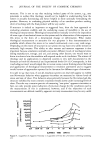
STABILITY ASSESSMENT OF EMULSIONS 355 basis (11). Recent publications (16-18) have clearly indicated the value of evaluating emulsions by measuring their viscoelastic properties and have provided suggested experimental procedures which could be adapted to stability assessment. Despite this information, however, the application of such techniques does not appear widespread. Consequently, I would like to conclude this discussion of stability assessment by reviewing what has been and what could be done. Basically, many structured systems such as polymers, gels, suspensions, and emulsions under very low levels of stress will exhibit linear elastic deformation because of relatively strong intermolecular or interparticle bonding• In such cases the stress applied is directly proportional to the strain (extent of deformation) and independent of the rate of strain. As with perfectly elastic solids, this linear relationship is described by Hooke's law. In the case of a true elastic body the strain will remain constant under constant stress, and upon release of the stress, the solid will fully recover its original structure. In the case of a viscoelastic substance, under such conditions a slow relaxation or increase in strain occurs over an extended time period. This arises because the structured body undergoes a process of bond breaking and remaking in such a way as to modify the structure. Eventually, with continued application of the stress viscous flow will occur. When the stress is small enough to cause Hookean elasticity and NewtonJan viscosity, we speak of linear viscoelasticity, for which theoretical concepts were well worked out (11, 18). Upon release of the stress in such systems some recovery of structure occurs because of the elasticity, but this recovery cannot be complete because of the relaxation which has taken place. A typical plot of compliance (strain per unit stress) versus time, often called a creep curve, is shown in Figure 7. What makes this approach so attractive for emulsion stability assessment is that we are able to obtain fundamental material constants such as elasticity and viscosity without significantly stressing the system mechanically. Indeed, Barry (18) has referred to this as an evaluation of the "ground state" of an emulsion or suspension. Therefore, we are not only in a position to observe very subtle structural changes which take place upon storage and use, but we also can determine the values of fundamental constants which correspond to acceptable stability. This allows us, for example, to develop quality control specifications translatable from laboratory to laboratory. Because of the high sensitivity of viscoelas- tic measurement, it should also be possible to attempt to predict long-term stability utilizing a much less extreme accelerated condition and, hence, minimizing the possibility of a change in the mechanism of instability. Although the application of viscoelastic measurements to an understanding of polymer solution behavior at a fundamental level is well documented (11), reports on the use of such techniques for disperse systems of interest to cosmetic and pharmaceutical scientists have been extremely limited. Barry (19) has carried out extensive studies on some semi-solid o/w emulsions and has been able to monitor very well the significant changes in viscoelasticity brought about by the effect of emulsifier concentration on emulsion structure. Sherman (20) has used viscoelastic creep tests to study liquid w/o emulsions stabilized by sorbitan monooleate. He has correlated the tendency for coalescence during shelf life for emulsions ranging from 30% to 65% water with their viscoelastic properties. Hiestand (14), using the rising sphere viscometer developed by McVean and Mattocks (21), has applied a very small stress on a 5% solid suspension stabilized with methylcellulose and has measured viscoelastic relaxation. He was able to show that the relaxation process arose from the flocculated structure of the suspension and not the vehicle alone. Thus we see the potential utility of these techniques in

356 JOURNAL OF THE SOCIETY OF COSMETIC CHEMISTS 280 x 240 m,m (.• 7 160 120 80 4O I I I I I I I 0 2 4 6 8 I0 12 14 TIME (min.) Figure 7. Compliance vs. Time for a viscoelastic emulsion system: A) Elasticity B) Viscoelasticity C) Visous Flow D) Recovery. studying disperse systems ranging from high to low in the degree of overall consistency and structure. We may now ask, what is the next step? It seems to me that the most pressing problem facing cosmetic formulatots is their inability to predict whether a disperse system will or will not hold up over its expected shelf life. Observing viscoelastic properties of a given formulation under storage conditions over a period of time, and/or under minimal stress conditions, should be carried out. The least that will happen is that one will have fundamental theological parameters which describe a stable emulsion system. Even better is the possibility that this technique will pick up change in theological behavior which can then be extrapolated to shelf-life conditions. It remains for such studies to be carried out before the potential value described can be realistically
Purchased for the exclusive use of nofirst nolast (unknown)
From: SCC Media Library & Resource Center (library.scconline.org)