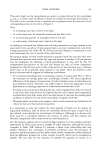
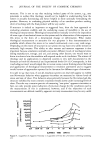
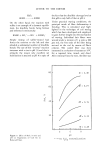
I,ETTER TO THE EDITOR 365 H202 2KSH .... KSSK On the other hand, the reaction with sulfite is an example of a dynamic equilib- rium, the disulfide bonds being broken and reformed continuously: KSSK + SO5= -• KS- + KSSO 3- Simple rinsing of sulfite-treated hair forces the reaction to the left and thus rebuilds a substantial number of disulfide bonds. The rate of this "reversal" reaction increases with a rise in pH (1) and this is primarily the reason why excellent set stabilization is attained at pH 8 in spite of the fact that the disulfide cleavage level at this pH is only half of that at pH 4. Under practical waving conditions, the principal mode of fiber deformatio!• is bending. This is simulated and high- lighted in the technique of coil setting which has been developed and employed to gain further insight into the mechanism of waving. Individual hair fibers were wound under a tension of 1 g onto a 900 /am rod, the free ends of the fiber being secured to the rod by means of Duco cement. The coiled fiber was then immersed in a solution of reactant at 35øC for a required time, rinsed, and dried. After removal from the wire, the fiber was Figure 3. Effect of H202 (5 min) and pH on Impartation of Coil Set to Reduced Fibers. 8O 6O 4O 2O • = 0.38 0.27 0.15 = 0.10 •= 0.38 3 6 9 pH .... no H202 neutralization

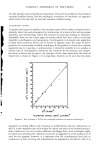
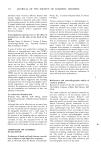
366 JOURNAL OF THE SOCIETY OF COSMETIC CHEMISTS released in water for 30 minutes at 35øC. The set was calculated as the percentage fraction of turns in the set fiber relative to that originally imparted (hair 9 inches long forms --•70 coils). Figure 3 summarizes the setting results on hair fibers which, prior to coiling, had been reduced with thioglycollic acid (pH 5.0 at 35øC) to yield different levels (o 0 of disulfide bond cleavage. Confirming lon- gitudinal data, no set is attained without the bond-rebuilding oxidation step. At any given cleavage level, a rise in pH leads to set enhancement. As the oxidation of combined cysteine to cystine is virtually pH independent, the higher setting effi- cacy is most likely a reflection of the increased pliability of reduced hair at higher pH values. Sulfite diffuses into hair at a much slower rate than thioglycolate at comparable pH, and Figure 4 stresses the importance of time in waving with sulfite. This is partic- ularly true under alkaline conditions where a combination of low S-S cleavage levels and the negative charge on the fiber effectively restricts the diffusion into the hair of strongly anionic SO3= moiety. In absolute terms, the 30 minute longitudinal setting seems more effective than coil setting, but this is probably due to the fact that the reactivity of-S-S- bonds in hair is greatly enhanced by stretching of fibers (3). It is also important to stress that at low cleavage levels, sulfite appears to be a much more effective setting (waving) agent than thioglycolate, clearly reflecting 5O 40 2O 2O 10 60 min. ! P • I 5 6 7 8 9 pH Figure 4. Effect of Time and pH on Coil Set in Sulfite.
Purchased for the exclusive use of nofirst nolast (unknown)
From: SCC Media Library & Resource Center (library.scconline.org)