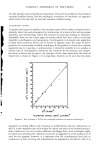
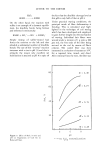
352 JOURNAL OF THE SOCIETY OF COSMETIC CHEMISTS structure. This is not to say that studying isolated parts of the system, e.g., zeta potentials or surface film rheology, would not be helpful in understanding how the system is actually functioning and hence helpful in more rationally formulating the product. However, in evaluating physical stability of an emulsion product nothing short of working with the final product will be very useful. If structure is indeed as important as suggested here, then the best approach to evaluating emulsion stability and the underlying causes of instability is the use of rheological measurement. Rheological measurement basically involves the imposition of some type of mechanical stress on the system and the observation of the response to this stress in the form of a dimensional change or deformation. What makes rheological measurement so attractive for our purposes is that instrumentation is available which allows this stress to be varied continuously over a very wide range. Depending on the extent of structure in our system we may want very subtle stresses or extremely high stresses. This ability to alter stresses and measure responses is also important because emulsions normally encounter different levels of mechanical stress during manufacture, storage, and use, and among other factors, one would want to know in advance how the emulsion will respond under such conditions. The science of rheology and its applications to dispersed systems is very well documented in the literature at both the theoretical and experimental levels (10-13). Consequently, in this concluding section I would simply like to review some current thinking about the basis and application of rheological measurement to emulsion assessment and to suggest careful review of approaches reported in the literature for different types of situations. It is safe to say that most, if not all, emulsion systems we deal with appear to exhibit non-Newtonian behavior when apparent viscosities are measured at various levels of stress and rate of shear. This behavior arises primarily because the flocculated gel-like structure exhibited by most cosmetic emulsions breaks down under increasing levels of shear. Thus the very common practice of measuring "one-point" apparent viscosities, at best, can only provide some indication of structure change for the conditions used in the measurement. If this is understood, however, and if the objectives of such measurements are defined carefully, apparent viscosity measurement may be very useful T o •OO, OO½ o• 60,0OO]- o• 40•000 r '-' 20,OOO r '-* - ,ooo 1_ ø2 6ool- t t ,,oool_ • 6oop , o.m 0.04 o• 0.4 • 4 •o 40 •oo 400 ELAPSED TIME (DAYS) Figure 4. Logarithm of Apparent Viscosity vs. Logarithm of Time for o/w lotions exhibiting hardening (22).

STABILITY ASSESSMENT OF EMULSIONS 353 in rapidly spotting problems. For example, as shown in Figure 4, an apparent viscosity change of some significance occurs as the product cools some time after emulsification of a wax-containing lotion, apparently due to a change in the rate of wax recrystalliza- tion. We saw earlier in Figure 3 that an abrupt drop in apparent viscosity occurred when the lotion was subjected to a temperature at or above the melting point of some ingredient or ingredients. The Brookfield viscometer with a helipath attachment has been used to detect the tendency for creaming or sedimentation (14). By measuring apparent viscosity at various depths within the disperse system, using very low spindle speeds, it was possible to detect differences in concentration of dispersed particles arising from particle movement upward or downward at early stages before this was apparent by visual means. Because emulsions exhibit non-Newtonian rheology, continuous shear rheometry, which allows one to relate shear stress to rate of shear with a known and continually variable rate of shear, is widely used in emulsion evaluation (15). Emulsions ranging from pourable liquids to semi-solids will typically exhibit the curves shown in Figure 5. SHEAR STRESS Figure 5. Rate of Shear vs. Shear Stress for semi-solid o/w emulsions varying in emulsifier concentra- tion. Hysteresis between values obtained upon increasing and decreasing shear arises because of structure breakdown and a time dependency for restructuring. If this process is reversible and isothermal we speak of thixotropic behavior. More often, as seen in Figure 6, however, when we deal with emulsions the process involves an
Purchased for the exclusive use of nofirst nolast (unknown)
From: SCC Media Library & Resource Center (library.scconline.org)