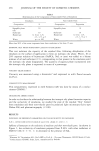
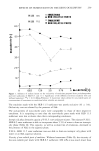
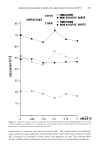
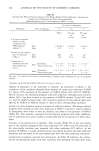
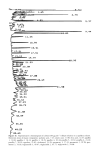
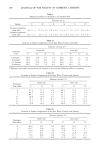
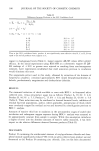
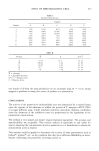
264 JOURNAL OF THE SOCIETY OF COSMETIC CHEMISTS with ether surfactant. Conductivity rose in all cases in the presence of NaPCA. It is higher in emulsions than in their non-volatile parts. RELATIONSHIP BETWEEN ISOTROPIC OILY PHASE AND OCCLUSIV1TY OF EMULSIONS Occlusivities of the three groups of emulsions studied in the presence of humectants seemed related to the capacities of the corresponding oil-surfactant mixtures to produce isotropic oily phases upon addition of water or aqueous solutions of humectants. On the contrary, variations of occlusivity were independent of viscosity and conductivity of non-volatile parts of emulsions. In order to clarify the role of the isotropic oily phase in occlusivity, we prepared a number of ternary mixtures comprised of oil and surfactant (10 g + 10 g) in the same ratio as in emulsions and 0.5 g of water or 0.5 g of a 10% aqueous solution of sodium lactate. Their occlusivities were then measured. For each mixture, the quantity of water or 10% aqueous sodium lactate incorporated without destroying isotropy was deter- mined and expressed in terms of a pecentage. As shown in Table V, for P.H.S., the mixture with HLB 9.25 surfactant having the largest isotropic oily phase formation capacity showed the greatest occlusivity. With the HLB 11.5 surfactant the mixture was not able to form an isotropic oily phase and its occlusivity was negligible. For HLB 8.5 and 10.5 intermediate values of occlusivity and isotropic oily phase formation capacity were obtained. The same phenomena hap- pened when 10% sodium lactate was present. With mineral oil, the mixture with HLB 9.5 surfactant formed an isotropic oily phase most easily and its occlusivity was the strongest (Table VI). With the HLB 11.5 surfactant the mixture was unable to form an isotropic oily phase and manifested a negligible occlusivity. Comparable phenomena were observed when 10% sodium lactate was present. MICROSCOPIC STUDY OF RESIDUAL "FILMS" This study was carried out to better understand the role of the isotropic oily phase in the occlusivity of emulsions. A selected member of microphotos have been presented here. Table V Occlusivity of Ternary Mixtures Prepared From Perhydrosqualene and Ester Surfactant Parameters HLB 8.5 9.25 10.5 11.5 Water Nature I.O. I.O. N.I.O. N.I.O. Occlusivity(%) 52 -+ 4 78 + 1 41 -+ 4 2 + 2 I.O. (%) 5.5 1.8---10.1 3--4.8 0 Nature I.O. I.O. N.I.O. N.I.O. NaL Occlusivity(%) 35 + 4 78 -+ 1 45 ñ 1 4 _+ 3 (10%) I.O. (%) 4.8 1.7--8.3 3--5.2 0 I.O.: Isotropic oily. N. I. O.: Nonisotropic oily. The sign "--•" indicates the interval of percentages of aqueous phase which are solubilized in the isotropic oily phase (I.O. %).

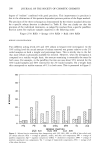
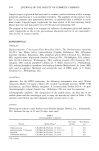
EFFECTS OF HUMECTANTS ON EMULSION OCCLUSIVITY 265 Table VI Occlusivity of Ternary Mixtures Prepared From Mineral Oil and Ester Surfactant Parameters HLB 8.5 9.5 10.5 11.5 Water NaL (10%) Nature I.O. I.O. I.O. N.I.O. Occlusivity (%) 29 + 3 36 +-- 2 20 + 2 0 I.O. (%) 3 1.8--6.9 2.4--•5.2 0 Nature I.O. I.O. I.O. N.I.O. Occlusivity (%) 30 + 3 65 + 3 32 ñ 1 12 ñ 3 I.O. (%) 2.5 1.5--•6.8 2.4--5.7 0 Same legend as Table V. An emulsion prepared from P.H.S. with ester linkage surfactant of HLB 9.25 left a continuous residual "film," whereas the emulsion prepared from HLB 11.5 surfactant left a porous film (Figures 4a and 4b). The same phenomena were also observed with ternary mixtures (Figures 4c and 4d). An emulsion prepared from mineral oil with ester surfactant of HLB 9.5 formed a more continuous film than one prepared with HLB 11.5 surfactant (Figures 5a and 5b). Comparable phenomena occurred with ternary mixtures prepared with HLB 9.5 and 11.5 surfactant (Figures 5c and 5d). DISCUSSION The occlusivity of emulsions has been described as dependent on the nature of their non-volatile components (4,14-16). Our previous results (8,10) showed that the oc- clusivity of emulsions depended mainly on their capacity to form an isotropic oily phase following dehydration on the surface of application. The HLB value of surfactant used to form the emulsion played a major role in determining the emulsion's occlusive properties. The physicochemical properties we have analyzed provide an explanation for the modification of the occlusive properties of emulsions by the presence of humectants. ISOTROPIC OILY PHASE FORMATION CAPACITY Emulsions having the highest isotropic oily phase formation capacity offered the greatest occlusivity, e.g., emulsions prepared from perhydrosqualene with ester surfactant of HLB 9.25. Emulsions having no isotropic oily phase formation capacity showed a weaker occlusivity, e.g., emulsions prepared from perhydrosqualene with ester surfac- tant of HLB 11.5. In most cases, the humectants diminished the occlusivity of emulsions. This can be explained by their ability to decrease isotropic oily phase formation capacity, e.g., emulsions containing sodium lactate which were prepared from P.H.S. with ester surfactant of HLB 8.5 or from mineral oil with ether surfactant of HLB 9.5. In exceptional cases, the presence of humectants enhanced the occlusivity of emulsions. This phenomenon corresponds well to their tendency to increase the isotropic oily phase formation capacity of emulsions, e.g., emulsions prepared from mineral oil using ester surfactant of HLB 9.5.
Purchased for the exclusive use of nofirst nolast (unknown)
From: SCC Media Library & Resource Center (library.scconline.org)