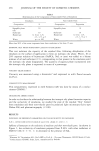
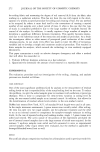
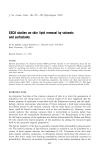
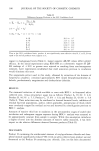
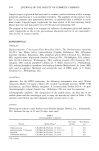
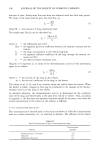
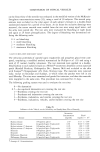
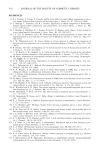
266 JOURNAL OF THE SOCIETY OF COSMETIC CHEMISTS . ..-:,.-::.,.. :...:- " .. • ,,- .. ,•.:•' :..'•:.. ::...•- ,. •, -, s,• %. -, • - • -.• •-•..• ',? .,.... ,.--.• •.•.'•% ,-- ... ' •_-•5• '• '• - • • '- - •-' , •.•' ..• ...., .... ,•.,-.• .•.-.•'• Figure 4. Microscopic views of emulsions and ternary mixtures prepared from perhydrosqualene and ester surfactants of HLB 9.25 (a,c)and 11.5 (b,d). VISCOSITY Although increased viscosity was supposed to enhance the occlusive properties of prod- ucts (17), our experimental data showed that it did not have any effect. For example, in the case of non-volatile parts of emulsions prepared from perhydrosqualene and ester surfactant of HLB 8.5, sodium lactate increased their viscosity whereas it decreased their occlusivity. Similar results occurred in other cases. CONDUCTIVITY It was thought that products having greater conductivity would facilitate the diffusion of water and thereby be less occlusive. However, according to our results, there did not exist any relationship between the conductivity and the occlusivity of the product. In the light of above analysis, it is now clear that isotropic oily phase formation capacity of emulsions is one of the major factors in determining their occlusivity. These findings

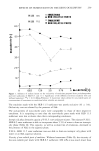
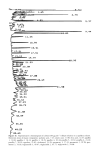
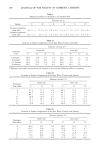
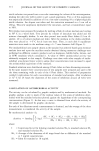
EFFECTS OF HUMECTANTS ON EMULSION OCCLUSIVITY 267 Figure 5. Microscopic views of emulsions and ternary mixtures prepared from mineral oil and ester surfactants of HLB 9.5 (a,c) and 1 1.5 (b,d). support our previous work (8). Our results do not permit us to demonstrate the rela- tionship of the presence of lameliar organization of lipid to the occlusivity of emulsions as described by Handjani-¾ila et al. (7). Moreover, since emulsions were applied at a dose of 3 mg/cm 2, after evaporation of more than 90% of their water the residual non-volatile part was a very small amount. That is why our prepared non-volatile parts applied at the same dose (3 mg/cm 2) were more occlusive than their corresponding emulsions (with the exception of perhydro- squalene and ester surfactant of HLB 11.5). This can be explained by the inability of non-volatile parts to spread on the surface of our gelatin model. Anyway, microscopic study proved that an emulsion having a greater isotropic oily phase formation capacity left a uniform oily residual "film" on the surface of application and thereby showed greater occlusivity. Of course, the initial occlusivity of the lipophile phase itself is important in the efficacy of emulsions (16-18). On the basis of our experiments, the following lipophile phases are listed in increasing order of occlusivity: oleyl alcohol sweet almond oil mineral oil miglyol 812 perhydrosqualene.
Purchased for the exclusive use of nofirst nolast (unknown)
From: SCC Media Library & Resource Center (library.scconline.org)