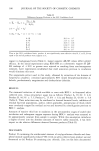
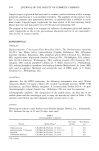
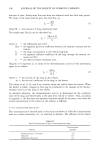
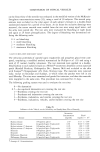
j. Soc. Cosmet. Chem., 36, 271-286 (July/August 1985) Evaluation of relative shampoo detergency D. THOMPSON, C. LEMASTER, R. ALLEN, and J. WHITTAM, Forrest C. Shaklee Research Center, 1992 Alpine Way, Hayward, CA 94545. Received October 31, 1984. Presented at the Annual Meeting of the Society of Cosmetic Chemists, New York, December 6-7, 1984. Synopsis An analytical protocol is described for the assessment of relative shampoo detergency on hair by which raw materials, prototype formulations, and competitive products can be objectively contrasted. Hair tresses are soiled with a standard nine-component synthetic sebum mixture using 2% and 10% sebum in hexane solutions. Soil removal is determined under three test conditions: bulk bath washer, traditional "finger squeeze," and controlled-pressure apparatus. Gas chromatography of the residual sebum components serves as the analytical basis for the investigations. Comparisons are based upon the "tracking" of 20 gas chro- matograph peaks which are indicative of the various sebum fractions. An internal control sample is used to compensate for any sample-to-sample variation in soiling level. Solutions (10%) of different surfactant types, ammonium lauryl sulfate (ALS), sodium laureth 2-sulfate (AES) and sodium alpha olefin C14-C16 sulphonate (AOS), are evaluated with both single and multiple soiling and washing cycles to investigate sebum partitioning as a function of the active ingredient type. Sebum fraction removal is seen to be dependent upon: 1. Washing technique--The finger squeeze method of sample treatment is the least reproducible of the sample treatments investigated due to the high degree of operator interaction required. 2. Surfactant system--The type of surfactant determines which sebum fractions are removed and to what extent. 3. Multiple cycles--Repeated washing and soiling cycles indicate that ALS leaves the least amount of residue with repeated use. INTRODUCTION The theory of detergency dates back over halfa century (1-4). In essence, the theoretical principles and tenets of surface chemistry can be used to describe the removal of soil from a solid surface based upon molecular interactions at the solid-liquid and liquid- liquid interfaces (5-7). Experimental detergency evaluation of various surfactant so- lutions, on the other hand, has been more difficult. Part of this difficulty lies in agreement on a standard soil, a controlled substrate, a consistent and reproducible soiling process, a standard soil removal procedure and, finally, analytical methodology capable of measuring subtle changes in minor components from the soiled substrate. Significant process has been made over the years in arriving at a standardized procedure 271

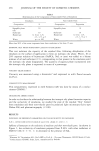
272 JOURNAL OF THE SOCIETY OF COSMETIC CHEMISTS for soiling fabric and measuring the degree of soil removal (8,9) from the fabric after washing in a surfactant solution. This has not been the case with regard to the devel- •opment of a widely accepted procedure for soiling and cleaning of hair. For any method to be accepted by others it must lend itself to the convenience of running a myriad number of test samples over a short period of time. It often is the case that this type of study is considered prohibitive due to the large number of variables beyond the control of the analyst. In addition, it usually requires a large number of samples to determine a significant difference between treatments. This quickly becomes imprac- tical due to the laborious nature of the extraction and analytical procedure. As a result the investigator defers to other means of perceptual panel evaluation of the overall cleaning process. In our study every effort was made to limit the effect of extraneous variables and to develop a simple and consistent analytical procedure. This resulted in fewer samples for analysis, which extends the technology to even modestly equipped laboratories. This paper summarizes a study on relative shampoo detergency and offers a method that will allow the researcher to: 1. Evaluate different shampoo solutions on a hair substrate. 2. Quantitatively determine the amount of soil removal in a reproducible manner. EXPERIMENTAL The evaluatior• procedure and our investigation of the soiling, cleaning, and analysis processes are detailed as follows. HAIR SUBSTRATE One of the most significant problems faced by analysts in the measurement of residual soiling levels on hair is reproducibility of the actual soiling level on the tress. To reduce this problem, we split the soiled samples prior to treatment with surfactant or prototype shampoo. This is done to compensate for tress-to-tress variation in soiling level by using the non-treated soiled sample as an internal control. In addition, this allows for the determination of residual sebum levels relative to the non-washed control. DeMeo hair tresses (New York, N.Y.) of standard 8-inch length were used in all cases. In the single treatment assessments, 3-gram tresses were initially soiled. After soiling, the tress was split into two equal samples: one for surfactant treatment and the other to act as an internal control to compensate for sample-to-sample variances in soiling levels. In the case of repeated soiling and washing studies, single 1.5-gram tresses were soiled and treated. The cyclic nature of this portion of the experiment precluded the use of internal control samples due to the large amount of initial tress required. In this instance 5 replicate samples were soiled and left untreated to serve as experimental control samples. Only virgin tresses were evaluated, but the method is applicable to damaged/bleached/waved hair as well. SEBUM The artificial sebum composition was based on a formulation used in previous work (10).
Purchased for the exclusive use of nofirst nolast (unknown)
From: SCC Media Library & Resource Center (library.scconline.org)